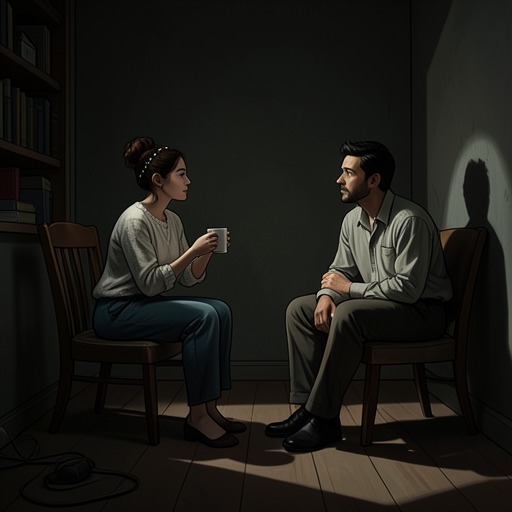
Lin Yanche Visits Su Qingrou and Accepts Her Distance
CEO's Beloved Honey GirlLin Yanche Visits Su Qingrou and Accepts Her Distance is a hospital encounter defined by reversal. Lin Yanche arrives to see Su Qingrou while his own body is failing, but Su Qingrou refuses renewed intimacy and asks him to leave. The decisive change lies in his response: the man once associated with force, mockery, and control no longer argues. He remains near her only long enough to look at her, admits that something is wrong with him, and accepts her distance. The visit therefore becomes less a reconciliation than a final negotiation with the limits of love, guilt, illness, and personal choice.
Causes and Background
The meeting occurs against the long history of damage between Lin Yanche and Su Qingrou. Their obligations to one another have become impossible to separate: later, when Su Xiangcheng asks what Lin Yanche still has over Su Qingrou, he explains that what she owes him and what he owes her have been tangled for a long time. That formulation recasts the relationship not as a clean romance but as an accumulation of favors, injuries, debts, and claims that neither person can fully settle. The hospital visit gains its force from this history. Lin Yanche comes carrying the past, while Su Qingrou has already chosen distance as the only available protection.
Illness alters the balance before either of them speaks openly about it. Yun Xiao reveals that Lin Yanche has liver cancer and is waiting for a suitable donor; without one, he can only wait for death. His visible thinness suddenly acquires a medical explanation, and the threat that had surrounded him is replaced by bodily fragility. Even Chu Fei, who might otherwise have continued opposing him, finds it impossible to keep attacking a man on the verge of death. The disease does not erase Lin Yanche's past conduct, but it changes the immediate moral and emotional pressure of the scene: survival, not dominance, has become the condition governing his movements.
What Happens in the Visit
Su Qingrou is surprised when Lin Yanche enters. The most striking surprise is not simply his presence but his appearance, which makes the severity of his condition visible. Lin Yanche says that he has come to see her and is leaving. He does not invite anyone to sit, and he positions himself closest to Su Qingrou, choosing the place from which he can see her most clearly while still remaining unable to reach out and touch her. The staging turns physical distance into a deliberate boundary. He wants proximity, but he does not claim access.
Su Qingrou understands that he has arrived and knows that, after she left the Hospital, Lin Yanche remained in the ward where she had recuperated, a space arranged by Chu Fei. Her knowledge gives the encounter a retrospective dimension: his attachment has continued in her absence, yet she does not treat that persistence as permission to resume the relationship. She laughs at the thought that Song Yuner must be anxious and suggests that Lin Yanche return to her. The remark redirects him toward the life and obligation he has elsewhere, rather than accepting his visit as a declaration of renewed devotion.
For once, Lin Yanche does not answer with a retort or a mocking counterattack. Su Qingrou notices the silence because it contradicts his usual behavior. When she tells him that they should not see too much of each other because there is nothing left to say, she is not merely ending the conversation; she is defining the terms under which their relationship may continue. Lin Yanche remains silent for a while, then answers that he understands and begins to leave. The scene's action is consequently contained in small permissions and refusals: he comes, she limits the encounter, and he goes.
Illness, Restraint, and the Value Shift
When Su Qingrou stops him and asks whether something is wrong, Lin Yanche forces a smile. His coldness remains, but it is no longer fierce. He appears like an old man in his seventies, with everything faded and no desire or purpose left beyond waiting for his life to end. His illness is presented through this altered presence rather than through a dramatic confession alone. The body communicates what the character cannot fully articulate: the former intensity has burned down into exhaustion.
Lin Yanche confirms that something is wrong, then minimizes it before insisting that he will not die. The contradiction exposes both pride and fear. He cannot offer Su Qingrou a clear future, yet he will not surrender completely to the role of a dying man. Su Qingrou responds by urging him to live well with Song Yuner, who has waited for him for so long, and not to abandon her. Her words are simultaneously compassionate and distancing. She acknowledges his remaining responsibilities while refusing to become responsible for his survival or happiness.
The scene therefore shifts the central value from possession to restraint. Earlier forms of attachment in this history have repeatedly treated closeness as a right to control another person's body or choices. Here, Lin Yanche's strongest action is his failure to impose himself. Su Qingrou's boundary holds, and his acceptance of it becomes the encounter's moral reversal. The disease creates the pressure of a possible final meeting, but it does not compel her to forgive him or return to him.
Consequences and Aftermath
The visit ends without reconciliation, physical contact, or a promise that the relationship will resume. Lin Yanche walks away after accepting Su Qingrou's order, leaving the emotional debt unresolved rather than converting it into a sentimental closure. His attachment remains, but it is now expressed as a wish to see her without touching her and as a willingness to remain outside the life she chooses. The distinction matters: love survives as longing, while entitlement loses its former force.
The aftermath makes the encounter communal rather than purely private. Su Xiangcheng later asks Lin Yanche what he still has for Su Qingrou, and Lin Yanche answers that their mutual debts have become hopelessly tangled. He does not seek to sort them out; he wants only to see her in a place where he can remain with her for the rest of his life. His calm gaze is described as free of malice, a sharp contrast with the hostility attached to his earlier conduct. Lu Xun then gently asks Su Xiangwan not to condemn him and to let Lin Yanche and Su Qingrou develop as they will. The request does not erase the harm between them, but it recognizes that their future cannot be dictated by outside judgment.
Narrative Significance
This event condenses the book's recurring conflict between attachment and freedom into a medical setting where time and bodily weakness make every gesture consequential. Lin Yanche's liver cancer exposes the limits of power: a man who once acted through force can now do little more than wait, visit, look, and leave. Su Qingrou's refusal is equally significant because it survives the pressure of his illness. Compassion is permitted, but it does not become surrender.
The encounter also contrasts several forms of care found elsewhere in the narrative. Lu Xun responds to illness with immediate protection, comforting Su Xiangwan and insisting that he has been there all along; family members mobilize around Su Qingrou's acute appendicitis and arrange her surgery; Lin Yanche, by contrast, receives no restoration of intimacy through his sickness. His condition reveals vulnerability but cannot purchase forgiveness. That distinction gives the event its bleak integrity: the dying body can awaken pity, yet another person's boundary remains valid.
As a late-stage separation event, the visit turns unresolved history into a quieter form of consequence. Lin Yanche still loves, owes, and remembers, but he no longer converts those feelings into demands. Su Qingrou still trembles when she meets his eyes, showing that distance has not made the past emotionally harmless. Nevertheless, she speaks clearly, and he leaves. The result is not emotional emptiness but a fragile, painful arrangement in which affection remains while possession, immediate reconciliation, and certainty about the future fall away.