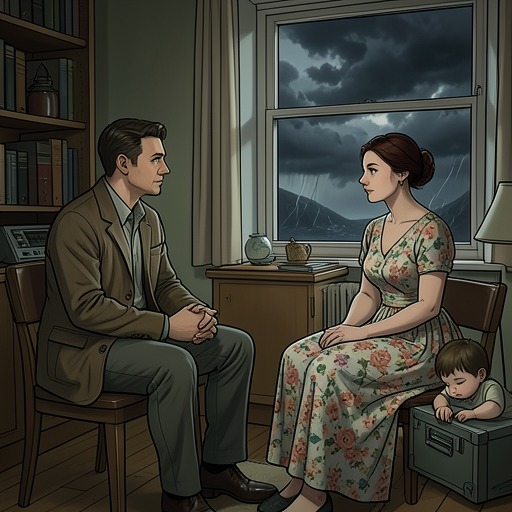
Lin Yanche's Attack on Jin Zhengnan
CEO's Beloved Honey GirlLin Yanche's Attack on Jin Zhengnan is significant not only because it injures Jin Zhengnan, but because it converts a volatile romantic conflict into a public emergency involving surgery, police attention, and competing claims over Su Qingrou. The incident reveals how quickly jealousy and possessiveness become bodily danger, while the aftermath places Lu Xun in the uneasy role of protector, intermediary, and cleaner of other people's disasters.
Causes and Immediate Circumstances
The attack follows an episode in which Su Qingrou had called Jin Zhengnan over, an action she immediately blamed herself for when the consequences became clear. At the hospital, she pulled at her hair in distress and repeatedly said that she should not have summoned him. Her guilt does not establish that she caused the violence, but it shows how the event is experienced within the story: as a chain of intimate decisions suddenly producing an injury that no one can undo.
Su Qingrou waited outside the operating room in tears. Bian Jiang was present, while Lin Yanche was absent, making his physical disappearance part of the scene's tension. Su Xiangwan also arrived with Lu Xun, whose presence was treated as both expected and unwelcome. Su Qingrou questioned why Lu Xun had brought Su Xiangwan, and Lu Xun answered with a frown and an unmistakably harsher tone than before. The hospital therefore becomes a crowded field of divided loyalties: Su Qingrou is frightened for Jin Zhengnan, Bian Jiang attempts to steady her, Su Xiangwan silently suffers for her sister, and Lu Xun confronts the consequences of an attack he did not commit.
The Hospital and the Emergency Response
The assault leaves Jin Zhengnan in the operating room and forces the surrounding characters to move from private resentment to practical crisis management. Lu Xun makes several telephone calls while the others wait. The police are likely to require statements because the incident has already been reported; even if Jin Zhengnan chose not to pursue the matter, the authorities would still expect an explanation. Violence has thus crossed a threshold. It is no longer merely a lovers' quarrel or a concealed family scandal, but an event that demands an institutional response.
When Lin Yanche's call finally comes through, Lu Xun immediately asks whether he is at the hospital. Lin Yanche's answer is cold and defensive. Lu Xun rebukes him for being old enough to know better than to settle deep grudges through direct violence, then reminds him that the consequences are now falling on everyone else. He also says that he must help clean up the situation, with the practical urgency of someone trying to prevent the crisis from spreading through the hospital, the police, and the families involved.
Lin Yanche's reply exposes the emotional logic behind the attack. He argues that a woman seen in another man's arms might not end up merely in an operating room. The statement treats Su Qingrou's intimacy as territory to be defended and presents violence as a supposed extension of romantic grievance. Lu Xun rejects that logic through anger and responsibility rather than agreement: whatever Lin Yanche believes he is protecting, he has created an emergency that others must contain.
Jin Zhengnan's Injury and Its Aftermath
The immediate outcome is cautiously relieved rather than fully resolved. Jin Zhengnan eventually emerges from surgery, and it is confirmed that nothing is wrong with him. The confirmation allows Su Xiangwan to say goodbye to Su Qingrou and leave, but it does not erase the seriousness of the attack. A successful operation prevents the scene from ending in death; it does not restore the relationships or remove the threat that produced the injury.
The next morning, Su Xiangwan calls to ask about Jin Zhengnan's injuries, but Jin Zhengnan is not the person who answers. Lin Yanche has access to Su Qingrou's number and speaks to Su Xiangwan instead. Her immediate concern is where her sister is and whether Lin Yanche has angered her again, a response that connects the hospital incident to a continuing pattern rather than an isolated outbreak. The assault therefore has a second consequence: it becomes evidence in the larger case against Lin Yanche's conduct, especially his tendency to turn emotional conflict into coercion and danger.
The event also helps explain why later references to Lin Yanche carry such menace. When Lu Xun is told that Lin Yanche has been hospitalized, the news is framed against his apparently indestructible body and his manic behavior. Later, Lin Yanche tells Lu Xun that Su Xiangwan's physical weakness makes her vulnerable to fever and illness, even warning him to prepare to identify her body. That threat is not the attack on Jin Zhengnan itself, but it shows the same fusion of intimacy, bodily harm, and intimidation that the earlier assault establishes. Lin Yanche's violence is repeatedly expressed through the bodies of people connected to him.
Conflict, Protection, and Narrative Significance
The attack intensifies the triangle of power involving Lin Yanche, Su Qingrou, and Jin Zhengnan, while also drawing Lu Xun and Su Xiangwan into its consequences. Lu Xun's role is especially revealing. He does not simply comfort Su Qingrou or defend one side of the romantic dispute; he makes calls, anticipates police involvement, confronts Lin Yanche, and accepts responsibility for containing the fallout. His anger is directed at the childishness and destructiveness of settling grievances by force.
At the same time, the event exposes the limits of protection. Su Qingrou is surrounded by people who care about her, yet she remains at the center of a conflict in which men claim authority over her safety and relationships. Her tears, self-blame, and later separation from the hospital show how little control she possesses over the consequences generated around her. The incident thus belongs to the book's wider pattern of possessive love and control in marriage: affection is repeatedly expressed through surveillance, threats, intervention, and the management of another person's body.
The attack also works as a piece of foreshadowing. It establishes Lin Yanche as someone whose jealousy can become physical, gives the police and the families a reason to treat him as a danger, and prepares the later narrative for more severe forms of coercion. His eventual hospitalization and liver cancer diagnosis do not cancel the violence of his earlier actions; instead, illness complicates the moral field by making him both a perpetrator of harm and a man whose own body is failing. The story preserves that contradiction rather than allowing injury to become an automatic absolution.
In structural terms, Lin Yanche's Attack on Jin Zhengnan is a reversal from private emotional conflict to visible public crisis. The operating room, the unanswered telephone, the police implications, and the relieved confirmation of Jin Zhengnan's safety create a sequence in which danger is narrowly contained but never genuinely ended. The event's decisive legacy is therefore not a death, but a new measure of what Lin Yanche is capable of and a sharper understanding that every intimate struggle around Su Qingrou can become a threat to life, law, and family stability.