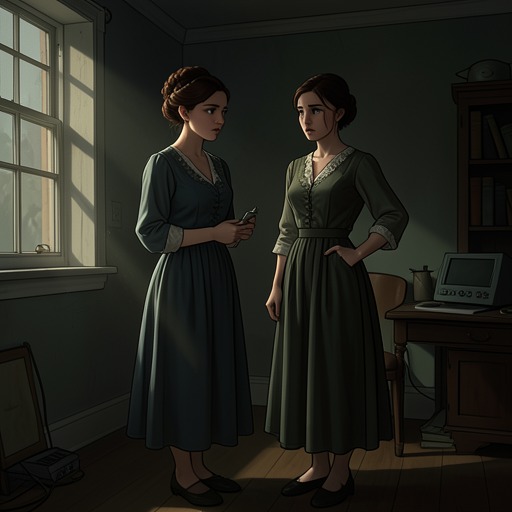
Su Qingrou's Imprisonment and Rescue
CEO's Beloved Honey GirlSu Qingrou's Imprisonment and Rescue begins when Su Qingrou tells Lin Yanche that their relationship must end and culminates in Lu Xun forcing his way into Lin Yanche's manor to reach her. Its decisive significance lies in the reversal of romantic intimacy into captivity: Lin Yanche treats Su Qingrou's departure as an offense to be punished, threatens Jin Zhengnan in order to control her, and turns the home associated with their relationship into a place from which she cannot leave. Su Qingrou's rescue is therefore not merely a physical extraction. It is also the scene in which she names the emotional exhaustion and fear that have made continued life with Lin Yanche unbearable.
The Break and the Threat of Confinement
Su Qingrou initiates the rupture in a calm, unmistakably final manner, telling Lin Yanche that they should end their relationship. The timing gives the scene a sharp domestic contrast: Lin Yanche has just come from the bathroom with wet hair and a towel around his neck, yet his cold eyes remain fixed on her face. An apparently ordinary household moment becomes a confrontation over freedom, loyalty, and possession.
Lin Yanche does not answer her request with acceptance. When Su Qingrou says she is leaving, he grabs her arm and threatens that Jin Zhengnan will never leave the hospital if she steps even half a step outside the manor. Su Qingrou immediately objects that Jin Zhengnan has nothing to do with the matter and is only her friend, but Lin Yanche uses their history of living under the same roof to insinuate sexual betrayal. His accusation and threat work together: he attempts to make Su Qingrou responsible for the danger facing another person while also degrading her character. The relationship's private conflict is thus extended into medical danger and external retaliation.
The manor becomes an instrument of that threat. Su Qingrou later reports that Lin Yanche has locked her inside and that she cannot leave. Her phone call to Su Xiangwan is explicitly a plea for help, not a routine update. The words establish the central condition of the event: Lin Yanche's authority over the residence has become house arrest, and Su Qingrou's only available route toward freedom is intervention from outside.
The Rescue at Lin Yanche's Manor
Su Xiangwan reacts immediately after receiving the call. She tells Lu Xun that Lin Yanche has gone mad and has placed her sister under house arrest, then takes him to the manor. The urgency is conveyed through her physical agitation: her palms sweat throughout the journey, and she remains restless because every additional second of Su Qingrou's confinement feels like torture. Her response makes the rescue a sisterly act as much as a confrontation between powerful men.
Half an hour later, Lu Xun and his entourage arrive at the entrance to Lin Yanche's manor, where numerous bodyguards prevent outsiders from entering. The guards attempt to avoid a direct fight, acknowledging that Lu Xun's bodyguards are formidable and that a one-on-one confrontation would not favor them. The standoff briefly gives the manor the appearance of a fortified private domain, but that barrier cannot hold. After several rounds of fighting, Lu Xun brings his men inside.
Once inside, Su Xiangwan sees Su Qingrou sitting by the balcony window and runs toward the house, warning her sister not to do anything reckless. The balcony is an especially charged position because Su Qingrou's immediate physical safety remains uncertain while she is isolated and emotionally overwhelmed. The rescue party does not simply locate a captive; it finds a woman at the edge of a crisis, watched over by the danger that produced it.
Su Qingrou's Decision to Leave
The rescue does not lead to reconciliation between Su Qingrou and Lin Yanche. When Su Xiangwan proposes finding him, Su Qingrou stops her and states that the relationship has already ended that night. She holds Su Xiangwan's hand tightly as she explains that she knows Lin Yanche has countless ways to torture her, but that she has no choice because she is too tired to continue. She fears that remaining in the relationship will drive her insane.
This declaration changes the value at stake in the event. At first, the immediate issue appears to be whether Lin Yanche will permit Su Qingrou to leave. By the end, the deeper issue is whether Su Qingrou can recognize her own exhaustion as sufficient reason to refuse the relationship. Her statement does not erase the danger or guarantee an uncomplicated freedom; it records a boundary reached after prolonged coercion. The physical rescue and the emotional decision therefore reinforce one another: Lu Xun's intervention opens the way out, while Su Qingrou's words define why she must take it.
Su Qingrou then embraces Su Xiangwan. The sisters' physical closeness contrasts with Lin Yanche's grip on Su Qingrou's arm. One gesture confines; the other shelters. The scene consequently places sisterly support against possessive control, presenting rescue as the restoration of a relationship in which contact does not demand submission.
Trauma, Vulnerability, and the Wider Plot
The event is connected to a broader pattern in which bodily vulnerability and emotional trauma are repeatedly used to expose or intensify power. Su Xiangwan later recalls that her mother had been described as terminally ill and had walked onto a balcony after seeing a childhood drawing of both parents holding her hand. That remembered suicide gives the balcony a family history of danger and helps explain why Su Qingrou's position near the balcony window carries more than immediate suspense. The image links present confinement to an older wound that has never become emotionally inert.
The narrative also repeatedly makes illness a means through which intimate relationships are controlled. Lu Xun recalls being kidnapped at twelve, drugged by his captors, and nearly losing his life; he says the experience left him resistant to drugs. Elsewhere, Lin Yanche is hospitalized during a manic episode, while Lu Xun receives a message that he is waiting at the hospital. These surrounding revelations do not replace Su Qingrou's ordeal, but they place it within a story where hospitals, bodily weakness, and threatened survival repeatedly become instruments of fear, protection, and leverage.
The later consequences preserve that atmosphere of precarious bodies. Su Xiangwan eventually collapses from fever before reaching an elevator, and Lu Xun comforts her while injured, telling her not to be afraid because he is there. Lin Yanche later reveals that he has liver cancer and is waiting for a suitable liver donor, with death presented as the alternative. Read beside the imprisonment, these developments complicate the moral field without excusing Lin Yanche's conduct: illness may explain fragility or desperation, but the event makes clear that vulnerability does not entitle one person to imprison another.
Consequences and Narrative Significance
The imprisonment and rescue establish a permanent break in the relationship between Su Qingrou and Lin Yanche. Lin Yanche's home is stripped of its supposed meaning as a shared domestic refuge and revealed as a controlled space guarded by men and enforced through threats. Su Qingrou's appeal to Su Xiangwan also confirms that the sisters' bond can become an emergency line of support when romantic intimacy has become dangerous.
The event's most important reversal is that Lin Yanche's attempt to prevent abandonment produces an unmistakable abandonment of him. His threat to Jin Zhengnan, his accusation of disloyalty, and his physical restraint do not restore affection; they demonstrate why Su Qingrou must leave. The manor may delay her departure, but it cannot make her consent to remain. In that sense, the rescue is both an action sequence and a judgment on possessive love: force can hold a person inside a building, yet it cannot return the trust or emotional attachment that coercion has destroyed.
The episode also foreshadows the continuing instability of Lin Yanche's life. His later hospitalization, violent volatility, and liver-cancer diagnosis show a man whose physical decline and mental disintegration unfold alongside the collapse of his relationship with Su Qingrou. The story does not turn those later conditions into retroactive justification. Instead, they deepen the tragedy of the separation while preserving the event's central ethical fact: Su Qingrou's freedom and safety remain the necessary outcome of a relationship that has crossed into confinement.