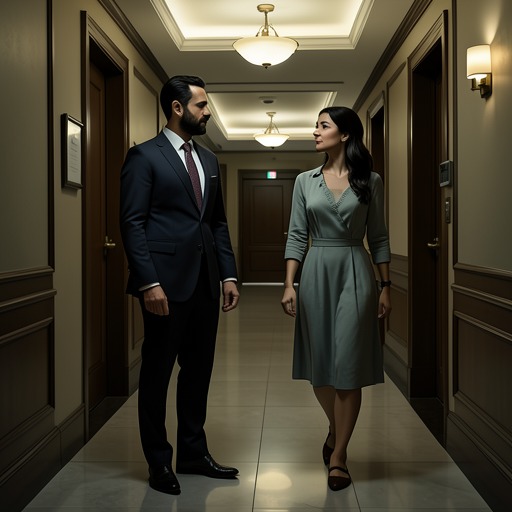
Blake Anderson and Kayla Morrison's adversarial employment relationship
Call Me YoursBlake Anderson and Kayla Morrison's adversarial employment relationship develops from a short-lived hiring oversight into a sustained conflict over authority, trust, and access. Kayla Renae Morrison employs Blake Anderson as a hotel operations manager, but his scrutiny of her and his disregard for her boundaries make him seem less like a dependable senior employee than a potential threat. Their relationship remains unresolved in the available episodes: Kayla considers removing him, yet the narrative offers no confirmation that she does.
Hiring and Uneasy Authority
Blake Anderson has been employed for less than four weeks when Kayla Renae Morrison realizes that she forgot to fire him. The delay is linked to her preoccupation with unsettling letters, not to a deliberate choice to retain him. She remembers that she never completed a background check and considers looking into him so that he can be fired or transferred to another branch of the Morrison Group of Hotels. Her thoughts escalate from ordinary employment caution to fear that he could be a serial killer or a psychopath; these are her suspicions, not established facts about him.
The imbalance between their formal roles and their actual confidence is present from the outset. Kayla can contemplate dismissing or transferring Blake, while he presents himself to hotel staff as an experienced manager with nearly thirty years in hotel management, including work at two five-star hotels. At the staff meeting, he announces that he will impose rules and dismiss employees who break them. His emphasis on diligence and punctuality makes his management style sound disciplinary before he has learned the staff’s circumstances. When he singles out Chris Davis and asks what his job is, the meeting becomes a public test of status as well as an introduction.
Management and Its Effects
Blake’s authority is felt by employees beyond his direct exchanges with Kayla. After the meeting, Jessica Cooper apologizes to Chris Davis for what happened the previous day, explaining that Blake is new and does not know how hard Chris works. She offers to arrange cover for his shift so that he can rest with a drink. Chris is cold, hungry, and short of money after spending what he had on paper; the contrast between those circumstances and Blake’s stern demand for diligence shows how managerial judgment can overlook the labor and need beneath an employee’s performance.
The novel also sets Blake’s hotel rules beside Kayla’s more encompassing authority over her household staff. At Morrison Villa, staff must keep the draperies down, remain on the premises during their shifts, and communicate with Kayla only when she speaks to them first; complaints are routed through Jessica. Employees may not befriend Adi Morrison, and their confidentiality agreements forbid interviews or disclosures to reporters. These are not stated to be rules for Blake, but they establish a wider pattern in Kayla’s world: employment brings strict limits on access, speech, and personal association. Against that background, Blake’s own authority at the hotel is not simply an extension of Kayla’s household rules. He is her employee, yet he exercises power over the staff in ways that make her question his judgment.
Suspicion and Boundary Crossings
Kayla’s distrust is rooted partly in Blake’s repeated attention to her. She has caught him staring, and his gaze makes her feel exposed, as though he might uncover a past she is desperate to keep hidden. She notices his appearance—a grizzled ginger beard, slicked-back ginger hair, and a gray tailored suit—but the important detail is her reaction: she feels unsettled whenever she sees him and worries that he might discover something that could endanger her. His looking away when their eyes meet does not reassure her; she still intends to investigate him.
Chris Davis develops a parallel unease around Blake at a shop open to the public. Blake watches him there too, and Chris feels that his presence has tainted the place. Chris cannot identify what is behind the stare, but reads Blake’s expression as a sign that he is up to no good. The two men’s reactions are distinct rather than proof of a shared explanation: Kayla fears exposure of her past, while Chris senses an unspecified threat. Together, their wariness makes Blake’s attention a recurring source of tension, even when no explicit confrontation occurs.
Other incidents add clues without settling what they mean. At Cocomo Café, its proprietor tells Chris Davis that a man had been asking about Kayla Renae Morrison and describes him as tall, broad-shouldered, red-haired, and green-eyed. The description may invite comparison with Blake, but the witness does not identify the man, so the episode does not establish that Blake was the one asking. Later, Kayla finds Blake smoking in a hotel break room and recognizes the cigarette brand as the same one she found in the woods. Blake’s hand shakes as he takes the cigarette from her and crushes its burning tip between his fingers. The match is a concrete link to the earlier clue, but it does not by itself explain where he had been or establish his responsibility for anything that happened there.
Conflict and Unresolved Outcome
The sharpest visible breach of Kayla’s authority occurs on the hotel rooftop. She is there with Jessica when Blake comes through the door with an older couple, though guests are not allowed up there. Kayla tells him so calmly, while inwardly struggling with anger; she does not know who the visitors are or why they have been admitted. Jessica takes Kayla’s hand, a small act of support that contrasts with the intrusion and the uncertainty surrounding it. The scene makes the conflict immediate: Blake’s employment gives him access to the hotel, but Kayla’s objection makes clear that access does not amount to permission to disregard her limits.
By this point, the relationship has accumulated an unresolved pattern: Kayla retains the formal power to fire or transfer Blake, yet she has delayed investigating him; Blake imposes strict standards on staff, watches Kayla and Chris, and appears in places or circumstances that sharpen their suspicions. The book does not establish a final dismissal, a transfer, or an explanation that resolves the clues. That incompleteness is central to the relationship’s narrative function. Their workplace connection becomes a channel through which ordinary managerial authority shades into personal insecurity and suspense, while the distinction between evidence and suspicion remains deliberately important.