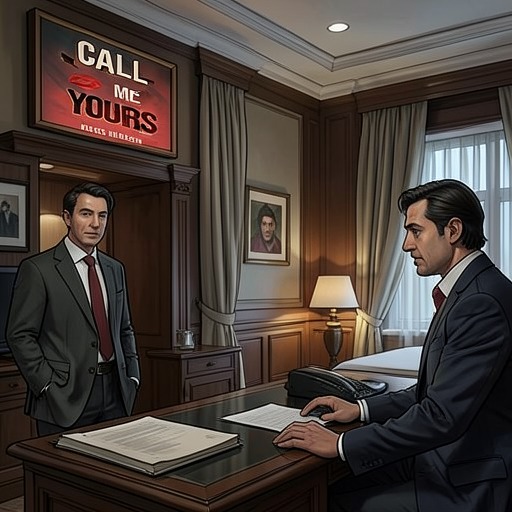
Blake's staff meeting humiliating Chris
Call Me YoursBlake's staff meeting humiliating Chris is a defining workplace episode in which Blake Anderson turns an ordinary Morrison Group of Hotels staff meeting into a public test of Chris Davis’s belonging. Chris arrives already marked by the limp left by his parents’ fatal car wreck, and Blake treats that visible disability as evidence that Chris is unfit even to stand among the hotel staff. The scene establishes how quickly professional authority can become social humiliation, while also showing that Chris’s dignity survives through the recognition of Jessica Cooper and his colleagues rather than through the institution’s own procedures.
Setting and Participants
The meeting takes place in a crowded conference room at Morrison Group of Hotels. Several colleagues turn toward Chris when he enters, and the attention makes his limp more pronounced: he misses a few steps and steadies himself by holding onto a chair. The detail makes his body part of the meeting before he has spoken. Jessica Cooper sits beside Blake Anderson at the head of the table and gestures for Chris to take a seat, placing him within the staff gathering even as Blake is preparing to exclude him.
Blake has just become the hotel’s operations manager. He presents himself as an experienced administrator with nearly thirty years in hotel management and experience managing two five-star hotels. His opening declaration is built around discipline: he will not tolerate idleness, gossip, indolence, unpunctuality, or a lack of good grace. He intends to impose new rules and threatens dismissal for anyone who breaks them. The language sounds managerial, but the later exchange reveals that his idea of order is also an idea of who deserves to be visible inside the workplace.
The Public Humiliation
When Blake asks Chris his name, Chris identifies himself and says that he is a janitor. Blake immediately directs a further question to Jessica Cooper, asking what Chris’s job is, as though Chris’s own answer were insufficient. Blake then objects that the meeting is for hotel staff and that cleaners or janitors have no reason to be present. He says Chris is not on his list and asks who employed him, adding that he does not want Chris’s death on the hotel’s hands because Chris can barely stand.
The insult rests on a false equivalence between physical impairment and professional inability. Blake does not ask about the quality of Chris’s work before judging him; he reads the limp as proof of danger, incompetence, and administrative inconvenience. His concern about responsibility therefore functions as another form of exclusion. Chris lowers his head in shame, and the meeting’s formal setting intensifies the injury: the new manager uses a collective staff forum to make one worker defend his right to occupy the room.
Defense and Immediate Aftermath
Jessica Cooper answers Blake directly. She explains that Chris is one of the hotel’s best janitors, has worked there for a little over a year, and performs his job without his disability affecting it. She also describes him as hard-working, kind, cheerful, and easy-going, insisting that the staff value him. Hailey supports her immediately, and Belle adds that Chris works harder than anyone there, keeping the restrooms, conference rooms, and halls clean. The employees’ protest turns Blake’s attempted isolation into a brief collective defense.
Jessica then asks Blake to speak with her privately. She taps the table to regain his attention, and although his jaw hardens, he follows her to a corner of the room. She whispers to him, after which Blake gives Chris a hard stare and stalks out. The scene does not provide a public apology or a correction of Blake’s assumptions. Instead, Jessica’s intervention contains the conflict without undoing its public damage, while the employees’ testimony supplies Chris with the recognition Blake withheld.
Chris’s response comes after the meeting has been dismissed. He goes into one of the restrooms and sobs. The private location is significant: the very spaces he cleans become the place where he can momentarily release the shame imposed on him. The narration states that people like Blake make Chris feel guilty for breathing the same air as them. That reaction shows the humiliation’s reach. Blake has not merely criticized a task or a performance; he has made Chris experience his own existence as an offense against a social hierarchy.
Disability, Stigma, and Narrative Function
The episode places Chris’s chronic back injury and impaired mobility at the center of a conflict that is ostensibly about staff administration. His limp is a concrete consequence of the car accident that killed his parents when he was sixteen, but Blake treats it as a complete definition of the worker before him. The contrast between the two perspectives is sharp: Chris’s disability is part of his history and daily labor, whereas Blake converts it into a stereotype about helplessness and liability.
The meeting also complicates the novel’s repeated association of disability with shame. Chris is not shown failing at his work; the colleagues’ specific account of the restrooms, conference rooms, and halls establishes his competence through ordinary labor. Jessica’s defense likewise refuses the assumption that kindness or disability diminishes professional value. Yet the scene does not erase the social force of stigma. Even after several people affirm Chris, Blake’s stare and words remain powerful enough to drive him into tears. Recognition can protect him from dismissal, but it cannot instantly remove the wound produced by public contempt.
As an event, the meeting is less a dispute over a chair in a conference room than a revelation of the hotel’s unequal social order. Blake’s rules promise efficiency and good grace, but his conduct violates the very civility he claims to enforce. His managerial authority becomes an instrument for sorting workers into those considered legitimate participants and those treated as bodies out of place. Jessica and the other employees temporarily resist that sorting, while Chris’s solitary sobbing records the cost of resistance when institutional power has already made humiliation public.