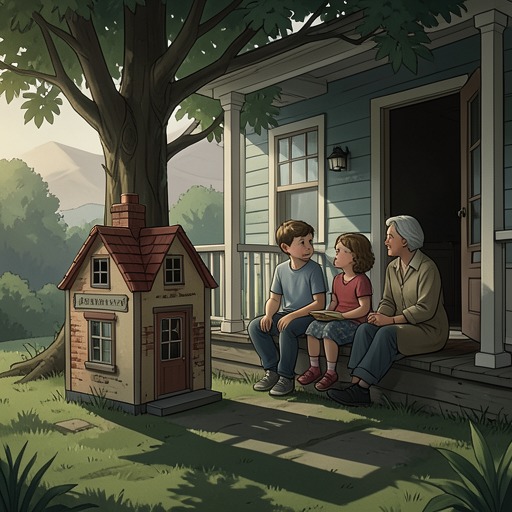
Chris Davis's apartment
Call Me YoursChris Davis's apartment is a collapsing one-room dwelling on a deeply impoverished street, and its material conditions provide one of the clearest measures of Chris's marginalization. The apartment is not merely a setting for his poverty: it is the enclosed space in which hunger, disability, secrecy, improvised survival, and unexpected care become tangible. When Adi enters it after Chris rescues her, the room briefly becomes a place of shelter and trust, but her departure also reveals how precarious that refuge is.
Setting and Physical Condition
Chris Davis's apartment stands in a neighborhood where deprivation has become part of the landscape. The rats behind the building are described as feeding better than Chris does, while a dumpster and gutter release a rotting smell that has become so familiar to him that he inhales it without visible reaction. Stray cats and dogs root through bins, the red-brick buildings look badly constructed, several roofs hang precariously over their apartments, windows are filled with dirt, and weeds have overtaken the yards. The apartment therefore belongs to a wider environment of accumulated neglect rather than representing an isolated private misfortune.
The immediate surroundings are also actively hostile. Hot air carries the acrid smell of rot, and a distant window releases yellowish liquid into the street, leaving Chris's stomach churning when the smell of urine reaches him. He limps toward the collapsed porch of the building, so the apartment's damaged architecture intersects with his chronic back injury and impaired mobility. The approach to the room is already a passage through physical danger, pollution, and social abandonment.
Chris's Life Inside the Room
Inside, the apartment is tiny, dark, and largely without functioning utilities. Nobody knows what Chris's life is within its four walls. He moves across peeling paint toward a small mattress in the corner, conceals small cracks with rags, and stuffs yellowed newspapers into larger ones. A spider web catches his fingers, underscoring how little the room is maintained and how completely he is left to manage its deterioration alone.
Chris cannot afford gas for the second-hand stove he obtained from a yard sale. He has no refrigerator or electricity, preserving a bottle of milk in a bowl of water and drinking directly from the tap. At night he uses a candlestick and matches, gripping the candle with shaky fingers before eating. His dinner is a wrapped sandwich, and even that limited meal is divided: when a skinny black-furred cat rubs against his leg, Chris gives half of it to the animal before entering the apartment. The gesture does not erase his hunger; it defines his capacity for care within it.
The room also functions as a private threshold for Chris's emotional life. He retrieves mail from a hastily assembled mailbox, hoping that Kayla Morrison will answer his letter, then opens her response with fear tightening in his stomach. The apartment's poverty is thus placed beside Chris and Kayla's letter romance. The contrast between the damaged room and the hope invested in a letter makes correspondence seem both intimate and precarious: the outside world reaches Chris through paper, while the room remains the physical boundary of his loneliness.
Adi's Arrival and Temporary Refuge
After Adi is hurt, Chris brings her to the apartment, telling her that he will take care of her bruises. The short walk leads through the foul alley to the old brick building, whose rickety porch nearly causes Adi to fall. Chris catches and steadies her, then holds the door open. His apartment is therefore introduced to Adi not as an abstract address but as the destination of an act of protection.
Adi is immediately uneasy when she looks into the dark room. She does not know what Chris might be capable of, even though she has trusted him enough to follow him there. The apartment's darkness and isolation intensify that uncertainty. Chris claims that a faulty switch box has tripped and caused the electricity to go out, but he is lying; Adi can guess that he cannot afford electricity and chooses not to challenge him. The room consequently becomes a place where kindness and concealment coexist. Chris offers practical care while trying to hide the humiliating extent of his poverty.
Even under those conditions, the apartment gives Adi a brief alternative to the instability she has fled. It is not comfortable in any conventional sense, but Chris's attention makes it feel safer than the circumstances outside. The narrative places his earlier division of food with the stray cat alongside his care for Adi: the same room that exposes his deprivation also reveals a habitual tenderness toward vulnerable beings.
Departure and Emotional Significance
When Adi leaves Chris's apartment, she contacts a man whose number is saved only under the letter G and decides to stay with him while she works out what she wants to do. She believes her mother, Kayla Morrison, would not notice her absence. Before getting onto the man's motorbike, Adi gives the building one last glance. Her departure is not presented as a clean escape from the apartment; she feels that she has left part of herself in the small room and expects to return before the week is over, while wondering whether Chris will still be there.
That final uncertainty defines the apartment's narrative significance. It is a place of extreme poverty, but it is also the first setting in which Adi experiences Chris's protection directly and where their friendship takes on emotional weight. Its physical defects make the social conditions around Chris impossible to overlook, while its brief transformation into a refuge demonstrates that shelter can be created through conduct as much as through property. The apartment remains fragile, dark, and materially inadequate, yet for Adi it becomes associated with care; for Chris, it is the hidden space where both his deprivation and his hope are exposed.