Creative block
Call Me YoursCreative block is the collapse of Jamie Cooper’s ability to make work, a crisis that threatens not only his artistic identity but also his finances, marriage, and sense of whether he can keep living. His studio still contains the tools of creation, and he continues to spend nights there, but the canvas and sketchbook remain stubbornly empty of anything he considers usable. The later revelation of Jamie’s Dissociative Identity Disorder with Alternating Alters places that silence within a broader history of trauma and dissociation without establishing a simple medical cause for it.
The Studio and the Empty Canvas
The block is introduced through a sharp contrast between the act of painting and the absence of an artwork. In the air heavy with wood and paint, Jamie adjusts his easel and splashes paint onto the canvas, but the red, yellow, and green lines make no sense to him. He once produced paintings worthy of prestigious galleries; now he sees himself as a failure whose creative resources have dried up. The disorder is not represented as an inability to touch a brush. Jamie can make marks, but he cannot turn them into work he believes has value.
The studio is cramped into a room in the family’s three-bedroom house, and its unfinished work makes the problem visible in the place where Jamie most wants to overcome it. He moves from the easel to papers and pencils spread over the sofa, then stares at an opened book surrounded by pencils. The deadline is two months away, yet he has not produced anything good enough to show his agent. The tools gather around him as evidence of effort, but not progress; the room holds the means of making art without the result that would restore his confidence or income.
Career, Money, and the Commission
Jamie’s creative decline has unfolded over years. His home was once filled with celebrities and admirers, and he and Jessica Cooper hosted parties every weekend. When he began missing deadlines and delivering work that did not meet expectations, his fame dwindled. Poor financial investments compounded the loss, forcing the couple to move into a smaller house. Friends and fans deserted him, and his previous agent dropped him. Six months before the studio scene, his childhood friend Ortiz Spencer became his agent, giving Jamie a personal connection in a professional relationship that had otherwise failed him.
A comic-book commission makes the block more than a generalized loss of inspiration. Jamie received the commission six months earlier and spent the advance, so he now faces both an obligation to deliver and the difficulty of telling his agent that he cannot do so. He loves drawing and bringing characters to life; seeing children’s stories illustrated by him has made him feel fulfilled. This history makes the blank pages especially consequential: he is not simply indifferent to the work. The job engages a form of art he values, while his inability to make even one sketch leaves him exposed to the possibility of failing at an assignment for which he has already been paid.
Shame and the Pressure to Continue
The block feeds a sense of shame that work alone cannot quiet. Jamie drinks from an opened beer can in the studio, but the drink does nothing to ease it. Jessica earns money as an assistant and pays the bills, a situation Jamie is ashamed of. His wish to regain his standing is therefore not presented as straightforward ambition: he does not particularly care about fame for its own sake, but believes he must do what he can for Jessica, who continues to love and believe in him. The work becomes a means of trying to remain present for the person supporting him as his career contracts.
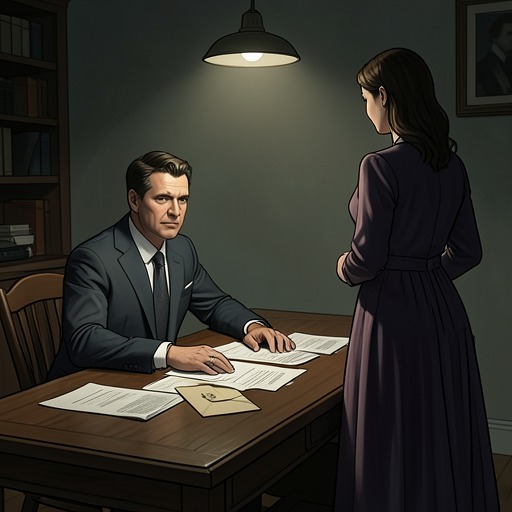
That pressure coincides with thoughts of death. As Jamie struggles to make a saleable painting, death enters his mind; it is described as something that trails him, and the thought will not go away. He is trying to stay alive for Jessica, even as the creative failure intensifies the shame and hopelessness around him. Jessica notices the strain, saying he spends every night in the studio, does not sleep, and barely eats. She also points out the contradiction between his apparent hours of work and the absence of sketches or drawings in his book. The scene leaves the block caught between visible exertion and missing output, while Jessica’s concern makes clear that its consequences have reached beyond his career.
A Later Clinical Reframing
The explanation of Jamie’s condition arrives later, in a conversation between Dr. Reid Francois, Jessica Cooper, and Jamie’s parents. Dr. Reid Francois explains that Jamie has Dissociative Identity Disorder with Alternating Alters, with four separate personalities in his case and the possibility of more alters in the future. An alter can take control until another takes over; the doctor describes the condition as a coping mechanism for situations a person cannot manage or escape. This account gives the earlier gaps and contradictions a larger psychological context, but it does not identify creative block itself as a symptom or state that the diagnosis directly produced Jamie’s inability to draw.
The doctor also explains that Jamie has dissociative amnesia fugue and does not remember his daughter. Jamie had difficulty accepting that he was not a girl and believed he was unloved; Dr. Reid Francois connects the emergence of Kayla Renae Morrison to that history. He suggests that having a daughter could have brought back childhood memories and trauma, leading Jamie to block out Adi Morrison. This account reveals how much of Jamie’s life is organized around a past he cannot fully hold in memory. It changes the meaning of his stalled artistic present, but the book keeps the connection interpretive rather than definitive: the diagnosis and trauma supply context, not a stated explanation for the missing sketches.
Meaning and Limits of the Block
Creative block is consequential because it strikes at once across several parts of Jamie’s life: the work he loves, the income he can no longer provide, the professional obligations he has accepted, and the belief that he must keep going for Jessica. The narrative measures the impasse through concrete absences—a painting without intelligible form, a commission without a sketch, and a deadline approaching without anything suitable for the agent. That pattern makes the block more than a passing frustration, while the surrounding evidence prevents it from being reduced to a single cause.
The clinical revelations widen the frame from failed productivity to a life shaped by dissociation, concealed identity, and childhood trauma. Yet no supplied evidence shows Jamie’s artistic recovery or a definitive resolution of the commission. The block therefore remains an unresolved condition in the account: its professional and intimate stakes are clear, and its psychological setting becomes more complicated, but the return of creative work is not confirmed.