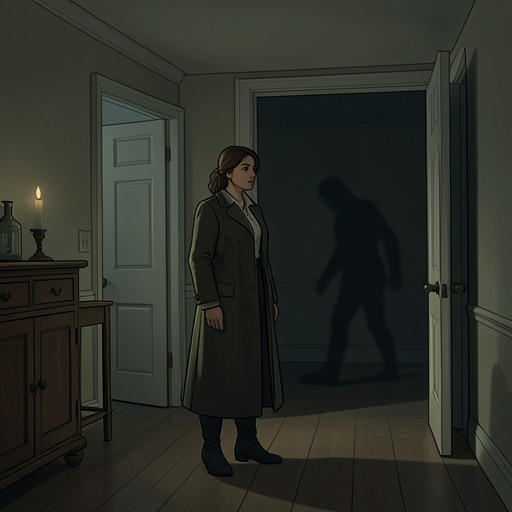
Detective Quentin
Call Me YoursDetective Quentin functions as the investigating officer who converts the Morrison household’s private crises into matters of evidence, interrogation, and legal consequence. Younger than his partner, Detective Zack, he is a thin man with an angular face, dark eyes, and the faint scent of woodsy cologne. His investigative style is controlled rather than theatrical: he takes notes, examines access points, questions employees, administers a polygraph, and confronts suspects with facts that unsettle their attempts at concealment.
Identity and Introduction
Detective Quentin enters the narrative with Detective Zack after Kayla Morrison discovers that her newly acquired paintings have disappeared. A butler whose name Kayla cannot remember ushers the detectives into the family living room and then withdraws, leaving the investigation to begin inside the wealthy household’s carefully managed privacy. Kayla welcomes the officers but wants the matter handled quietly, without the press or the insurance company learning about it. Quentin therefore arrives not merely as a representative of the law but as an unwanted force entering a domestic world that Kayla would prefer to control herself.
The contrast between the two detectives establishes Quentin’s distinct presence. Detective Zack is in his late thirties, with dark hair slicked back and tied behind him, while Quentin is nearly a decade younger, skinny, angular-faced, and dark-eyed. The narrative gives Quentin a sharper, more austere physical impression, matching his direct manner of inquiry. He asks whether anyone else lives on the property and learns that Kayla’s daughter, Adi Morrison, does. He then requests permission to inspect the house and the room where the paintings were stolen, immediately turning the conversation from courtesy to procedure.
Investigation of the Painting Theft
Quentin treats the mansion as a compromised scene rather than accepting its appearance of security. Kayla gives him a key that will unlock every door in the house, but Quentin points out that locks can be picked by con artists and thieves. His observation shifts attention away from the household’s formal control over its rooms and toward the possibility that someone with access, knowledge, or opportunity has defeated that control. He asks for the date of the theft, the number of missing paintings, and a brief description of each work, while also stating that the employees, including Jessica Cooper, will be taken to the station for questioning.
The detectives inspect the art room, looking at the sides of the door and the lock for evidence of forced entry, and then examine Kayla’s study and the rest of the house. They find no clues suggesting that an outsider broke in. Quentin’s investigation consequently narrows toward the people who already belonged to the household’s working environment. At the police station, he questions the staff while Kayla watches through a small glass window with Detective Zack. The interrogation is severe enough that Kayla feels Quentin has all but threatened her employees, yet none of the staff confesses.
After the last employee leaves the interview room, Quentin tells Kayla that he is certain one of her employees is responsible for the theft. The statement is not presented as a complete solution; it is an investigative judgment formed from the absence of forced entry, the household’s access arrangements, and the failure of the staff to provide a convincing confession. His role in this episode is to impose a causal structure on a crime that initially appears as an inexplicable violation of a protected home.
Questioning Jessica Cooper
Quentin’s method becomes most visible in his dealings with Jessica Cooper. Later, he tells her casually that she did not pass the polygraph test, delivering the information as though it were good news. The casual tone is itself a pressure tactic: it makes the revelation sound routine while forcing Jessica to confront the danger of her position. When she asks why she is eating dinner rather than being jailed or photographed for a mug shot, Quentin does not answer with a dramatic threat. Instead, he continues the conversation and asks why someone with no criminal record and a budding career would risk throwing everything away.
His central question is direct: he asks whether Jessica took the paintings. Jessica’s response redirects the issue toward whether Quentin will tell Kayla about the failed test. That redirection reveals how closely the investigation has reached her concealed actions. Quentin answers that he will not tell Kayla, then observes her. The exchange leaves Jessica under pressure without giving her an immediate legal escape or forcing a confession. Quentin’s silence becomes part of his investigative technique: withholding the information from Kayla keeps the conversation focused on Jessica’s reaction and preserves leverage.
The scene also complicates Quentin’s authority. He recognizes that Jessica has no previous criminal record and appears to possess a legitimate professional future, but he does not treat respectability as proof of innocence. At the same time, he does not immediately convert suspicion into arrest. His procedure relies on observation, contradiction, and controlled disclosure, making him an investigator of behavior as much as of physical evidence.
The Peanut-Allergy Attack and the Expanding Case
Quentin also appears in the aftermath of the attempted killing of Kayla at Cocomo Café, where someone ordered peanut butter fudge for a woman known to have a peanut allergy. When Adi Morrison rushes toward her mother’s bedroom, Jessica tells her that someone tried to kill Kayla and that Quentin has just been there. The reference places Quentin at the scene of the medical emergency as well as at the earlier art-theft investigation. His casework is therefore expanding from property crime into a deliberate attack on Kayla’s life.
This development increases the importance of the information Quentin is gathering. The stolen paintings suggest access and financial motive; the peanut-allergy attack suggests intimate knowledge of Kayla’s vulnerability. Jessica emphasizes that Adi is the only person who knows about the allergy, thereby turning Quentin’s investigation toward the family’s private knowledge and possible betrayal. Quentin is not shown resolving the attack in the supplied scenes, but his presence marks the point at which the danger becomes recognizable as attempted murder rather than an isolated accident.
The wider plot contains other signals that Quentin’s investigation is moving through a field of deliberate misdirection. Kayla receives an email with the subject “CALL ME YOURS.” from Chris Davis, while repeated unwanted calls continue to trouble her, and a later revelation exposes a much larger pattern involving altered identities, manipulation, and crimes committed against Jamie Cooper. These facts do not establish that Quentin personally uncovers every layer of the conspiracy, but they show the kind of unstable evidentiary world in which his work takes place: communications may conceal identity, domestic familiarity may conceal criminal access, and apparent personal conflicts may be connected to organized violence.
Investigative Function and Limits
Quentin’s narrative importance lies in his ability to make hidden wrongdoing legible without possessing complete knowledge of the psychological and criminal system behind it. He notices the absence of forced entry, identifies the household employee as a likely culprit, uses a failed polygraph to pressure Jessica, and appears after the attempted poisoning. Each intervention narrows the range of plausible explanations, but none immediately exposes the full conspiracy involving Jessica, Don, Christin, and Davis.
That limitation is structurally significant. The story combines a police mystery with family melodrama, romance, psychiatric revelation, and domestic crime. Quentin represents the evidentiary logic of the police investigation, while the deepest causes of the violence lie in concealed relationships and manipulated identities that cannot be understood through a single locked door or one interrogation. The later revelation that Davis befriended Larry, drugged him, watched him collapse, and then set his house on fire before presenting Jamie with a new deed shows how far the criminal plot extends beyond the initial missing paintings. Quentin’s earlier suspicions are therefore accurate in direction but incomplete in scale.
Narrative Role and Significance
As a character, Detective Quentin is defined less by private biography than by investigative pressure. The narrative gives concrete markers of his age, appearance, scent, notebook, questioning habits, and controlled speech, but it withholds an extended personal history. This keeps him aligned with the procedural function he serves: he is the figure who asks what happened, who had access, what evidence can be tested, and which apparently respectable person has something to hide.
His repeated return across separate crises creates a chain between the theft of Kayla’s paintings and the attempted murder at Cocomo Café. He also helps establish a contrast between visible law and concealed domestic power. Kayla can control the gates, the rooms, the press, and the household’s public image, but Quentin’s questions expose how fragile that control is. In a narrative where secrecy repeatedly takes the form of missing objects, withheld messages, disguised identities, and staged explanations, Detective Quentin’s persistence supplies a counterforce: not certainty, but the disciplined demand that every disappearance and contradiction be accounted for.