Dissociative Identity Disorder with Alternating Alters
Call Me YoursDissociative Identity Disorder with Alternating Alters is the diagnosis that retrospectively connects Jamie Cooper’s missing time, the lives of Kayla Renae Morrison and Chris Davis, and the novel’s concealed history of trauma. The condition is first disclosed to Kayla as an explanation for identities she has experienced as separate people; later, Dr. Reid Francois describes Jamie’s symptoms and the prospect of long-term treatment. The reveal changes the meaning of the romantic and family plots, but the novel’s account also binds the disorder closely to Jamie’s childhood gendered distress and traumatic experiences, making it important to distinguish the story’s explanation of his identities from any simple equation between gender nonconformity and illness.
Disclosure and the Named Identities
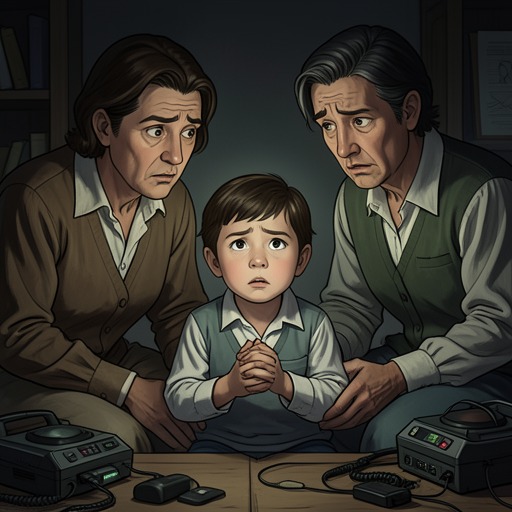
On the Morrison Hotel rooftop, Kayla and Jessica Cooper are interrupted by Blake Anderson, who arrives with an older couple. Kayla does not recognize them or understand why they are there. When the man asks whether the matter can be addressed immediately, Jessica identifies Kayla as one of her husband’s alters and says that Jamie has Dissociative Identity Disorder. She adds that Davis is another personality and that there are less dominant identities as well. The visitors introduce themselves as Richard Cooper and Kimberly Cooper, Jamie’s parents. The scene turns a private encounter into an explanation of Kayla’s identity: she is not, as she believed, simply a wealthy woman whose life happened to intersect with Jamie’s, but one of the identities associated with Jessica’s husband.
Jessica later makes the connection explicit to Kayla: Jamie is her husband, and Chris Davis is another of his alters. The names are not interchangeable in the relationships the characters have lived. Kayla has exchanged letters and developed a romantic bond with Chris; she has also built a life as a mother to Adi Morrison. Chris’s letter to Kayla describes losing his parents in a car wreck at sixteen and living with a back injury and limp. The disclosure therefore does not merely supply a hidden diagnosis. It forces Kayla’s intimate history with Chris into a new frame, without erasing the feelings and experiences that made that relationship real to her.
The novel uses small earlier disturbances to make the reveal reverberate through scenes that initially seemed unrelated. Kayla receives an email with the subject line Call Me Yours and recognizes Chris as its sender; at a café, a persistent caller addresses her as Jamie. Neither moment, by itself, explains the condition, but each acquires a different significance once the identities are disclosed. The rooftop scene likewise begins with Kayla waiting anxiously for someone to arrive at the hotel gates. Instead, the unexpected visitors bring the answer to the identity question she did not know she needed to ask.
Jessica’s Account of Jamie’s Symptoms
Jessica says that Jamie had episodes in which he could not remember the past. On one occasion he disappeared while she was away; after several days, he returned wearing a dress and full makeup, confused and unable to remember where he had been. The police suspected drug use, but Jessica says she did not believe Jamie was using drugs or being unfaithful, as the police implied. Her account makes the gaps in memory, the unexplained absence, and the change in appearance part of a pattern she tried to understand rather than isolated evidence of misconduct.
After the episodes began, Jessica researched what was then called multiple personality disorder, watched Jamie for symptoms, and sought medical advice. She recalls that some doctors dismissed her concerns and that she could not afford the doctors who listened. She says Jamie experienced depression, an eating disorder, and insomnia, and that she persuaded him to sell his art gallery because she hoped to use the money for medical bills. She did not tell him her suspicions, fearing that doing so would worsen his mental health. Her explanation presents care and concealment together: she was trying to protect Jamie, yet the secret also shaped their marriage and the way she understood the person she loved.
Childhood, Gender, and Trauma
A childhood memory gives Kayla’s identity a history that precedes the adult relationships. Jamie’s mother finds the child wearing a dress and tells him that boys cannot wear dresses. In the same remembered sequence, Jamie recalls finding boxes of girls’ clothes in the attic. His mother had bought clothing from infancy through age twelve, but he had to wear boys’ clothes and be called Jamie. He secretly wore the dresses, and, when his parents were away, his mother’s wig, clothing, and shoes; he also learned makeup, a feminine walk, and a feminine way of speaking. The memory presents this concealment as a source of profound distress and as part of Kayla’s account of who she is.
The novel links the childhood experience to the emergence of Kayla, but it does not make gender nonconformity and the diagnosis identical. In Dr. Reid Francois’s later explanation, Jamie had difficulty accepting that he was not a girl and believed he was unloved; the doctor says Kayla was born in this context. That account places the identity within a history of painful family experience, while the childhood scene gives the distress its own concrete circumstances: hidden dresses, imposed clothing, and a child’s conviction that his mother cannot see him as he understands himself. The distinction matters because Kayla is not merely a disguise or a plot clue; she has her own relationships, memories, and emotional life in the story.
Clinical Explanation and the Prospect of Recovery
Dr. Reid Francois explains to Jamie’s family that Jamie has four separate personalities and that further alters could develop. He describes an alter taking control until another takes over, and presents dissociation as a coping mechanism for situations a person cannot manage or escape. The novel also names Kayla, Chris, Davis, Don, and Little Jay across its account of the identities, while the doctor’s numerical statement is not reconciled with every name mentioned. This difference is part of the text’s presentation: the family receives a concise clinical account, while the plot has already shown identities through separate relationships and actions.
Dr. Reid Francois says there is no cure or medication for immediate treatment, although medication can reduce symptoms such as depression and anxiety. He recommends psychotherapy and a strong support system, explaining that Jamie may gradually gain control of the symptoms. He also attributes Jamie’s failure to remember Adi to dissociative amnesia fugue, connecting the family estrangement to the disorder rather than to simple indifference. In discussing the history behind the alters, he says Chris emerged from the trauma of Jamie’s kidnapping and developed Stockholm syndrome toward Christin and Davis, while Don arose from hatred of the assailants. He believes Kayla and Chris may be gone permanently, but allows that recovery can be slow and that, over years of treatment, the separate parts may become one.
Narrative Consequences and Meaning
The diagnosis reorganizes the novel’s different genres of intimacy and suspense. The letter romance between Kayla and Chris becomes part of Jamie’s divided life; Jessica’s account of a missing husband becomes a history of symptoms she could not afford to have properly assessed; and the family’s knowledge of Jamie’s past arrives only after Richard and Kimberly appear at the hotel. The explanation also gives earlier details new weight, including Kayla’s long-standing separation from the name Jamie and the gaps that had left Jessica searching for him.
The disorder is not resolved by disclosure alone. Dr. Reid Francois says Jamie has come around and is asking for Jessica, and the later family scenes turn toward continued treatment, support, and renewed trust. Jessica promises Jamie that she will no longer keep secrets from him. When she reveals the scar on her abdomen and asks whether he can feel it, he does; he then asks how she got it, a question he had previously avoided for fear of making her uncomfortable. The exchange does not establish that treatment is complete. Instead, it gives recovery a small, relational measure: Jamie is present, asking, and beginning to speak about what had remained unspoken. The novel’s ending therefore frames integration as a hoped-for long process and family repair as something made through attention and renewed honesty, not as an instant consequence of naming the diagnosis.