Jamie Cooper's house
Call Me YoursJamie Cooper's house is the home shared by Jamie Cooper and Jessica Cooper, and its changing spaces mirror the instability of their marriage and Jamie's collapsing artistic identity. It begins as a smaller residence forced on the couple by financial failure, yet it also contains the routines, memories, and concealed evidence that eventually transform domestic familiarity into danger. The house is therefore not merely a setting: it is the material structure through which lost fame, marital deception, criminal conspiracy, and the struggle to determine what is real become visible.
Domestic Setting and Artistic Decline
The house first appears through Jamie Cooper's cramped art studio, where the air is heavy with wood and paint and a canvas is covered by red, yellow, and green lines that make no sense. Jamie Cooper, once capable of producing masterpieces for prestigious galleries, has lost his muse and regards himself as a failure. His physical presence—tall and muscular, with broad shoulders, brown-red hair, green eyes, and a clean-shaven jaw—contrasts with the helplessness he feels before the unfinished work. The studio turns creative blockage into a permanent object: every failed canvas occupies the same domestic space in which his former achievement is remembered.
That decline is also inscribed in the house's economic history. Jamie Cooper and Jessica Cooper once filled their home with celebrities and admirers and hosted parties every weekend, but Jamie Cooper's missed deadlines and deteriorating quality caused his fame to dwindle. Poor financial investments then required them to move into a smaller house. The reduced residence preserves the outline of their former life while exposing its loss, and the crowded studio continually reminds Jamie Cooper that he must somehow recover his reputation, even though his main reason for trying is Jessica Cooper's continuing love and belief in him rather than personal desire for renewed fame.
Garden, Ritual, and Ordinary Surface
The backyard flower garden provides the house's most peaceful counterspace. It is small, but roses, lilies, and jasmine make the air smell like a luxurious cologne shop. Birds call from nearby fences and trees, while the sounds of a slammed screen door, a sprinkler, arguing neighborhood children, and a water hose place Jamie Cooper's home within an ordinary social world. Morning sunlight and the repeated work of tending the flowers give the garden a stable rhythm that the studio lacks.
Jamie Cooper performs this gardening ritual every morning and enjoys it. The ritual makes the garden more than decorative scenery: it is a recurring form of order inside a household increasingly marked by uncertainty. Its openness, fragrance, and neighboring voices create a sharp contrast with the closed spaces elsewhere in the house. The same flowers later intensify the secret study's atmosphere when their fragrance enters through its open window, linking the apparently wholesome backyard to the hidden interior where Jessica Cooper's crimes are recorded.
Attic, Closet, and the Hidden Study
The house's concealed architecture emerges after Jamie Cooper learns that Jessica Cooper secretly commissioned him to create illustrations. The discovery destroys the inspiration he needed for the work and leaves him with too much time, so he begins spring cleaning. In the attic he finds several boxes of designer clothes, another sign that the household contains unused or concealed remnants of identities and ambitions not visible in daily life.
His search becomes more consequential in a closet in the guest bedroom. While looking through Jessica Cooper's clothes for a letter or note after seeing her meet another man secretly and finding that she has lied repeatedly, Jamie Cooper notices a red button on the closet's back panel. He had used the closet before but had never known the button was there. When he presses it, the wardrobe door slides aside and reveals a secret study with floral wallpaper, a small brown oak desk, an open window, a reading lamp, and several notebooks.
The study converts suspicion into evidence. Jamie Cooper checks the notebooks until the last one reveals Jessica Cooper's plan to murder her employer, Kayla Renae Morrison, in order to take ownership of her properties. The revelation overturns his image of Jessica Cooper as a sweet, loving, and harmless wife. The hidden room is consequently a spatial expression of the marriage's divided surface: the visible home contains affection and domestic routine, while the concealed room contains calculated violence and financial ambition.
Behind the study's bookshelf Jamie Cooper finds a stack of original paintings. Jessica Cooper had told him that her employer was looking for them, but the works are worth millions of dollars. He hugs the canvases to his chest, overwhelmed by the realization that his wife has taken them and that he failed to understand the person living beside him. The paintings make the house a repository of both artistic value and criminal proof; they also force Jamie Cooper to confront the collapse of his assumptions about Jessica Cooper and about his own attentiveness.
The House as a Threshold of Threat
The house remains connected to the wider conspiracy even when its danger is not immediately visible. Kayla Renae Morrison receives an email with the subject “CALL ME YOURS” after returning from a fundraiser, while repeated calls from the same unknown number continue to hound her. These communications place the domestic interiors of Kayla Renae Morrison's life and Jamie Cooper's home within the same network of surveillance, romance, and deception. The house is thus part of a larger pattern in which private rooms become points of contact for threats that characters do not yet understand.
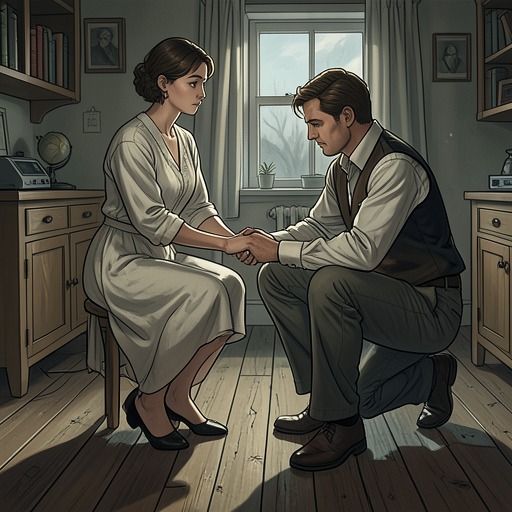
The home also stands in contrast to the Morrison Hotel, where Kayla Renae Morrison later encounters Blake Anderson bringing an older couple onto the rooftop without permission. Jessica Cooper takes Kayla Renae Morrison's hand during the confrontation, a gesture that appears protective even as the house-based evidence has already established Jessica Cooper's hidden hostility toward her employer. The contrast between public reassurance and private criminal planning deepens the domestic setting's central irony: intimacy and protection can function as performances masking control.
Criminal Reversal and Spatial Significance
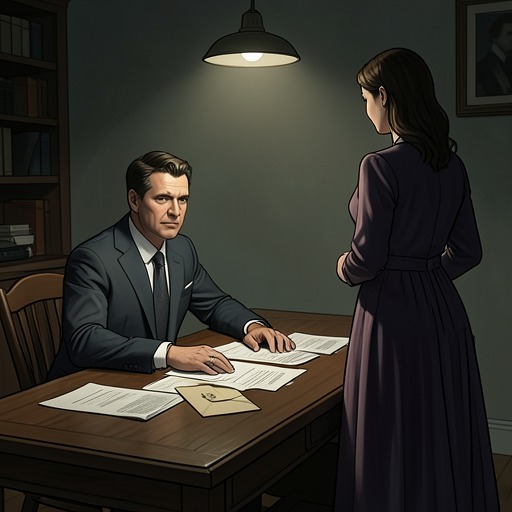
The most extreme reversal associated with Jamie Cooper's house occurs when Davis tells Jamie Cooper that he befriended him at his favorite club, slipped something into his drink, followed him home, and watched him fall into bed before setting the house on fire. Davis then declares that Jamie Cooper is dead and produces a new deed for him to sign, while Christin kisses his cheek and confirms that everything has been planned. In this account, the house is not only where Jamie Cooper lives; it is a target whose destruction is meant to erase him and clear the way for a property fraud.
Taken together, the studio, garden, attic, closet, secret study, and threatened structure create a domestic topography of competing truths. The studio holds artistic failure, the garden holds repetition and temporary calm, the attic holds discarded material traces, and the secret study holds the evidence that reorganizes Jamie Cooper's understanding of his marriage. The house's decisive narrative function lies in this progression from ordinary shelter to archive, crime scene, and object of attempted erasure: what appears to be a modest home gradually reveals how thoroughly violence has entered the spaces where trust was supposed to reside.