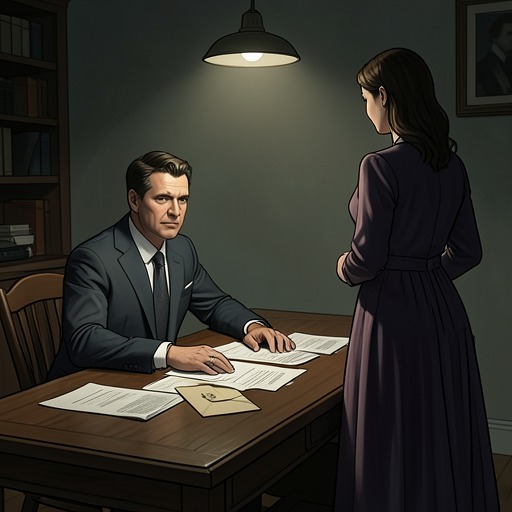
Jamie Learns That Ortiz Is Dead
Call Me YoursJamie Learns That Ortiz Is Dead is a decisive reversal in Jamie Cooper’s understanding of his own life. A routine attempt to contact Ortiz Spencer about a package and a supposed illustration commission becomes an encounter with a death that occurred a year earlier, revealing that Jessica Cooper has controlled or falsified the information surrounding Jamie’s career, friendships, and recent past. The event turns Jamie’s confusion into a concrete crisis of trust: the person he believed was guiding his professional work was already dead, and the wife who claimed to maintain that professional connection may have been constructing an entire reality for him.
Causes and Immediate Circumstances
Jamie’s suspicion begins with the arrival of a postal truck at his driveway. He is not expecting mail, but he wonders whether the package might have come from Ortiz, whom he regards as his childhood friend and agent. The possibility is complicated by his growing unease about Jessica’s behavior, including his belief that she lied about the cost of a dress and his inability to understand how she could afford such an expensive garment. His private doubts therefore precede the phone call: the package is not merely an object to be received, but a possible trace of a relationship Jessica may have been managing without him.
Jessica comes out of the house while Jamie is crossing the yard, and the timing intensifies his uncertainty. Because Jessica has been communicating with Ortiz while Jamie worked on a project, Jamie has allowed her to function as the intermediary between himself and the agent he trusts. Rather than asking Jessica to explain the package, he takes out his phone and dials Ortiz’s number. The unanswered call briefly sustains the expectation that Ortiz might still be reachable; when the phone rings back, Jamie answers with excitement, believing that the person on the other end may finally resolve the mystery.
The Revelation on the Phone
The caller is not Ortiz. A woman identifies herself as his wife, then corrects the relationship more painfully by explaining that she is his widow. Jamie recognizes her as Elena and initially speaks to her as though Ortiz were still alive, asking what is happening and how Ortiz is doing. Elena’s response changes the scene from ordinary professional contact to belated bereavement: Ortiz passed away a year ago.
Jamie reacts with disbelief because the information contradicts the professional history he thinks he possesses. He protests that Ortiz commissioned him to work on a comic book six months earlier, a commission that would have been impossible if Ortiz had already died. Elena rejects the possibility that she is joking and asks what happened to Jamie. She says that he stopped coming around, and that when she called to tell him what was happening, Jessica told her Jamie was busy. The revelation is therefore not limited to Ortiz’s death. It also indicates that Jamie’s absence from his friend’s life was noticed, explained away, and possibly engineered through Jessica’s communications.
Elena’s grief gives the disclosure a moral force that Jamie’s confusion cannot immediately absorb. She asks how he could abandon his friend when Ortiz needed him most, while Jamie can only apologize and admit that he had no idea. His apology does not repair the lost year; it marks the painful distance between the actions Jamie believes he took and the consequences Elena experienced. The event makes absence itself evidentiary. Jamie did not simply fail to receive news—someone appears to have stood between him and the news.
Collapse of Jamie’s Professional Story
Jamie asks Elena whether Ortiz commissioned him for an illustration job before his death, emphasizing that Ortiz was his agent. Her answer destroys the career narrative attached to the alleged commission: Ortiz was never his agent, and Elena says that Jamie ruined his career. This contradiction is sharper than a simple correction of dates. Jamie has been treating the comic-book project as proof of continuing professional purpose, while Elena’s account suggests that the supposed agency relationship never existed at all.
The scene consequently binds personal deception to professional disorientation. Ortiz is simultaneously Jamie’s childhood friend, the person Jamie expects to send him a package, and the imagined agent whose commission gives meaning to his work. Once Ortiz’s death is confirmed, each role becomes unstable. The childhood friendship is shadowed by Jamie’s unexplained disappearance; the agency relationship is denied; and the illustration job becomes evidence that Jamie’s understanding of his own recent activity cannot be trusted.
Jessica’s earlier role as intermediary acquires a different significance after Elena’s testimony. Jamie had accepted that Jessica was communicating with Ortiz while he was occupied with his project. Elena’s account instead establishes that Jessica told her Jamie was busy and thereby helped prevent contact. When Jessica takes the package into the house and later returns to the yard, the physical movement mirrors the informational concealment at the center of the event: correspondence and explanations pass through her hands, while Jamie remains outside the truth.
Consequences and Narrative Significance
The immediate consequence is Jamie’s recognition that Jessica may have lied to him. He explicitly wonders whether she deceived him after hearing that Ortiz had died a year before the alleged commission, and he recalls that Jessica claimed to have been communicating with Ortiz. The event does not yet provide every answer, but it supplies a contradiction that cannot be absorbed into his previous assumptions. A supposedly ordinary domestic afternoon becomes the point at which Jamie’s marriage, career, and memory begin to separate from one another.
The conversation ends before Jamie can pursue the full explanation. With Jessica approaching, he tells Elena that he will have to call back and wishes he had reached out sooner. That interruption preserves the event’s tension: the truth has emerged, but Jamie cannot yet examine it openly. Elena has confirmed the death and challenged his account of his career, while Jessica is physically returning before the call can continue. The scene thus shifts from discovery to immediate concealment, leaving Jamie caught between the widow’s testimony and the spouse who has controlled his access to it.
As a narrative event, Jamie Learns That Ortiz Is Dead converts delayed information into a crisis of identity and causality. The death happened a year earlier, but Jamie experiences it as new because his contact with Ortiz, his professional commission, and his absence from Elena’s life have all been mediated by Jessica. The plot’s value shift moves from expectation to disorientation: Jamie calls for confirmation of a package and receives confirmation that the world he has been living in contains a fabricated relationship. Ortiz’s death is therefore not only a loss in the backstory. It is the fact that makes Jamie’s present intelligible as manipulation, and it begins the collapse of the explanations Jessica has supplied for his life.