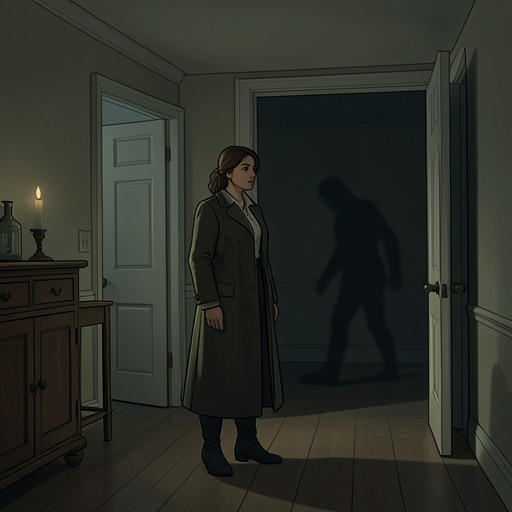
Jessica’s murder-and-embezzlement conspiracy
Call Me YoursJessica’s murder-and-embezzlement conspiracy is the hidden criminal architecture connecting the theft of Kayla Morrison’s paintings, the effort to obtain her mansion and wealth, the manipulation of Jamie Cooper, and Kayla’s psychiatric confinement. What first appears to be a series of isolated dangers gradually becomes a coordinated attempt to remove Kayla, transfer her property, and give Jessica and Jamie a different life—one built on stolen art, fraudulent ownership, and the disappearance of the woman whose trust made the scheme possible.
Origins in an Unequal Household
Jessica’s access to Kayla’s property is created by the household itself. Kayla’s employees, including Jessica, are governed by strict rules: the draperies must remain down, employees cannot leave the premises during their shifts, they must not speak directly to Kayla unless she first addresses them, and complaints must be routed through Jessica. They are also forbidden to befriend Kayla’s daughter, Adi Morrison. These rules make Jessica an intermediary between Kayla and the staff while keeping the household socially divided. The arrangement gives Jessica proximity to Kayla’s possessions and routines, but it also places her inside a system where information and access are tightly controlled.
The conspiracy exploits precisely that position of trust. When Kayla discovers that her newly acquired paintings are missing, a butler brings Detective Zack and Detective Quentin into the family living room. Kayla wants the matter handled quietly, without the press or the insurance company learning about it, and she permits the detectives to inspect the art room, study, doors, locks, and house. They find no evidence of forced entry. At the police station, Quentin questions the staff, including the security personnel, while Kayla watches through a small glass window. His conclusion is that one of her employees is responsible. The investigation therefore narrows toward the household’s internal access, even though the conspirator remains hidden within the appearance of loyal service.
The Financial Design
Jessica’s dealings with Taylor Gonzalez reveal that the painting theft is not opportunistic kleptomania but an established commercial operation. At a steakhouse thirty miles from home, chosen so she will not meet anyone who knows her, Jessica meets Taylor, a petite, bespectacled man in his fifties. He fills her glass from a bottle of water and asks what she has brought. Jessica tells him that she has a collection of original paintings and explains that she has been stealing Kayla’s paintings and selling them to him for years. Taylor is discreet, asks no questions, and pays a reasonable price. He promises that the money will reach Jessica’s account in less than twenty-four hours.
The sale is only one stage in a larger plan. Jessica intends to use the transferred money to support the next step: getting rid of Kayla and Chris Davis with the assistance of Dr. Reid Francois. Once Kayla and Chris are removed, Jessica believes that she and Jamie will have a better life. She expects that winning Adi over may take time, but she plans to devote herself to it. The scheme consequently combines several objectives that do not naturally belong together: embezzlement through stolen art, the elimination of romantic and familial obstacles, control of Kayla’s property, and the reconstruction of Jessica’s domestic life around the proceeds of crime.
The financial objective is stated plainly in the notebook Jamie Cooper discovers in Jessica’s concealed study: “Get rid of Kayla, take her money and properties, and change the deeds to my name.” The sentence transforms suspicion into documentary evidence. It identifies the intended victim, the desired assets, and the legal mechanism by which the theft is to be completed. The plan is not merely to kill Kayla or steal movable objects; it is to rewrite ownership so that the mansion and its associated wealth appear to belong to Jessica.
Discovery, Coercion, and Escalation
Jamie’s discovery of the secret study initially produces the wrong interpretation. Behind a closed wardrobe door, he finds a small brown oak desk, a reading lamp, and notebooks. The first notebooks contain nothing, but the last contains the plan to eliminate Kayla, seize her money and properties, and change the deeds. Jamie recognizes Jessica’s handwriting. He recalls the suitcase of designer clothes in the attic and concludes that Jessica must have stolen those items as well. At first he imagines that she is a kleptomaniac who is not in the right frame of mind, and he tries to explain the murder plan as an extension of an illness rather than as a deliberate conspiracy.
His interpretation does not survive the scale of the evidence. Jamie understands that Jessica is planning a horrendous crime and decides that he must protect Kayla, save his wife from herself, and return the paintings to their rightful owner, Kayla Morrison. He dials 9-1-1, but his jaw refuses to open when a voice answers. The attempted call marks a conflict between recognition and action: he has discovered the truth, yet the intimate bond of marriage and the shock of finding Jessica’s criminal self obstruct his ability to report it.
The conspiracy also draws Don into a coercive negotiation. Don threatens Jessica and claims that he has watched her for a long time and knows her plans. He proposes marriage and offers to help get rid of Kayla, while acknowledging that both of them want Kayla’s wealth. He has already penetrated the supposedly secure mansion unseen and frightened Kayla. Jessica knows that Don is ruthless and fears that he could hurt her or Adi. She therefore offers cooperation only on her own terms: Don must disclose his plans and promise that no harm will come to Adi or Little Jay. Her attempt to limit the violence does not undo her own scheme; instead, it shows the conspiracy branching into unstable alliances in which every participant tries to use the others while protecting a private interest.
The danger surrounding Kayla is repeatedly signaled before its full explanation. She receives persistent calls from the same number, and anger flares when she sees it on her phone. Later, while walking beyond the mansion’s yard into the woods, she finds several half-smoked cigarette butts near a rock, gathers them with her shawl because she cannot bear to touch them, and then discovers a large footprint. Jessica does not smoke, and staff are forbidden to drink, smoke, or hold parties on the property. The clues make the mansion’s controlled boundaries appear penetrable: rules govern the legitimate occupants, but an unseen intruder can turn the grounds into a message and a threat.
The Medical and Violent Phase
The conspiracy reaches its most coercive form when Kayla is brought to a hospital and wakes strapped to a bed by her hands and legs. Dr. Reid Francois tells her that Jessica, whom he initially describes as her assistant after Kayla calls her a wife, hired him to help her. Male nurses lead Kayla through a hallway marked by bleach, security doors, patients strapped to beds, and staff who do not intervene. Faced with confinement and the prospect of becoming one of the patients she has seen, Kayla decides to stop struggling and play along. The psychiatric institution therefore functions as both a physical prison and a mechanism for redefining her credibility and identity.
Jessica’s motives become explicit during the treatment. She wants her husband back and believes that Kayla, Chris, and the other alters have kept him away from her for too long. She wants Dr. Francois to get rid of the alters, especially Kayla and Don, who have caused her trouble. Kayla’s wealth is needed to pay the bills, so Jessica considers asking the doctor not to eliminate her too quickly, whereas Don is treated as a more immediate danger because he has attacked Jessica. Little Jay is regarded as easier to handle. This reasoning reveals the conspiracy’s most disturbing logic: Jessica treats distinct identities as obstacles to be managed while treating Kayla’s wealth as a resource that can be extracted from the person who possesses it.
When Dr. Francois places Kayla under hypnosis and calls for Chris, Kayla’s physical presentation changes. She removes the blond wig, twists in pain, becomes still, and then sits hunched over, rubbing her neck and lower back. The scene makes the medical procedure part of the criminal plan rather than a neutral treatment. Hypnosis is used to summon and manipulate the identities that Jessica wants to suppress, while the wealth-bearing identity is preserved only insofar as it remains useful.
The conspiracy’s violence extends beyond Kayla. Christin and Davis abduct Jamie Cooper, tie his hands and legs, and claim that they survive by taking things from wealthy people who do not deserve them. Davis then tells Jamie that he befriended Larry at Jamie’s favorite club, drugged his drink, followed him home, and set the house on fire after Larry fell into bed. Davis says Larry is dead and produces a new deed for Jamie to sign. The fraudulent deed gives the criminal partnership a legal instrument to accompany its violence. Murder, incapacitation, property transfer, and false documentation operate as parts of the same system rather than as separate crimes.
Meaning and Consequences
The conspiracy’s decisive reversal is the collapse of Jessica’s image as a kind woman and devoted wife. Jamie’s first response is disbelief: Kayla is Jessica’s boss, and he cannot understand why Jessica would want to kill her. The notebook, years of painting sales, designer clothing, secret communications, and medical collaboration steadily replace that charitable interpretation with evidence of planning. Jessica’s role as an employee gives her access; her marriage to Jamie gives her an emotional shield; her knowledge of Kayla’s distrust gives her tactical insight; and her association with Dr. Francois, Taylor, Don, Christin, and Davis expands the scheme into a network.
Kayla’s own efforts to control information intensify the irony. She tries to keep the stolen-painting investigation away from the press and insurance company, limits access to her home, and maintains rules intended to preserve distance between herself, her employees, and Adi. Yet those same boundaries produce an environment where Jessica controls communication, where staff access becomes suspicious only after the theft, and where threats can be concealed behind domestic routine. The mansion’s luxury—chandeliers, gold-painted walls, marble, burgundy drapes, and Kayla’s portrait above the fireplace—becomes the visible surface of an asset struggle. Beneath it, the central question is who may enter, who may speak, who may own, and who may survive.
Jessica’s murder-and-embezzlement conspiracy therefore joins domestic thriller, property crime, medical confinement, and family betrayal. Its most consequential discovery is not simply that Jessica stole paintings or contemplated murder, but that she imagined wealth as something that could be detached from Kayla’s person through a chain of accomplices, altered identities, psychiatric authority, and fraudulent deeds. The conspiracy turns intimacy into opportunity and protection into captivity, making Kayla’s apparent security the very condition that allows the plot to approach her from within.