Kayla's art collection
Call Me YoursKayla's art collection is one of the clearest material embodiments of Kayla Renae Morrison's character. It represents cultivated love of art rather than mere luxury consumption, yet its extraordinary monetary value also exposes her to theft, manipulation, and violence. The collection moves through the narrative from private pleasure and public status to violated property, criminal evidence, and a dangerous measure of the power surrounding its owner.
Formation and Scale
Kayla is described as a business tycoon and socialite, but her relationship to art is more serious than the social world around her. At Vanessa Lauren Art Gallery, she is irritated by celebrities and wealthy spectators who attend chiefly to be seen by paparazzi, while she genuinely loves the works being sold. She has spent millions of dollars acquiring original paintings from different parts of the world and owns enough Renaissance and modern pieces to open a gallery of her own. Her personal art room is consequently not just storage: it is identified as her favorite part of Morrison Villa and as a private territory where wealth, discernment, and personal attachment meet.
The collection also operates within an overt culture of luxury. Kayla arrives at the auction in a tailored white business suit, diamond-embedded earrings, a black sequined designer purse, and expensive stilettos, then purchases another historical painting for fifty-five million dollars. The scale of that purchase places the collection among the visible privileges of her fortune, but the narrative distinguishes her from guests displaying designer goods for social attention. The paintings are valuable because they are artworks and because they are hers; Kayla treats them with an intimacy that exceeds their market price.
The Collection at Morrison Villa
The paintings are housed within an estate whose architecture emphasizes both abundance and controlled access. Morrison Villa occupies 1.5 acres and includes a large cream-colored mansion, golden entry doors, a multi-car garage, a spa, a gym, a tennis court, a lake, and staff quarters near the garden. Inside, chandeliers, gold-painted walls, marble flooring, burgundy drapes, colorful furniture, and porcelain vases create an environment already saturated with display. A portrait of Kayla by a French artist hangs above the white marble fireplace, placing her own image within the same culture of collected and commissioned art.
The private art room gives this display a more intimate dimension. Kayla has insured most of the paintings, although the size of the collection makes complete coverage difficult. The paintings are therefore simultaneously protected assets, aesthetic objects, and cherished possessions. Kayla later describes each painting as being like one of her babies, a comparison that explains why their disappearance feels to her less like an ordinary burglary than a personal violation. Her response is not limited to concern over financial loss: she wants her paintings back and initially considers dismissing the entire household staff, though she holds back in order to let investigators question them.
Theft and the Visible Absence
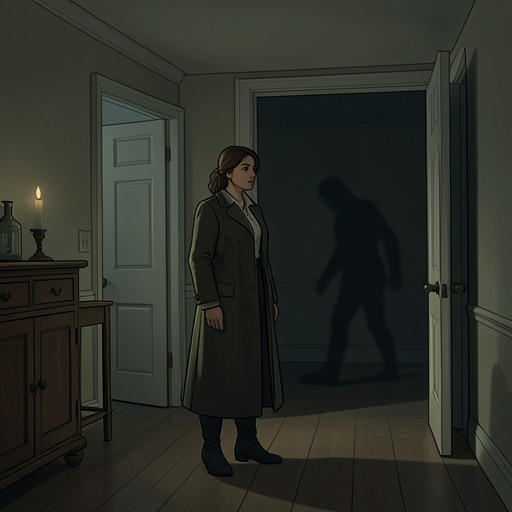
The collection becomes narratively active when absence suddenly makes it visible. Returning to her office, Kayla senses that something is wrong even though the plush carpet and black bookshelf appear undisturbed. The decisive clue is a large gap between two paintings on the wall. She realizes that there should be three, and one of her Herman Hughes paintings is gone. The missing object transforms a familiar room from a stable extension of her identity into evidence of breached security.
Kayla then unlocks the art room with the key from her wallet and searches the numerous paintings. At first, nothing seems amiss, but another empty space reveals that the newly acquired paintings have disappeared as well. The theft therefore includes one painting from the study and two from the art room, while Kayla remains uncertain whether older works have also been taken. She summons Detective Quentin and Detective Zack and directly asks them to recover the paintings. The uncertainty about the full extent of the loss intensifies the violation: even the boundaries of the collection are temporarily unknowable.
The timing also links the theft to Kayla's public collecting. The historical painting purchased for fifty-five million dollars at Vanessa Lauren Art Gallery was scheduled for delivery the following morning, according to the gallery's policy. The later discovery that newly acquired paintings are missing turns a triumphant auction purchase into part of a larger pattern of compromised security. What had signified control over rare objects now demonstrates that ownership cannot guarantee their safety.
Criminal Value and Hidden Evidence
The paintings' market value makes them useful to people who see Kayla primarily as a financial target. Jessica Cooper knows how much the works are worth and, after the case goes cold, does not contact the insurance company because she does not want outsiders investigating her affairs. Her knowledge is not incidental administrative information; it becomes part of the mechanism by which the collection can be converted into illicit wealth. The paintings thus connect Kayla's employer-assistant relationship to a concealed criminal economy.
Jamie Cooper later discovers the hidden works behind bookshelves in Jessica's secret study. He finds a stack of paintings after reading a notebook that reveals Jessica's plan to murder Kayla and take ownership of her properties. He recognizes the canvases as the original paintings Jessica had said her employer was looking for and understands that they may be worth millions of dollars. The hidden paintings materially confirm what the notebook discloses: the conspiracy is not an imagined possibility but a crime with recoverable objects, a concealed location, and a direct route to Kayla's wealth.
The collection's value also sharpens the danger surrounding Kayla. Kayla tells Chris Davis that she owns Morrison Group of Hotels and belongs to a wealthy family, explaining that men have repeatedly professed love after learning how much she is worth. Don likewise describes her as a billionaire with hotel chains, a mansion, and properties in affluent neighborhoods, and calculates that he could receive more by waiting for Kayla's death than by accepting Jessica's proposed payment. In this context, the stolen paintings are not isolated valuables: they are part of the same fortune that attracts false intimacy, coercion, and murder planning.
Meaning and Narrative Function
Kayla's art collection holds together several apparently opposing meanings. It is a form of genuine aesthetic devotion in a room full of people performing sophistication, yet it is also an unmistakable sign of class power. It gives Kayla a private refuge inside Morrison Villa, but its visibility and monetary worth help make that refuge vulnerable. It is treated as a set of living attachments by Kayla, while Jessica's conspiracy treats it as transferable property and Jamie's discovery treats it as physical proof.
The paintings also embody the story's tension between possession and security. Kayla can buy historical and original works for extraordinary sums, insure many of them, place them in a guarded mansion, and still find empty spaces where part of her identity had been. Their disappearance is powerful precisely because the objects are normally silent and stable. A missing canvas becomes louder than a broken lock: it reveals the breach without showing the thief, converts decorative space into testimony, and forces Kayla to confront the possibility that danger has entered through the people closest to her.
By the time the paintings are found hidden behind Jessica's bookshelf, the collection has moved beyond the status of luxury goods. It has become a material record of the conspiracy against Kayla, a source of evidence for Jamie, and a measure of how wealth can be transformed from pleasure into risk. The collection remains central because it makes the novel's abstract pressures—status, desire, deception, and acquisitive violence—physically visible in canvases that can be admired, stolen, concealed, and used to expose the truth.