Kayla's missing letters
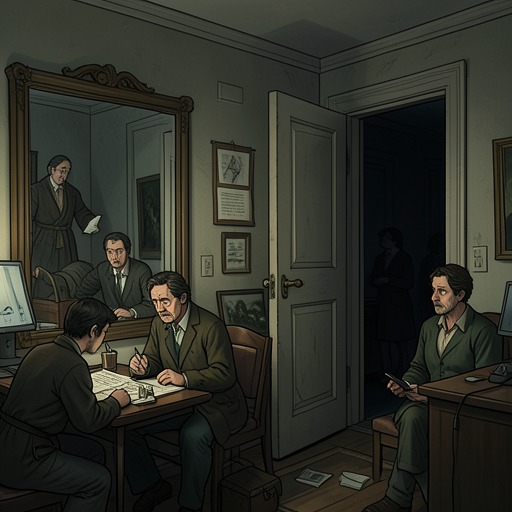
Call Me YoursKayla's missing letters are a decisive turning point in Kayla Morrison's romance with Chris Davis and in the novel's movement from epistolary intimacy toward suspicion and danger. The letters are not ordinary possessions: they are the material proof of a relationship Kayla has not yet been able to secure in person. Their disappearance therefore takes away both communication and reassurance, leaving her to confront the possibility that someone inside her household has entered the most private part of her life.
Background and Emotional Value
Kayla Morrison begins the story eager for a letter that might finally feel different from the hundreds she has already received from eligible bachelors across the country. She presents indifference when her assistant brings an envelope, telling her to place it on the vanity, but the performance conceals how desperately she wants the letter to be the one. Her wealth has attracted men she regards as lazy or opportunistic, and a past mistake continues to shape her caution. In that context, the correspondence with Chris Davis acquires unusual value: it seems to offer a relationship based on recognition rather than access to her money.
The letters also matter because their physical form makes the romance tangible. Kayla loves exchanging letters with Chris, running her fingers over his handwriting, and holding the pages close to her chest at night. The paper carries an intimacy that email cannot reproduce. Each letter preserves Chris's presence in his absence, allowing Kayla to maintain a private emotional world inside an otherwise highly exposed life as a wealthy woman surrounded by employees, family tensions, and people who may want something from her.
Discovery of the Disappearance
The loss becomes explicit when Kayla removes her diamond drop earrings and reaches into the nightstand drawer for Chris's letter. Her wallet and passport are still there, but the letters are gone. The contrast makes the theft especially unsettling: the intruder has not simply taken valuable property, but has selected the objects whose worth is emotional and relational. Kayla's heart pounds as she searches the drawer, and she frantically pulls it open again, unable to accept what the empty space means.
A second absence complicates the scene. Kayla discovers that her favorite coat is missing as well, and it is worth fifteen thousand dollars. Yet the coat does not command her attention. She treats it as replaceable while calling the letters priceless, a contrast that defines the event's value system more clearly than any abstract declaration could. Luxury can be purchased again; Chris's handwriting and the history accumulated between the two correspondents cannot.
Kayla immediately turns toward Adi Morrison as a possible culprit. She demands that Adi give back the letters, accusing her of wanting to make Kayla suffer for some grievance. Adi denies taking anything, and the confrontation escalates as Kayla's anger rises. Kayla throws a pillow against the window and threatens punishment if the letters are not returned. The scene transforms an absent object into a domestic conflict, showing how quickly the missing correspondence contaminates the mother-daughter relationship with accusation and fear.
Suspicion and the Breakdown of Privacy
Kayla does not know whether Adi took the letters or whether Kayla herself misplaced them. That uncertainty is important: the event creates suspicion without immediately supplying proof. Adi is a natural suspect because she is close to Kayla and has access to the household, but the accusation remains unconfirmed. The missing coat offers evidence of a physical intrusion, while the intact wallet and passport suggest that the intruder's purpose was selective rather than purely financial.
Kayla later identifies Adi and Jessica Cooper as her prime suspects because they are the only people known to have access to her room. Jessica's position makes the suspicion especially painful. She is Kayla's assistant and insists that she would never steal from her employer. Jessica also questioned the household staff, all of whom denied that anyone had entered the house or taken the letters. Because Jessica had accompanied Kayla on a trip, Kayla acknowledges that she could not have taken the letters during that absence, but the uncertainty does not disappear.
The incident shakes Kayla's confidence in her home. She changes the lock on her door, treating the room no longer as a secure private refuge but as a breached space. When Detective Quentin later questions her about the theft of priceless paintings, Kayla explains that the house has a security system but no camera in the hallway because the arrangement makes Adi uncomfortable. That detail gives the missing letters a wider significance: the household's compromises in the name of family comfort have also created an opening through which private objects and valuable property can disappear.
Consequences for the Romance
The stolen correspondence interrupts the rhythm of Kayla and Chris's courtship. Kayla has not sent Chris any letters since his last letter disappeared along with the others. She eventually writes again to explain what happened, but the act of writing no longer carries the same confidence. The letter becomes an attempt to repair a communication channel damaged by an unknown hand rather than a simple continuation of their romantic exchange.
Kayla decides that letters are no longer safe and that she and Chris will have to communicate through email. The decision protects their ability to remain in contact, but it also marks a loss. Email restores immediacy while eliminating the tactile qualities she treasures: Chris's handwriting, the paper held against her chest, and the physical archive of their developing love. The event thus shifts the romance from an intimate, material form to a more vulnerable and technologically mediated one.
That shift is echoed when Kayla later opens her email and finds a message from Chris with the subject “CALL ME YOURS.” The message renews her excitement, and her heart beats faster as she opens it, but the emotional charge is now inseparable from the earlier violation. Communication survives, yet it survives under pressure, with Kayla aware that messages may expose her rather than merely comfort her.
Narrative Significance
Kayla's missing letters function as both a plot mystery and a material symbol of threatened intimacy. The disappearance links the romantic storyline to the novel's larger pattern of secrecy, surveillance, theft, and concealed motives. The same world in which Kayla's paintings can vanish without witnesses is one in which the written record of her love can be removed from a locked drawer. Private feeling is repeatedly forced into the logic of property, access, and control.
The event also establishes a sharp contrast between appearance and value. Kayla's luxurious possessions include expensive jewelry, a fifteen-thousand-dollar coat, and priceless paintings, yet the objects she values most are the letters that cannot be replaced by money. Their theft reveals what wealth cannot protect: trust, privacy, and the physical traces of another person's affection. By forcing Kayla to suspect Adi and Jessica, the disappearance makes emotional dependence feel dangerous, while the eventual move to email preserves the romance only by stripping it of part of its material tenderness.
The letters therefore remain important even in their absence. Their disappearance changes Kayla's behavior, alters the form of her relationship with Chris Davis, hardens the security of her room, and intensifies the atmosphere of domestic uncertainty. What is missing from the drawer becomes present everywhere else in the story: in Kayla's anger, in her suspicion, in the changed lock, and in the fragile new messages through which the romance must continue.