Kimberly Cooper
Call Me YoursKimberly Cooper is Jamie Cooper’s mother and Richard Cooper’s wife. She enters the story as a quiet, anxious woman whose family history is inseparable from Jamie’s fractured identity. Her significance lies in the painful gap between love and recognition: she loves Jamie deeply, yet her unfulfilled wish for a daughter and the gender expectations surrounding his childhood help create the conditions through which his hidden self develops.
Identity and Family Background
Kimberly is introduced alongside Richard when they arrive at the Morrison Hotel rooftop seeking Jamie. She has curly salt-and-pepper hair and wears a navy-blue skirt with a white chiffon blouse; Richard has reddish hair streaked with white and wears gray trousers with a white shirt. Their appearance marks them as an older couple carrying the weight of a long family history. Richard identifies them as Jamie’s parents, while Kimberly asks whether the different personalities know about one another, revealing both her fear and her urgent need to understand what has happened to her son.
Kimberly’s relationship to Kayla Renae Morrison is initially confused and hostile from Kayla’s perspective. Jessica Cooper explains that Jamie has an alter named Kayla Renae Morrison, a wealthy hotel owner who accepted Adi Morrison as her own daughter without remembering that Adi was Jessica’s child. Kimberly therefore becomes one of the people who can connect the apparent contradictions among Jamie, Kayla, and the family history concealed from them. Her presence turns the rooftop encounter from a confrontation with apparent strangers into an encounter with Jamie’s biological family.
Jamie’s Childhood and the Daughter She Wanted
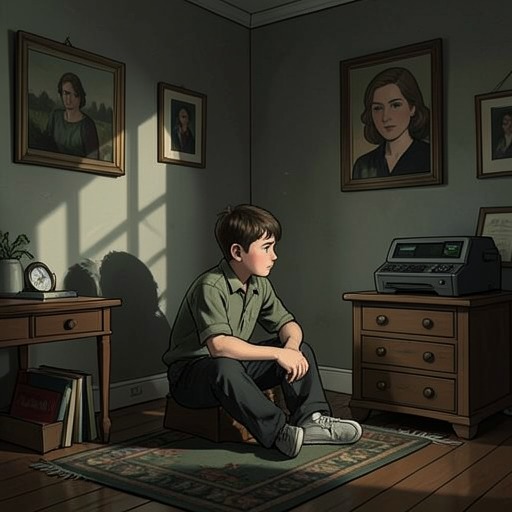
Kimberly’s most consequential background detail concerns her desire for a daughter. In Jamie’s childhood memory, she discovers him wearing a dress and reacts with alarm, insisting that boys cannot wear dresses. Jamie experiences her response not simply as a rule about clothing but as evidence that she cannot see or accept the girl he believes himself to be. He remembers Kimberly looking longingly at other girls in the park and interprets that longing as proof that she wanted a daughter rather than him.
The attic intensifies this wound. Jamie finds boxes filled with girls’ clothing that Kimberly had purchased from infancy through the age of twelve. Some garments are too small, but he wears them secretly, along with Kimberly’s clothes, wig, and shoes. He also teaches himself makeup, feminine movement, and a feminine voice. The clothes are therefore both evidence of Kimberly’s earlier hopes and instruments of Jamie’s private self-expression. Kimberly did not intend the boxes to become a source of torment, but their discovery gives Jamie a material image of the daughter he thinks she wanted and of the identity he feels forbidden to inhabit.
Kimberly later explains that she had not understood the signs, including moments when she caught Jamie wearing her makeup. She recognizes that her wishes may have contributed to his questioning of whether she loved him as a son. Her remorse does not erase the childhood rule that boys must not wear dresses, but it complicates the memory: Kimberly’s affection existed alongside fear, misunderstanding, and a failure to recognize what Jamie was communicating through clothing and appearance.
Guilt, Absence, and the Family Crisis
By the time Kimberly speaks with Jessica, she understands Jamie’s condition as a tragedy in which she bears part of the responsibility. She says she wishes she had discarded the girls’ clothes before Jamie found them and began questioning whether his parents loved him. Her confession is marked by self-blame, especially because she now recalls the warning signs that once seemed insignificant. Richard tells her to stop blaming herself and urges both of them to remain strong for Jamie and his family.
Kimberly’s guilt is set against the much larger network of secrecy surrounding Jamie. Jessica had instructed Adi to hide whenever Jamie was present because Jamie had forgotten his daughter. Kayla, meanwhile, believed Adi was her own child and did not remember Jessica’s role in Adi’s birth. Kimberly is not responsible for all of these deceptions, but her account shows how concealment operates across generations: a mother hides her disappointment, a child hides his feminine self, Jessica hides Adi from Jamie, and the family eventually loses access to a shared truth.
Her family also exists within the danger created by Christin and Davis. The account of Jamie’s captivity describes how torture and repeated insults weakened him until he began treating his assailants as his parents. Christin and Davis then exploited his confusion, retaining him as a controllable son after the Mansion Deed had been signed over to Chris Davis. Kimberly is not an active participant in that crime, but the revelation makes her absence from Jamie’s life more devastating: while strangers were reshaping his identity through violence, his real parents did not know where he was.
Reunion and Maternal Recognition
Kimberly’s reunion with Jamie is one of the story’s clearest movements from fear to recognition. After Jessica brings Jamie into the room, Kimberly approaches him in tears and embraces him. Jamie cannot hold back his own tears, and Richard places an arm around him. The scene does not depend on an explanation or argument; physical contact restores a family connection that years of disappearance, amnesia, and competing identities had interrupted.
Kimberly tells Jamie that he is the best thing that ever happened to her and that his departure left part of her missing. She also reveals that she and Richard searched for him for years. This declaration directly counters Jamie’s childhood conviction that Kimberly’s desire for a daughter meant she did not truly want him. The reunion cannot undo the pain caused by her earlier misunderstanding, but it gives Jamie evidence that he was loved and mourned even when his own memories had turned that love into rejection.
The family’s recovery remains unfinished. Jessica reports that Adi has stayed in her room since Jamie was taken to the hospital and will not speak to her or allow physical closeness. Dr. Reid Francois has suggested therapy for both Jessica and Adi, while Kimberly and Richard must also confront their role in Jamie’s past. Kimberly’s return is therefore not a magical repair but the beginning of a family effort to live with the damage openly.
Narrative Role and Significance
Kimberly represents the difference between intention and consequence in the novel’s treatment of family love. She did not intend to injure Jamie by saving girls’ clothing, nor did she understand what his dress, makeup, and other forms of gender expression meant to him. Yet the social rule that boys must dress as boys becomes, in Jamie’s memory, a command to deny his deepest sense of self. Kimberly’s character holds both truths together: she is a loving mother, and she failed to recognize the child asking to be seen.
Her arc also enlarges the story beyond Kayla Renae Morrison’s wealth, Jessica’s secrets, and Jamie’s dissociative identities. The preserved clothes in the attic, the questions on the rooftop, the confession of regret, and the final embrace form a chain of recognition. Kimberly begins as a mother whose hopes have been misunderstood and whose son is missing; she ends as a mother confronting him directly, naming her love, accepting responsibility, and joining the family’s difficult movement toward truth.