Morrison Villa
Call Me YoursMorrison Villa is the expansive New Orleans residence of Kayla Morrison, a place where extraordinary luxury, rigid hierarchy, and mounting danger occupy the same enclosed world. Set on 1.5 acres and protected by security staff, the mansion initially appears to guarantee privacy and control. Yet its rules isolate Kayla from the people who serve her, while the theft of her paintings, evidence of an intruder, and fear of renewed violence transform the house from a symbol of protection into a threatening enclosure.
Setting and Physical Grandeur
Morrison Villa stands behind gates at the end of a winding driveway bordered by rows of boxwood hedges. When Kayla returns from the auction, the security men on duty salute her, and the mansion presents itself as a carefully managed estate rather than an ordinary family home. The cream-colored building has expansive entryways and double golden doors; a multi-car garage holds an assortment of luxury cars, while a spa, gym, and tennis court extend the property’s facilities beyond the main residence. A lake lies behind the house, with Kayla’s yacht docked there, and the staff quarters stand near her garden.
The interior reinforces the same language of wealth. Expensive chandeliers hang from high ceilings, gold-painted walls echo the golden tones of the marbled floor, and heavy burgundy drapes frame windows furnished with colorful plush pieces and porcelain vases. A portrait of Kayla by a French artist hangs above the white marble fireplace, turning the house into a gallery of her status as well as a place of residence. Her bedroom and both wings are elaborately designed, but the spaces she genuinely loves are more private: her bedroom, study, art room, and the sitting area on the roof. This distinction matters because the mansion’s abundance does not produce uncomplicated comfort; Kayla retreats into selected rooms within the larger display.
Household Order and Social Boundaries
The villa operates through rules imposed by Kayla on every employee, including Jessica Cooper. The draperies must remain down, employees may not leave the premises once their shifts begin, and they must not speak to Kayla unless she addresses them first. Complaints are to pass through Jessica, who is expected to manage them as an intermediary. Staff members are also forbidden to befriend Kayla’s daughter, Adi Morrison. The house therefore depends on a strict chain of access: Kayla occupies the center, Jessica filters communication, and the remaining workers are kept physically and socially at a distance.
The household’s rituals make that hierarchy visible. When Kayla enters the living room, butlers bow and maids hurry into the kitchen. Jessica knocks on Kayla’s door to announce dinner, receives Kayla’s empty glass after she finishes her wine, and remains responsible for translating the household’s needs to its owner. Even the property’s security and domestic order are meant to preserve Kayla’s control over who may approach her, what may be seen, and how information reaches her. The villa is luxurious, but it is also a regulated institution whose intimacy is governed by rank.
The Mansion as a Center of Wealth and Secrecy
Morrison Villa is connected to Kayla’s public identity as a business tycoon, socialite, and renowned collector. Her purchases at the Vanessa Lauren Art Gallery include a historical painting valued at fifty-five million, and the gallery’s policy is to deliver the paintings to her residence the following morning. The villa consequently functions as a repository for objects whose value attracts admiration and criminal interest. Its art room and study are not merely decorative spaces; they hold the material evidence of Kayla’s fortune and the private correspondence through which she seeks a relationship beyond that fortune.
Kayla’s emotional life is also hidden inside the house. She places Chris Davis’s latest letter in the nightstand drawer before going to dinner, and later opens an email in her study with the subject “CALL ME YOURS.” From the villa, she discloses to Chris that she owns Morrison Group of Hotels and belongs to a wealthy family, explaining that her money has repeatedly attracted men who wanted access to it rather than love. The mansion thus shelters both the visible signs of privilege and the secret communications through which Kayla tests whether Chris values her as a person.
Breach, Surveillance, and Flight
The villa’s apparent security is undermined when Kayla discovers that her newly acquired paintings have disappeared. A butler ushers Detective Zack and Detective Quentin into the family living room, and Kayla tries to keep the investigation quiet so that the press and insurance company will not learn what happened. The detectives inspect the art-room door, its lock, and the study, but find no sign of forced entry. At the police station, Kayla watches through a small glass window while Quentin questions the staff; the oppressive air, cigarette smell, sweat, and cleaning chemicals make the investigation physically distressing for her. Quentin concludes that one of the employees must be responsible, converting the supposedly protected household into a field of suspicion.
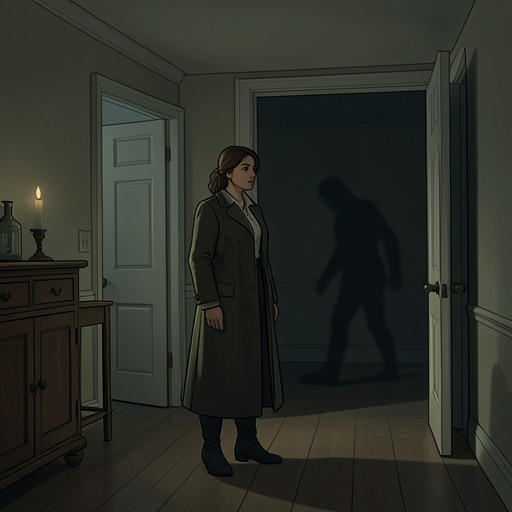
The threat becomes more personal when Kayla walks beyond the sprawling yard and realizes that she has entered the woods. There she finds several half-smoked cigarette butts near a rock and then sees a large footprint in the soil. She is not a smoker, cannot tolerate the smell of cigarettes, and knows that Jessica Cooper is also prohibited from smoking on the property. The objects therefore read as a deliberate sign rather than casual litter. Kayla concludes that an intruder has entered her grounds and connects the danger to the earlier peanut-allergy attack, fearing that whoever is stalking her may attempt to kill her.
Kayla responds by ordering Jessica to pack their bags and announces that they will stay at the hotel for several days. She questions Jessica about the missing paintings, does not believe Jessica’s denial, but chooses not to press her at that moment. Kayla waits in the limousine while a bodyguard brings Adi home, then leaves the estate with her daughter. As the limousine pulls away, she looks back at the house and cannot shake the feeling that it will be the last time she sees the mansion. The place that once displayed her control has become inseparable from suspicion, intrusion, and the possibility of permanent loss.
Narrative Significance
Morrison Villa embodies the contradiction at the heart of Kayla’s life. Its acreage, yacht, art collection, luxury facilities, and ceremonial staff demonstrate the reach of her wealth, while its closed draperies, communication restrictions, and controlled access reveal how that wealth produces isolation. The house can keep strangers out, but it cannot prevent betrayal from within; it can preserve paintings, but it cannot secure Kayla’s emotional life; and it can surround her with staff, yet leave her vulnerable to loneliness and pursuit.
Its transformation is therefore spatial as well as psychological. At first, entering the villa brings visible relief and orchestrated service. Later, the same property contains unexplained theft, interrogations, cigarette evidence, a footprint, and the fear of a returning attacker. Kayla’s departure to the hotel is not simply a change of residence but a reversal in the meaning of home: Morrison Villa begins as the strongest expression of her autonomy and ends as a place she feels compelled to abandon. In that reversal, the mansion becomes one of the book’s clearest images of wealth as both refuge and target.