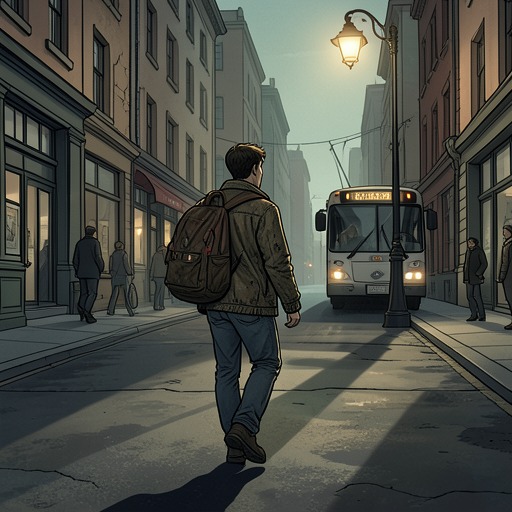
St. Francisville
Call Me YoursSt. Francisville is the small Louisiana town where Chris Davis was born and raised, the setting of his family life before bereavement forced him toward New Orleans. In the narrative, it carries a double meaning: it is remembered as a sleepy hometown associated with ordinary affection and work, yet it is also the place where a road accident destroyed Chris’s family, injured his back, and set the course of his adult isolation.
Home and Early Identity
St. Francisville was Chris’s childhood home. He later tells a psychiatrist that his parents worked on a ranch there: his father was the foreman and his mother was the cook. This places Chris’s earliest life within a working rural household whose structure was defined by his parents’ labor and by the close family unit they formed around him.
When Chris writes to Kayla Renae Morrison, he describes St. Francisville as a small, sleepy town, contrasting its quietness with the bustle of New Orleans. The comparison shows that the town remains a measure of familiarity for him even after he has left it. New Orleans offers colleagues and new acquaintances, but Chris still frames his former home as the place against which city life feels emotionally thin.
The Crash That Ended His Childhood
The decisive event associated with St. Francisville is the car wreck that occurred when Chris was sixteen. His parents had a day off and had taken him to a county fair. On the journey home, a drunk driver struck their vehicle. The collision overturned the truck and left the family trapped in a rapidly worsening disaster.
Chris’s memory of the crash is intensely physical. His back was badly hurt, his mother was thrown through the windshield, and his father was trapped behind the wheel with his lower body crushed. Although Chris was injured and struggling to breathe, he crawled back to the vehicle and tried to rescue his father. His father’s body was still warm but motionless, and the truck caught fire less than five minutes after Chris pulled him out. Chris was later taken to a hospital, where the recognition that the catastrophe was real—not a nightmare—caused him to break down in tears.
The accident therefore transformed St. Francisville from a family home into the site of irreversible loss. Chris survived, but he lost both parents, sustained a chronic back injury, and was left without the family that had defined his childhood. The town’s pastoral associations cannot be separated from the violence of the road accident that ended them.
Departure and the Memory of Place
After the crash, Chris hitched a ride to New Orleans. His departure is presented not as an ordinary migration but as the consequence of becoming an orphan at sixteen. St. Francisville is thus the starting point of the displacement that shapes his later life: he moves from a small town where he had parents and a settled identity into a large city where he is surrounded by people yet remains vulnerable to loneliness.
Chris’s later account of the town does not erase the crash. His letter to Kayla joins everyday recollection—his upbringing, his parents’ occupations, and the contrast between rural quiet and urban bustle—to the blunt fact that his parents did not survive the move toward adulthood. The memory of St. Francisville operates through this compression of comfort and catastrophe: the same place holds the image of home and the origin of his solitary life.
Narrative Significance
St. Francisville functions less as a continuously occupied setting than as a recalled location whose meaning is revealed gradually. Chris first invokes it as the town where he grew up, while the fuller psychiatric account supplies the traumatic circumstances of his departure. This movement from biographical detail to embodied memory gives the location structural importance: it explains why Chris is displaced, why his back remains a mark of the past, and why his adult identity is inseparable from parental death.
The location also intensifies the narrative’s treatment of trauma and memory. Chris can describe the sequence of the crash in concrete terms—the failed brakes, the impact, his parents’ injuries, the fire, and his rescue attempt—yet the account remains charged with the helplessness of a sixteen-year-old forced into an impossible act of survival. St. Francisville is consequently both a geographical origin and a psychological wound, the place from which Chris leaves and to which his defining memory repeatedly returns.