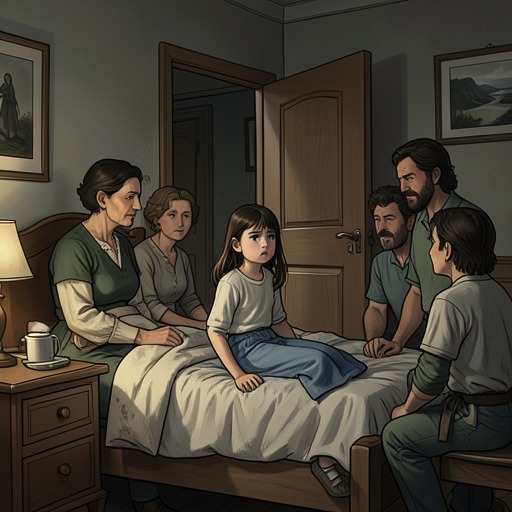
The orphanage
Call Me YoursThe orphanage is the institutional home of Little Jay and one of the novel’s clearest settings for the conflict between protection and belonging. It keeps a vulnerable child physically safe, yet it also marks the distance between the family life Jessica wants to create and the life she can presently provide. Through visits, warnings, promises, and later revelations, the orphanage becomes more than a background location: it is a measure of how the adults around Little Jay understand care, responsibility, and family.
Institutional Setting and Little Jay’s Vulnerability
The orphanage is under the charge of Sister Gertrude, who calls Jessica when Little Jay’s situation requires her attention. Jessica goes to see him as soon as she receives the call, indicating that she remains involved in his life even though he does not live with her. The institution’s protective authority is also explicit: Little Jay is not permitted to leave without approval, and Jessica tells him that the good sisters will worry when they discover that he has gone. His unauthorized departure therefore turns a private longing for contact into a matter requiring adult and institutional intervention.
Little Jay is six years old and is presented as imaginative, emotionally wounded, and repeatedly rejected. He has imaginary friends and invents stories, qualities that distinguish him from the people around him but also expose him to ridicule. Jessica sees him as a special boy whose history has left him “broken” in the sense of having suffered rejection many times over. Her guilt intensifies whenever the orphanage calls her to visit, because she recognizes both his need for affection and her failure to offer him a stable home. The orphanage thus embodies a paradox: it provides supervision and continuity, but it cannot erase the child’s experience of being unwanted.
Jessica’s Visits and Promised Future
Jessica finds Little Jay in her car after he has left the orphanage. She is frightened by his unexpected appearance, but her immediate response is not rejection. She warns him that he cannot leave and promises to return him after they get something to eat. At the same time, she offers a future that the orphanage cannot provide: she imagines buying a small house with a fence where he could play in the yard and would no longer have to hide. Her promise joins practical planning to emotional reassurance, yet its conditional language also reveals how far that future remains from the present.
At Eva’s Diner, a police officer accompanies Jessica and Little Jay after the runaway incident. The child holds Jessica’s hand as they enter, then moves to a pink booth, while the officer sits opposite them and observes her. Little Jay eats a hamburger and drinks a milkshake hungrily; Jessica orders soup, and the officer orders a grilled cheese sandwich. The meal makes Jessica feel guilty about leaving him at the orphanage, even as she believes that she must continue working to save for their future. The scene gives institutional responsibility a human scale: the officer’s supervision, the restaurant’s ordinary public space, and the child’s appetite all surround a relationship struggling to become a family.
Jessica’s attachment to Little Jay is direct and reciprocal. He asks for a pinky promise that they will be together soon, and she agrees while saying she is doing her best to make that possible. He embraces her, tells her he loves her, and she answers that he is the sweetest little boy in the world and that she loves him. These assurances are emotionally genuine, but they do not solve the material and relational obstacles that keep him at the orphanage. The institution remains the place to which she must return him, while the imagined house remains the place where she hopes love might finally become permanent.
Care, Strain, and the Wider Network
The orphanage also exposes the uneven distribution of care among the adults. Jessica works, deals with the demands of Kayla, and struggles with conflict involving Adi, while still trying to remain present for Little Jay. After the visit, she drinks vodka in her car even though she hates liquor, using it occasionally to cope with frustration. Her drinking does not replace her concern for Little Jay, but it shows how the pressure of economic survival, employment, and family conflict limits the care she can offer. Her wish to save money for a house is therefore bound to exhaustion rather than simple neglect.
The orphanage’s importance extends beyond Jessica. Don carries a lollipop because Little Jay has a sweet tooth and regards the child as his favorite person in the world, the closest thing he has to family. After Don loses his job, the lollipop becomes a painful reminder of the child he loves and the family connection he lacks. Don has enough money for one night in a hotel and dinner, and his thoughts turn toward Kayla, but Little Jay remains the emotional center of his attachment. The orphanage consequently links several isolated adults through the child’s dependence: Jessica tries to build a future for him, while Don uses him as the nearest available form of kinship.
The setting also sits within the story’s hidden network of identities and altered selves. Later, Jessica tells Jamie that there were other alters, including Chris, Little Jay, and Don. In that revelation, Little Jay is not only an institutionalized child remembered from the external plot; his name is also part of the internal structure of Jamie’s dissociative identity. The orphanage therefore acquires retrospective significance. It is a real place connected to a real child, but it also becomes associated with a fragmented identity whose emotional meaning is distributed across the novel’s concealed psychological history.
Secrecy, Authority, and Narrative Significance
The orphanage is repeatedly surrounded by information that must be managed. Jessica must explain Little Jay’s presence in her car, the officer monitors the encounter, and Detective Quentin later tells her that she is not in cuffs because of the child. Quentin remains in charge of the investigation into the stolen paintings and says that he will continue investigating even though he does not yet know why Jessica took them. Jessica’s plea that the matter not reach the press shows how the child’s presence intersects with a criminal secret: Little Jay’s vulnerability does not cancel legal scrutiny, but it affects how authority responds to Jessica in the moment.
The location’s deepest narrative function is to make abandonment visible without reducing it to a single event. Little Jay is supervised but not securely claimed; Jessica loves him but cannot yet bring him home; Don cherishes him while lacking a stable place of his own; and the later alter revelation shows that family bonds in the novel can be both intensely felt and profoundly fractured. The orphanage stands at the boundary between institutional protection and chosen family. Its recurring presence turns promises of care into obligations that must be paid for through work, secrecy, sacrifice, and sometimes harmful coping, making it one of the story’s central sites for examining what it means to belong.