“The girl on the street”
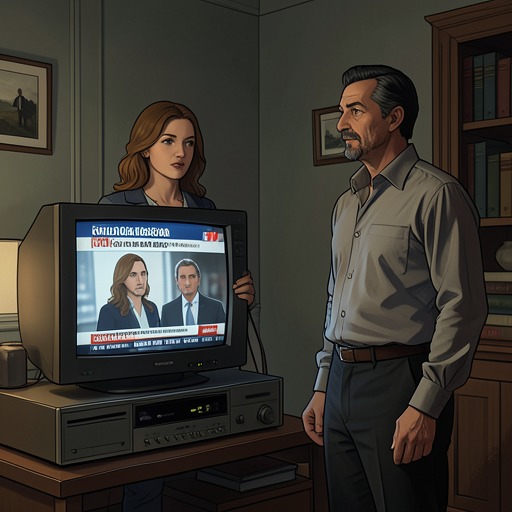
Can You Keep a Secret“The girl on the street” is Jack Harper’s name for the imagined customer at the center of Panther Corporation’s early-stage plan to enter the women’s market. In a television interview, the phrase turns an ostensibly ordinary woman into both a commercial audience and a claim of personal knowledge: Jack says Panther can reach her because he knows who she is, while the interviewers question whether either the company or its male leader can understand her.
A customer imagined for a new product line
Asked whether Panther’s move would amount to a soft drink marketed at women, Jack answers that the company is planning “an entire line”: a drink, clothing, and a fragrance, all shaped by what he calls a strong creative vision. The interviewer’s question assumes a shift from Panther’s established association with men, competition, and masculine values. Jack’s phrase names a different intended audience, not simply a different version of the existing sports market.
He defines that audience as a woman in her twenties who works in an office, commutes by the London Underground, goes out in the evening, and returns home on the night bus. The male interviewer adds that there are thousands of such women. The formulation therefore presents the target as recognizable and numerous: not an exceptional celebrity or specialist consumer, but someone encountered in the ordinary rhythms of work, travel, and social life.
The force of “ordinary”
Jack’s fuller description calls her “just an ordinary, nothing-special girl.” That language makes ordinariness the selling point. The intended customer is not distinguished by a rare ambition or a public identity; she is defined as the familiar woman Panther hopes its new line can address. Yet the phrase also reduces a varied audience to a single representative figure. The interviewer’s suggestion that thousands fit the outline makes the category sound broad, while leaving open how much the outline actually tells the company about those individuals.
The wording acquires further significance because Jack does not present this woman as an abstraction he hopes to learn about. When a skeptical interviewer asks whether “a man like you” can tap into the psyche of an ordinary, nothing-special girl, he replies, “Yes. I can!” He then insists, “I know this girl.” The confidence shifts the phrase from a market label toward a personal claim: Jack presents himself as able to speak authoritatively about women whose ordinary lives differ from his own.
Research, certainty, and the interviewers’ challenge
Jack says Panther has done research and that the company feels it knows its market. The interviewer counters that focus groups and a few questions cannot establish what women think, and asks whether a company associated with masculine values can make the transition to a female market. The exchange sets market research against the limits of presumed understanding: Jack treats the research as only part of a larger picture, but the excerpt does not establish what that larger picture consists of.
When Jack says he knows what the imagined customer likes, eats, drinks, and wants from life, he makes his abstract assurance vivid through small consumer details. She wears a size twelve while wishing to be a size ten, eats Cheerios for breakfast, and dips Flakes in her cappuccino. Such specifics make the “girl on the street” sound sharply observed, yet they also reveal how the supposed knowledge is organized around familiar tastes, routines, and a desire to change her body size. The interview’s tension remains unresolved: these particulars may make Panther’s imagined customer feel recognizable, but they do not answer the interviewer’s underlying question about whether Jack’s confidence amounts to genuine understanding.
Narrative and thematic significance
The phrase condenses the promise and risk of Panther’s proposed expansion. It gives the company a human-sounding target rather than a demographic statistic, and Jack’s account ties that target to an entire line of products rather than to a single drink. At the same time, the interview stages a challenge to the authority behind the description. The woman interviewer repeatedly questions whether a male-led company can know the female customer it wants to reach; Jack answers not by qualifying his claim, but by declaring that he knows her.
As a result, “the girl on the street” names more than a customer segment. It is a carefully ordinary figure through whom the scene tests the difference between designing for women and claiming to know women. The phrase makes Panther’s ambition legible, while the interviewer’s skepticism prevents Jack’s confident portrait from passing as uncontested fact.