Brian
Can You Keep a SecretBrian, known to Emma Corrigan as Dad, is a practical father whose relationship with his daughter turns on two intertwined questions: whether she can stand on her own feet, and whether he has truly seen her. For much of their history, money and family attention complicate their closeness. Their eventual conversation breaks through both kinds of distance: Brian releases Emma from her debt, admits that he and Emma’s Mother may have overlooked her, and tells her plainly that he loves her.
Identity and Family Life
Brian appears in the family sitting room watching cricket with Nev. Emma notices his neatly trimmed greying beard and the beer in his silver tankard. The room’s decorations suggest a household that preserves its family history: Kerry’s swimming cups remain displayed on the wall, and Emma’s Mother polishes them every week. Emma’s own riding rosettes are there too, though she suspects they receive less attention. The contrast is a small but telling detail in Emma’s account of how recognition is distributed within the family.
When Emma arrives, Brian greets her with mock surprise that she has made it without stopping to visit historic cities. His joke meets her assurance that she has arrived safely, establishing an easy familiarity between them even as other parts of their relationship remain strained. The warmth is real, but the memories Emma carries into the house complicate it.
Emma recalls Kerry’s arrival as a child: a red suitcase in the hall, a new voice in the kitchen, and a girl who seemed grown-up in her school uniform. Because Kerry’s mother had died, Emma’s parents urged Emma to be kind to her. They gave Kerry Emma’s room, and the family’s concern for Kerry became part of the circumstances in which Emma learned to defer to her. The memory belongs to Emma’s perspective, but it places Brian within the parental decisions that altered the girls’ household and helps explain why Emma later experiences family attention as uneven.
Money, Work, and Independence
Brian’s relationship with Emma also includes a substantial personal debt. After a disastrous first major business meeting, Emma considers giving up on her job but tells herself she cannot: this is already her third career in four years, and she owes her father four thousand pounds. The debt makes her professional insecurity concrete. Her determination to persist is tied not only to self-worth and self-esteem but also to the obligation she feels toward Brian.
When Emma visits him at home, she gives him a cheque for £300. Brian accepts it and says it can go on the tally, framing repayment as part of learning the value of money and how to stand on one’s own feet. Nev echoes the lesson with a teasing question about Emma’s current career. The exchange combines affection and embarrassment: Brian praises the payment, but the running account keeps Emma’s debt—and her uncertain work history—present in family life.
That earlier insistence on repayment makes Brian’s later offer to cancel the debt a substantial change rather than a casual financial gesture. He tells Emma to forget the money and says that she owes her parents nothing. His words remove an obligation Emma has treated as a reason she must keep going, while also changing the terms on which father and daughter can meet. Independence is no longer measured by continuing to pay him back.
Family Tensions and Acts of Recognition
Kerry’s place in the family remains a source of painful comparison for Emma. During a family gathering, Emma’s Mother discovers Kerry’s brochure for a Paris trip and the accompanying tickets. Kerry explains that the gift is for both parents, including Uncle Brian. Brian responds with delight and praises Kerry. Emma, meanwhile, sees her own flowery card for her mother lying forgotten among the wrapping paper. She realizes Kerry knew that Emma had planned a spa treat and says so; Kerry claims not to remember. The scene presents Brian receiving Kerry’s generous gesture warmly, while Emma is left with the hurt of believing her own effort has been displaced.
Later, when Emma’s parents come to her office, their arrival reverses the ordinary direction of family attention. Brian wears a smart grey suit, and he and Emma’s Mother hold flowers between them as the office watches. They have come to see their daughter in her working world, making their presence both conspicuous and personal. On a walk together, Brian mentions that they saw Jack Harper on television. Emma sharply denies that Jack is her friend, and the parents exchange a glance before the conversation moves on. The visit does not begin with easy intimacy; its importance lies in the fact that they have come and are trying to speak with her.
Reconciliation and Change
Over coffee, Brian’s practical concern first takes the form of a proposed car. He says Emma ought to have one because travelling on buses is unsafe, and invokes Grandpa’s agreement. Emma objects that she cannot afford it and brings up the money she still owes. Brian answers by offering to wipe the slate clean. When she resists, he repeats that she owes them nothing. The insistence interrupts the old pattern in which money stood between his care for her and her ability to accept it.
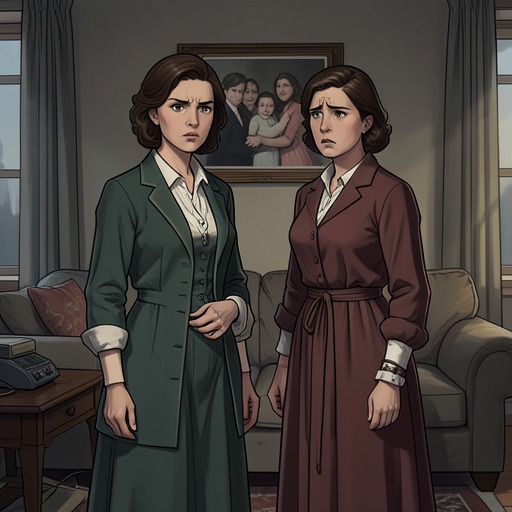
Emma struggles to take in the change. She looks from Brian to Emma’s Mother and back again, and the moment feels to her like seeing one another properly for the first time in years. Emma’s Mother suggests a holiday together the following year. Brian then tries to explain that they may not always have noticed Emma, but falters before he can complete the thought. The unfinished admission matters: his regret is present, though it does not arrive as a polished explanation or erase the family history that preceded it.
Emma’s Mother finally urges him to tell his daughter that he loves her. Brian does so in a choked-up voice and brushes at his eye. Emma says she loves him and her mother too; Emma’s Mother takes Emma’s hand, Emma takes Brian’s, and the three share an awkward group hug. Brian’s emotional directness comes after practical offers and an incomplete acknowledgment, giving the reconciliation its particular shape: material help opens a way into a conversation about attention and affection, but it is the spoken declaration and reciprocal touch that complete the scene.
Narrative Significance
Brian is defined less by a long account of his private life than by the shifting meaning of his gestures toward Emma. The cheque and the tally make care feel entangled with obligation; the later cancellation of the debt separates his support from repayment. The family memories of Kerry show why Emma might doubt that she has been noticed, while the office visit and proposed holiday show her parents making concrete attempts to reach her.
The reconciliation does not make the past disappear. Instead, it changes what the family can acknowledge: Brian can admit that he and Emma’s Mother may have overlooked Emma, and he can say what his daughter has needed to hear. His movement from lessons about money to forgiveness, and from hesitant speech to an explicit declaration of love, makes him central to the repair of Emma’s relationship with her parents.