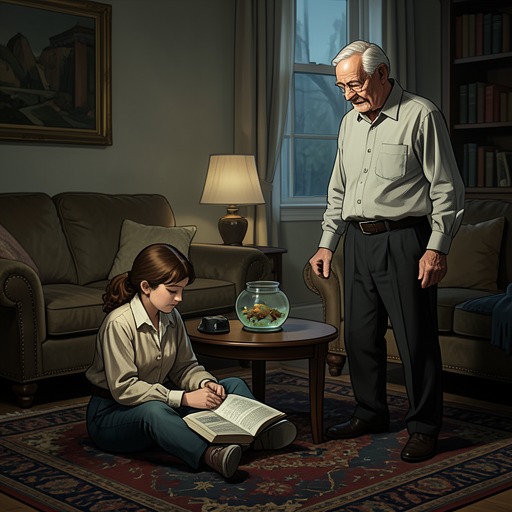
Emma Corrigan and Grandpa
Can You Keep a SecretEmma Corrigan and Grandpa share a warm, familiar bond expressed through visits, small acts of care, and a moment of shared work among his keepsakes. When Emma comes to see him in his annexe, she brings Panther Bars and tries to clear some of the clutter. The task turns unexpectedly intimate when an old photograph brings back her childhood family life and the changes that followed Kerry’s arrival.
Identity and Household Setting
Grandpa is Emma’s maternal grandfather. He has lived with the family since undergoing heart surgery ten years earlier. At the family’s former house in Twickenham, he had only a bedroom; in their larger home, he has an annexe of his own, with two rooms and a tiny kitchen. The separate space gives him room for his belongings, though the account presents it as crowded: about six cardboard packing cases stand on the floor, and the clutter leaves both him and Emma unsure where to put another box.
The setting conveys both closeness and independence. Grandpa is part of the household, but has a defined space of his own, where he sits in his favourite leather armchair listening to classical music. Emma enters through the side gate and knocks at the annexe door, bringing her into his private room rather than simply encountering him in a shared family space. Their visit unfolds there, among the possessions he has accumulated and is reluctant to discard.
Affection and Practical Care
Emma greets Grandpa directly and bends to kiss him. He welcomes her with delight, calls her his darling girl, and squeezes her hand. The description notices his dry, cool skin and hair that has grown whiter since Emma last saw him, grounding their affection in the visible passage of time. Grandpa’s pleasure at seeing her is immediate, and his praise of her as a good girl follows a familiar exchange of kindness rather than any grand declaration.
Emma has brought a box of Panther Bars. Grandpa is completely addicted to them, as are his friends at the bowling club, and Emma uses her allowance to buy a boxful whenever she comes home. The present is therefore both a specific pleasure and a repeated form of attention: Emma remembers what he likes and brings enough to share with his friends. When she asks where to put the bars, the two of them look helplessly around the crowded room. Her practical gift meets the physical reality of his crowded space, and their shared helplessness gives the scene a light, affectionate awkwardness.
Keepsakes and Shared Attention
Emma tries to help Grandpa sort his possessions, asking where the things to be thrown out are. He avoids her gaze when she presses him to discard old newspaper cuttings. She then finds a yo-yo and assumes it is rubbish. Grandpa reaches for it, his eyes softening, and explains that it belonged to Jim, someone Emma has never heard of. He says he never saw Jim again and has never forgotten him. The yo-yo, unremarkable to Emma at first, carries a relationship and a memory that its appearance alone does not reveal.
Old Christmas cards prompt Grandpa to explain why he keeps such things: people he has known and loved have begun to die, and even a small memento can be worth holding on to. Emma is touched by this reasoning, but still distinguishes sentimental keepsakes from items she considers disposable. She identifies a card from Smith's Electrical Maintenance dated 1965, another from Southwestern Gas Supplies, and old copies of Punch as things he does not need to retain. Their exchange shows a difference in how they judge the clutter: Emma approaches it as a sorting problem, while Grandpa sees at least some of its contents as traces of people and time.
The Photographs and Emma’s Family Past
The distinction becomes harder for Emma when she reaches an envelope of photographs. She begins to ask whether the pictures show anything Grandpa really wants to keep, then stops at an image of herself with her mother and father on a park bench. Emma is about nine, sitting on her father’s knee and eating an ice cream; her mother wears a flowery dress, and her father a sunhat. The family appears happy together. In another photograph, Emma is wearing her father’s hat, and the three of them are laughing. The pictures change the tone of the sorting: these are not anonymous scraps but images of a childhood that Emma recognizes as precious.
Emma identifies the remembered scene as belonging to a time before Kerry came into their lives. Her recollection gives the photographs a history beyond the moment they depict. Kerry arrived with a red suitcase, a new voice in the kitchen, and an unfamiliar perfume. Emma remembers her as a stranger in school uniform who nevertheless seemed grown-up, and recalls that her parents urged her to be kind because Kerry’s mother had died. Kerry was given Emma’s room. The family’s appeal to kindness thus sits alongside a concrete change in Emma’s place at home.
The photographs also recall the park where Emma’s family once went to use the swings and slides. Kerry found it boring; Emma wanted desperately to be like Kerry, so she said it was boring too, and the family stopped going. In this remembered detail, the change is not only that Kerry entered the household. Emma also recalls adapting her own preferences in order to imitate her. The grandfather’s box of pictures consequently brings together an earlier image of family happiness and Emma’s later memory of how she adjusted to a new family member.
Significance of the Relationship
Grandpa’s collection gives Emma a point of entry into memories that are her own as well as his. His explanation for keeping cards and his tenderness toward Jim’s yo-yo establish that objects can preserve attachments for him; the family photographs make that principle newly personal for Emma. The scene does not resolve their different approaches to sorting. Instead, it lets Emma move from jokingly insisting that Grandpa throw things away to recognizing, through the pictures, what can be lost when a small object is treated as worthless.
Their relationship is conveyed through this ordinary encounter rather than through a full account of their history together. Emma brings him a favourite treat, greets him affectionately, and tries to help; he welcomes her, praises her, and shares the memories attached to what he has kept. The visit makes Grandpa more than a recipient of care: his possessions and recollections help Emma recover a particular picture of her earlier family life. In turn, her reaction shows how a practical visit can become an encounter with the past that she had not set out to revisit.