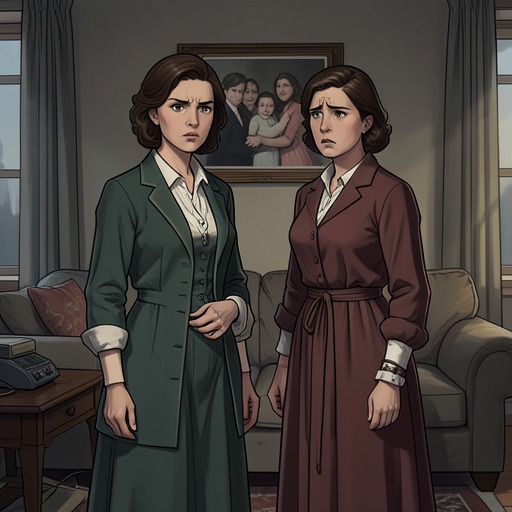
Emma Corrigan and Kerry
Can You Keep a SecretEmma Corrigan and Kerry are cousins whose relationship combines everyday family proximity with a long-running imbalance in Emma’s sense of belonging. Kerry entered Emma’s household after her own mother died, and Emma remembers being displaced by the newcomer; years later, Kerry’s apparent ease and family standing still make Emma feel outmatched. A birthday gathering brings that history into the present, as an apparent clash over a gift revives Emma’s conviction that Kerry has always been able to wrong-foot her.
Childhood and Kerry’s Arrival
Kerry’s arrival is a defining memory for Emma. She recalls the red suitcase in the hall, a new voice in the kitchen, and a girl she initially experienced as a stranger. Though Kerry wore school uniform, Emma thought she looked grown-up: she was older in appearance, wore gold studs and streaks in her hair, and was allowed a glass of wine at supper. The adults emphasized that Kerry’s mother had died and that everyone needed to be kind to her. Emma understood this as a reason to accommodate Kerry, including giving up her own room to her cousin.
The family photographs Emma looks through years later make the change feel like a before and after. In one, she is about nine, sitting on her father’s knee while her parents sit beside her on a park bench; in another, the three of them laugh together. Emma’s thought that the photographs show the family before Kerry came into their lives expresses her sense of loss, not simply a neutral chronology. The park itself carries a smaller version of the same adjustment: Kerry found it boring, and Emma, eager to be like her, began saying so too. They stopped going. In Emma’s recollection, even her preferences were bent toward Kerry’s, as she tried to preserve closeness by imitating the cousin who seemed to set the terms.
Family Proximity and Unequal Belonging
As adults, Emma and Kerry remain near one another. Emma’s parents have moved from Twickenham to a village in Hampshire, and Kerry and her husband, Nev, live in another village about five minutes away. Kerry sees Emma’s parents often. When Emma arrives for her mother’s birthday, she finds Kerry beside her in the kitchen, sharing an easy familiarity that Emma notices immediately. Their matching feather-cut hairstyles, brightly coloured tops, and laughter make them appear, in Emma’s eyes, more like mother and daughter than aunt and niece.
Kerry’s welcome for Emma is warm in manner: she says that they do not see enough of one another, while Emma’s mother agrees. Yet Emma’s internal response is distrustful. She does not take the affectionate surface as evidence that Kerry will support her. That contrast matters to the relationship: their family setting presents them as close, almost sisterly companions, while Emma privately experiences the closeness as a space where Kerry has the advantage and Emma’s grievances go unrecognized.
Work, Comparison, and Resentment
Emma’s sense of being second to Kerry also enters her working life. When Emma was desperate for a job, she asked Kerry for work experience at her company. She wrote a careful letter acknowledging that the request might put Kerry in an awkward position and said that even a few days of running errands would help. Kerry sent back a standard rejection letter. Emma felt deeply embarrassed and kept the rejection from her parents. The episode gives her suspicion a concrete basis: whatever Kerry’s later friendliness may suggest, Emma remembers a time when she asked for help and received a formal refusal.
At the birthday lunch, Emma’s father tells her she should pay attention to Kerry’s business advice and implies that doing so might help her improve her life. The comparison reinforces Emma’s sense that the family regards Kerry as the more competent guide and Emma as the one who needs correcting. Emma’s own professional ambition is already charged with a desire for family recognition: a promotion to Marketing Executive would, she hopes, show her parents and Kerry that she is not a failure. Her repeated resolve to wait until she is promoted is less a direct confrontation with Kerry than a private answer to the ranking she feels imposed on her.
The Birthday Dispute
The clearest adult rupture occurs when Emma sees her mother’s birthday presents. Emma has brought a spa treat and believes she had told Kerry about it months earlier, during a conversation in the garden. Kerry’s gift appears to overlap with that plan. Emma sees the brochure in her mother’s hands and her own card forgotten among the wrapping paper; she concludes that Kerry knew and has taken the moment from her. The text establishes Emma’s recollection of having told Kerry and her certainty about what the overlap means, but Kerry denies remembering the conversation. Her denial leaves the question of intention unresolved.
Emma blurts out that she had already told Kerry about the spa present. Kerry responds as if she has no memory of it and offers an apology if she has spoiled anything. Emma’s mother quickly smooths the disagreement over, insisting that both presents are lovely and that she does not want the cousins quarrelling on her birthday. She describes them as best friends. This public settlement does not settle the matter for Emma: she tries to smile, but feels like a child again, unable to win while the family takes Kerry’s side. She then looks at her watch and calculates how soon she can leave, turning the remainder of the visit into something to endure.
A Rivalry Beneath the Family Story
The relationship is shaped by a difference between how the family frames Kerry’s place and how Emma remembers its consequences. Kerry’s bereavement gave the adults a reason to protect and accommodate her; Emma’s memory holds onto the room she surrendered, the park she stopped visiting, the unanswered possibility of work experience, and the birthday gift that seemed to eclipse her own. None of these details alone proves a deliberate campaign by Kerry. The birthday dispute, especially, rests on Emma’s conviction and Kerry’s denial rather than a confirmed confession of intent.
That uncertainty gives the rivalry its particular force. Emma is hurt not only by what Kerry may have done, but by the repeated feeling that her account will not prevail: her mother minimizes the dispute, her father points her toward Kerry’s advice, and the family’s language of closeness sits beside Emma’s private expectation of losing. In the scenes presented, the bond remains unresolved. The birthday visit ends with Emma managing her hurt and looking for a way to leave, not with a reconciliation or an acknowledged change between the cousins.