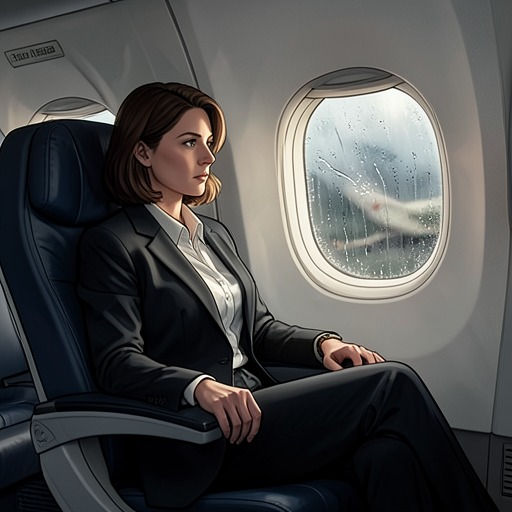
Emma Corrigan's fear of flying
Can You Keep a SecretEmma Corrigan’s fear of flying is a concealed vulnerability that moves from private embarrassment to acute distress as a flight becomes turbulent. Before boarding, she tries to steady herself with reassurance and vodka; once the plane bumps, the abstract fear becomes physical and immediate. Her admission that she is frightened, and her sudden need for someone reassuring, reveal how much effort she has spent presenting the fear as insignificant.
Identity and Background
Emma’s fear is not described as an inability to fly. She distinguishes it from a phobia: she can get on a plane, but would rather remain on the ground. That qualification matters because it shows the fear operating alongside ordinary functioning, and helps explain why she has not treated it as something that others need to know. She considers it lame and irrational, not a legitimate reason to ask for support.
The anxiety has developed gradually over the preceding few years. Emma says she did not used to be scared; the change has been incremental rather than attached in the account to a single incident. She recognizes that flying is statistically safe, noting that thousands of people do it each day and that a crash is less likely than finding a man in London. The comic comparison shrinks the danger on paper without diminishing her actual unease. She can reason against the fear and still feel it.
Before the Flight
With forty minutes remaining before departure, Emma is at a bar, having put her phone away. She runs her fingers through her hair, checks the clock behind the bar, and takes a deep gulp of vodka, draining her glass. The small sequence gives the anxiety a bodily and behavioral form: time is being counted down, nervousness is creeping in, and drinking accompanies an attempt to get through the wait. Her repeated reassurance that everything will be fine is not evidence that she feels calm; its recurrence marks how hard she is trying to persuade herself.
Her denial also falters in stages. Emma first insists that she is not frightened, trails off, and then acknowledges that she is. The admission is brief but decisive: the fear is no longer something she can keep outside her own account of the situation. In the numbered section devoted to the subject, she states that she has never told anyone about being scared of flying. Her silence is tied to embarrassment and minimization, rather than to an assertion that the fear has disappeared.
Turbulence and the Search for Reassurance
Once aboard, a bump in the plane changes the fear’s character. Emma notices a hostess staggering as the aircraft moves and immediately wonders why the plane is bumping. The question registers a sudden loss of composure: what could remain a general dislike while waiting now demands an explanation in the moment. The aircraft becomes, in her perception, a large enclosed box thousands of feet above the ground, with no way to escape. Height, confinement, and helplessness converge in a single image.
Emma describes the rush of fear as arriving without warning and calls the situation madness. Her response is not simply to repeat the safety statistics she already knows. Instead, she recognizes that she cannot do this on her own and feels an overpowering need to talk to someone reassuring and safe. She thinks of Connor. This turn from abstract reasoning to a desire for interpersonal comfort shows that knowledge of the odds cannot supply the kind of security she is seeking in the moment.
Concealment and Narrative Significance
The fear exposes a gap between Emma’s outward account and her private experience. She has kept it from everyone because she thinks it sounds foolish, yet the pre-flight effort to reassure herself and the intense reaction to turbulence demonstrate that it is consequential to her. Her ability to board a plane does not cancel the fear; it makes the vulnerability easier for her to dismiss and conceal until circumstances bring it sharply forward.
The sequence also sets Emma’s self-sufficiency against her need for reassurance. Before the flight, she tries to manage the anxiety alone, using self-talk and vodka; in the turbulence, she admits that she wants someone safe. Connor is the person who comes to mind, but the evidence establishes the impulse to seek him, not what he does in response. The fear therefore reveals both a private source of distress and a relational need, while leaving the outcome of that appeal unstated.