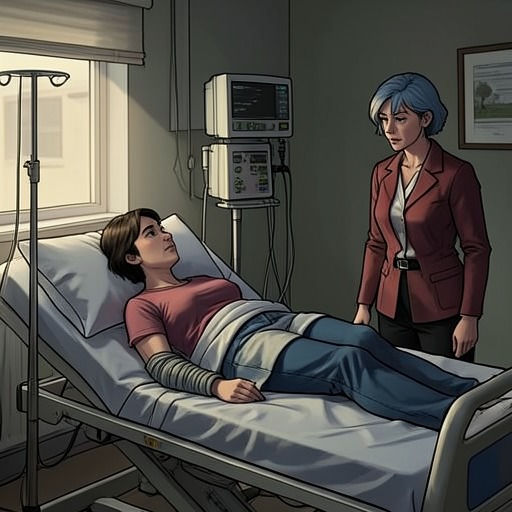
Emma's public humiliation
Can You Keep a SecretEmma's public humiliation is not confined to Jack Harper's televised disclosure: it unfolds as private confidences become public entertainment, workplace gossip, and a crisis of trust. The sequence also exposes the gap between Emma's efforts to manage how others see her and the intimate, imperfect self that Jack makes available to an audience without her consent.
Before the Exposure
Emma's discomfort with appearing uninformed at work offers an early glimpse of the self-presentation that the later exposure will overturn. During a business discussion with Doug Hamilton and another man, she adopts a relaxed professional manner and asks Doug to recap what has been said, while silently wishing for the explanation in plain English. The moment is small, but it establishes the strain between projecting competence and admitting confusion.
That strain also appears in her personal life. As Emma and Connor Martin prepare to live together, Connor suggests they begin calling each other darling, explaining that their commitment has made the absence of endearments noticeable to him. The exchange shows a relationship negotiating intimacy through awkward speech rather than effortless romantic convention. Later, Emma tries to contain what Jack knows by describing their conversation on the plane as having taken place under duress and in extreme circumstances. She insists that she said many things she did not mean. Her clenched fists and determination to explain signal that the confession is already difficult to take back; the television disclosure will make that private conversation impossible to contain.
Private Details Become a Public Performance
Watching Jack's interview, Emma experiences the disclosure as a nightmare of exposure: she cannot tear herself away while her personal secrets are revealed on television. The details are not abstract. Jack mentions her lucky underwear on first dates, borrowed designer shoes passed off as her own, her claim to kick-box, uncertainty about religion, and worries about her breasts. The accumulation turns self-conscious habits and insecurities into a public inventory.
The Barbie bedcover becomes a particularly sharp emblem of the violation. When Jack mentions it, laughter roars through the room; Emma buries her face in her hands, mortified that anyone has learned about something she believed no one was supposed to know. The interview then shifts toward whether she is sexy. Jack describes her as sexual and says that she carries condoms in her purse. That answer makes the exposure more complicated than a simple catalogue of embarrassment: the audience's attention now turns to an intimate image of Emma that Jack has publicly supplied.
The Workplace Aftermath
Once the interview ends, humiliation follows Emma back into the office. She leaves her desk and hurries down the corridor and toward the stairs as colleagues returning to their offices stare at her. Her father has urgently asked to speak with her, but she says she cannot talk to anybody. On the stairs, Fiona, a woman Emma barely knows, grabs her arm and urges her not to be ashamed of her body, inviting her to a Saturday workshop. Emma tears herself away in horror. The exchange shows how even an attempted gesture of support can feel like another unwanted claim on her exposed body and attention.
The public attention does not disappear when Emma tries to believe it will. Entering the foyer with some optimism, she hears a man from Accounts discussing her Barbie bedspread with a visitor, while women on the stairs gossip about her relationship with Jack and express pity for Connor. At another point, colleagues sing Close to You in unison as she looks up; she refuses to react and turns to her email, only to find ninety-five messages where she would normally expect about ten. The repeated song, the gossip, and the sudden volume of email show how the interview is reproduced through everyday office behavior. The broadcast may have ended, but other people continue to circulate and perform its contents.
Betrayal and the Meaning of the Humiliation
The exposure coincides with the collapse of Emma's understanding of her romance. Looking at her reflection, she thinks that the perfect man was a cynical user and the dreamy relationship a fabrication; she describes herself as a humiliated laughing stock. These conclusions are her immediate response to the upheaval, not a settled account of what Jack intended. Her confrontation with him makes the distinction clear: she accuses him of feeding her an extraordinary romance, making her care for him, and using her for research, while Jack replies that she has misunderstood and that he did not set out to use her.
The force of the episode lies in the collision between intimacy and audience. The disclosures are humiliating because the details were shared in confidence, but they also expose the vulnerability beneath Emma's carefully managed professional and romantic images. Her efforts to minimize what happened, remain calm in the foyer, and avoid reacting to the chorus cannot restore privacy once colleagues have turned the revelations into a shared joke. The public humiliation therefore becomes both a social ordeal and a rupture in trust: Emma must confront not only that strangers and coworkers know her secrets, but that the person who knew them through intimacy has made them public.