Family approval and reconciliation
Can You Keep a SecretFamily approval and reconciliation are not a simple return to an untroubled family life in Emma Corrigan's story. The movement toward repair follows years in which Emma felt displaced and overlooked, and it becomes real through particular acts: her parents acknowledging her, Brian telling her she owes them nothing, and the family reaching for one another across a table. The ending offers a beginning again, not proof that every old hurt has disappeared.
Early Family Dynamics
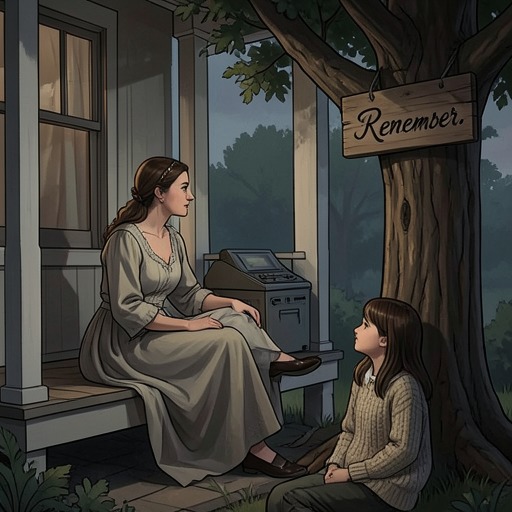
Emma's memories trace her sense of exclusion to Kerry's arrival. She recalls the red suitcase in the hall, an unfamiliar voice in the kitchen, and Kerry, still in school uniform but seeming grown-up to her. Emma's Mother and Brian urged Emma to be kind because Kerry's mother had died; Kerry was given Emma's room. The memory sets care for a bereaved child beside Emma's own loss of space and attention. The evidence does not establish that her parents meant to reject Emma, but it shows how the family arrangement became part of her understanding of where she stood.
The photographs Emma looks through sharpen that contrast. One shows her with Brian and Emma's Mother, wearing Brian's hat as the three of them laugh together. Emma remembers the picture as belonging to a time before Kerry entered their lives. Another recollection concerns a park with swings and slides: Emma found it enjoyable, but Kerry thought it boring. Wanting to be like Kerry, Emma agreed, and the family stopped going. These details make the imbalance more than a general feeling; Emma remembers adapting her preferences in order to follow Kerry's lead, while the earlier image of the three of them preserves a picture of belonging she feels she has lost.
Repeated Disappointments
The dispute over a spa treat for Emma's Mother brings the old pattern into the present. As Emma's Mother looks through the brochure, Emma notices that the card she made is forgotten among the wrapping paper. She then realizes that Kerry knew about the gift: Emma remembers telling her months earlier, during a conversation in the garden. When Emma confronts her, Kerry casually says she does not remember. The scene leaves Kerry's intention unresolved, but records Emma's conviction that a private confidence and a personal effort have not been given due attention. The forgotten card and Kerry's denial turn a family gift into a test of whether Emma has been heard.
A separate grievance surfaces at dinner, when Jack Harper asks Kerry about the difficult decision of turning Emma down, referring to the time Emma applied for work experience at Kerry's firm. He presents the two women as close and recalls the refusal directly. Kerry laughs and begins to deny what he means. The exchange puts an earlier professional disappointment into the family conversation and shows that Emma's sense of unfair treatment extends beyond childhood comparisons. Jack's intervention makes the refusal explicit in Kerry's presence; the available scene does not show a resolution, but it brings a previously consequential rejection into view.
A Change in the Family Relationship
The reconciliation takes shape when Emma's parents tell her to forget the money she owes them. Brian insists that she owes them nothing. Emma looks from him to her mother and back, struggling to take in what they are saying. The moment is significant both materially and relationally: a debt that had remained between them is set aside, and Emma experiences the conversation as if the three are seeing one another properly for the first time in years and starting again.
Emma's Mother proposes that they take a holiday together the following year. Emma checks whether this means just the three of them, a question that echoes her remembered photographs of the family before Kerry arrived. Yet the family is not simply returning to its earlier arrangement. Emma's Mother also says Kerry sends her love and may visit her father in Hong Kong, whom she has not seen for at least five years. Emma takes in the altered family situation as a rearrangement in which nothing is quite as it was before. The suggested holiday and Kerry's possible visit point toward separate relationships being reconsidered, rather than one fixed family configuration being restored.
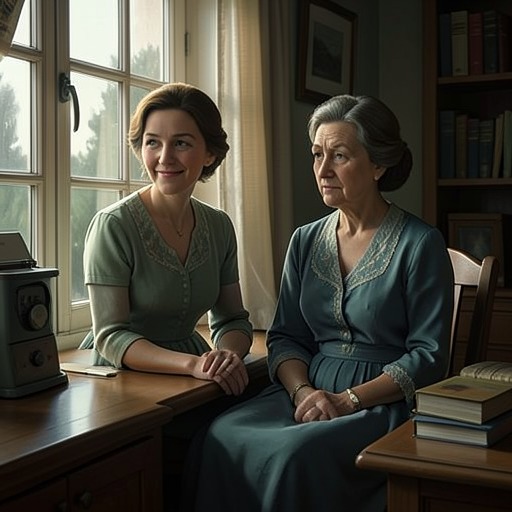
The most direct repair comes when Emma's Mother urges Brian to tell his daughter that he loves her. Brian says he loves Emma in a choked voice, and Emma answers that she loves him and her mother too. Emma's Mother takes Emma's hand; Emma takes Brian's, and the three share an awkward group hug. The physical gesture follows words that had been difficult for Brian to say, making affection explicit after a conversation marked by pauses and hesitation. Emma's Mother says she knew coming was not a mistake, framing the meeting itself as an act that has made this exchange possible.
Approval and Reconciliation
The parents' declaration that they are proud of Emma answers a need distinct from the financial question. Brian's offer to release her from the debt removes an obligation, while the statement of pride recognizes Emma herself. Her response is nearly tearful, and the later exchange of love gives the approval a personal form that earlier family encounters had not supplied. Reconciliation here depends on recognition as well as practical relief: Emma must hear that her parents see value in her, not merely that she is no longer indebted to them.
The scene does not erase the history of Emma's room being given to Kerry, the park abandoned to match Kerry's preference, the spa card overlooked, or the work-experience refusal raised at dinner. Instead, it places those accumulated hurts beside a new conversation in which the family can acknowledge affection and imagine time together. The contrast gives the ending its force: Emma's remembered family photographs preserve closeness as something once present, while the awkward hands joined at the table make renewed closeness a current, imperfect action. Family approval and reconciliation thus emerge not as a return to sameness, but as a change in what Emma and her parents can say and offer one another.