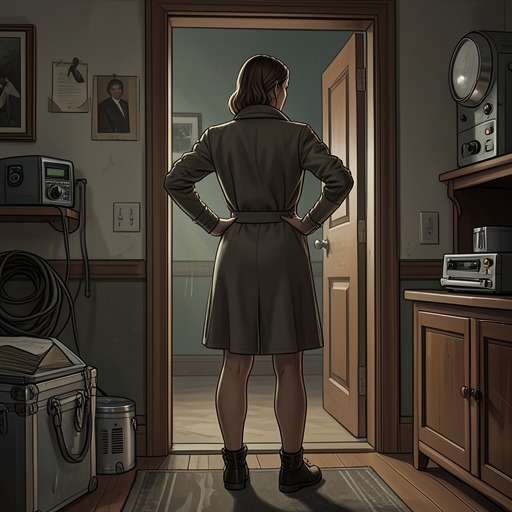
Grandpa
Can You Keep a SecretGrandpa, Emma Corrigan’s maternal grandfather, is a warm, settled presence in her family’s home. His life is marked by a close bond with Emma, familiar domestic routines, and an affectionate protectiveness that sometimes prompts her to reassure him with a promise she does not mean to keep. Through him, the story links family intimacy to everyday objects and habits: a box of Panther Bars, a telephone answering machine, and the rooms where several generations live alongside one another.
Identity and Home
Grandpa has lived with Emma’s family since undergoing a heart operation ten years earlier. At their former house in Twickenham, he had a bedroom; in their larger current house, he has an annexe attached to the side, with two rooms and a tiny kitchen. The arrangement gives him a distinct domestic space while keeping him part of the household. When Emma visits, he is in his favourite leather armchair, classical music playing on the radio, with about six cardboard packing cases on the floor in front of him.
These details establish his setting through ordinary, specific comforts rather than through a formal account of his past. The armchair and radio make the annexe feel personally inhabited, while the boxes suggest that belongings are being handled or sorted. Grandpa’s home is not separate from the family’s story: Emma enters it carrying something for him, and the visit becomes one of the scenes through which her affectionate family ties are made visible.
Emma’s Affection and Everyday Care
Grandpa’s response to Emma is immediate and tender. He looks up, his face lights up, and he invites her closer; she bends to kiss him, and he squeezes her hand. Emma notices that his skin feels dry and cool and that his hair is whiter than the last time she saw him. The physical details register the passage of time, but the scene’s emotional centre is their ease with one another: his delighted welcome and her familiar gesture of affection.
Emma brings him Panther Bars. He is devoted to the energy bars, as are his friends at the bowling club, and Emma spends her allowance on a boxful whenever she comes home. The gift is therefore more than a treat: it is a repeated act of attention shaped around something Grandpa enjoys and shares with his friends. His pleased thanks and praise for Emma complete the exchange, showing how readily their affection moves in both directions—from her practical generosity to his openly expressed fondness.
Habits, Messages, and Concern for Emma
Their connection continues over the telephone. Emma arranges for a money-off coupon advertisement for Panther Bars to appear in Bowling Monthly because Grandpa reads it, and she calls to tell him that he and his friends will be able to stock up more cheaply. When the answering machine begins, she assumes she is leaving him a message; he then answers, explaining that he has been screening calls. He treats listening to friends’ messages and laughing at them as a new hobby, bringing a teasing, sociable note to an otherwise ordinary call.
The conversation turns from the coupon to his worry about Emma’s safety. After seeing a news report about muggings in central London, Grandpa asks her to promise that she will not use London transport. Emma hesitates, says she will, and crosses her fingers as she does so. The small deception shows both sides of their relationship: his concern is sincere, while she loves him enough to avoid a direct confrontation but does not intend to follow his instruction. Her affectionate goodbye and his equally loving reply keep the exchange warm, even as it exposes the gap between his anxieties and her independence.
Family Memory and Narrative Role
Grandpa’s rooms also hold family material that can open onto Emma’s memories. While sorting through cards and old papers in a box, she finds photographs of herself as a child with her parents: one shows her on her father’s knee, eating an ice cream, and another captures the three of them laughing. The pictures make her stop. They recall a time before Kerry entered the family and bring back the park they used to visit, which Emma later called boring because she wanted to be like Kerry. The photographs belong to a domestic scene of sorting, but their effect is inward: they recover a happier image of Emma’s earlier family life and sharpen the contrast with the changes that followed.
Grandpa is not the cause of those changes, and the scenes do not make him their interpreter. His significance lies instead in the affectionate continuity he offers within the family home. Emma comes to him with gifts, remembers the family past among the things being sorted, and receives his concern in a form she can answer with a half-truth. Together, these moments present him as a loved elder whose everyday presence connects Emma’s present relationships with the childhood memories still held in the household.