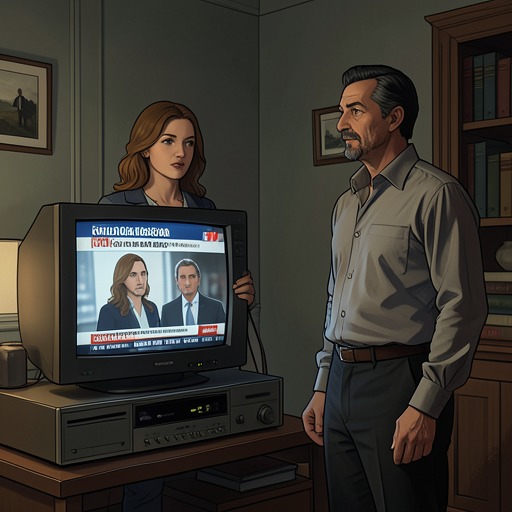
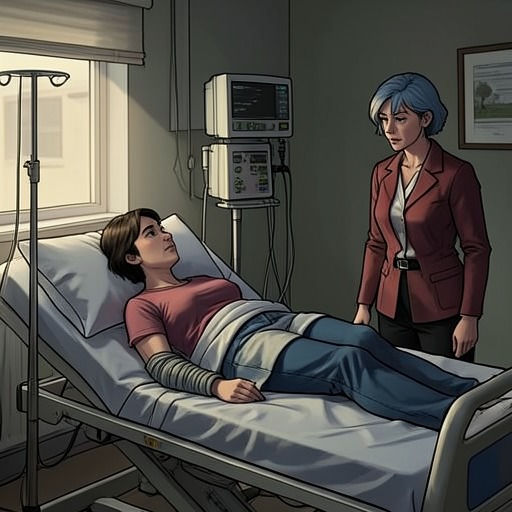
Jack Harper reveals Emma’s secrets on television
Can You Keep a SecretJack Harper’s televised disclosure of Emma Corrigan’s secrets turns private confidence into public spectacle. As Emma watches with colleagues and people close to her, the broadcast exposes details she had shared in confidence, then shifts into a more compassionate account of her hopes and fears. The moment’s force lies in that double movement: her privacy is breached, but the portrait Jack gives is not reducible to the embarrassing disclosures that first make her feel exposed.
Background: Performing Confidence
The interview’s exposure gains meaning against the self-presentation that already surrounds Emma. In a business conversation, she responds to unfamiliar corporate jargon with cheerful agreement even though she does not understand it. At Panther Corporation, employees are likewise told to appear natural while working to the department’s highest standards when Jack visits. His arrival changes ordinary office behavior into a performance: Emma holds her head unusually high, Artemis adopts a brisk, studious manner, and a colleague turns from the sports pages to documents. The gap between inner uncertainty and an outwardly composed image is therefore established well before the interview reveals Emma’s private thoughts.
That gap also appears in her personal life. When Connor Martin gives her a glass teapot connected with the prospect of their living together, Emma tells him she cannot move in. The moment shows her struggling to say something consequential directly, while the televised scene reverses the terms: intimate truths she had disclosed elsewhere are now spoken by Jack, beyond her control. These episodes are distinct, but together they make the broadcast part of a larger pattern in which Emma’s private feelings and public presentation fail to remain aligned.
The Broadcast’s Changing Portrait
At first, the interview makes Emma feel trapped in a public display. She cannot turn away as Jack’s voice continues, and she struggles to take in the personal information he is revealing. The details include her presentation of herself and private insecurities; what matters in the scene is not merely that any one fact is embarrassing, but that a collection of confidences is being presented to an audience without her consent. A roar of laughter follows one disclosure, and Emma hides her face. The reaction makes the room’s spectators part of the event: they are no longer simply watching a television programme but watching Emma receive its revelations.
The exchange becomes more acute when the interviewer asks whether Emma is sexy. Jack answers by describing her as sexual and mentions that she carries condoms in her purse. The attention in the room swivels toward her. The broadcast then raises her private dream about her flatmate Lissy, and Emma tries to correct the distinction between a dream and a fantasy. Her urgent response cannot stop the transmission. She imagines Lissy watching at home and recognizing herself in the disclosure, extending the harm beyond Emma’s immediate embarrassment to the possibility of damage to a friendship.
Jack’s account then changes register. He speaks of Emma’s belief in love and romance, her expectation that life might become exciting, and her ordinary hopes, fears, and worries. He also identifies her longing for approval from people important to her and the possibility that she feels unloved. Emma watches his warm, serious expression and feels close to tears. The interview thus discloses more than a catalogue of comic or awkward particulars: it offers an interpretation of the vulnerability beneath them.
Exposure and Audience
Emma’s shock is intensified by the different audiences gathered around the same broadcast. Her mother is watching, and Emma cannot bring herself to look at Connor. The people in the room include faces she reads as sympathetic, curious, gleeful, or relieved not to be in her position. Their varied expressions turn private exposure into a social event whose meaning Emma cannot manage. She compares her helplessness to that of a zoo animal: she is visible to others, but cannot withdraw from their gaze or control what they make of what they see.
The scale of the broadcast also matters, though the scene presents it through Emma’s overwhelmed perception. She imagines it playing on televisions in homes everywhere. The feeling of limitless exposure contrasts with the intensely personal material being aired: confidences once bounded by private conversation now seem impossible to retrieve. Her attempt to protest the description of her dream offers a brief effort to reclaim the meaning of what has been said, but it cannot undo the disclosure or reach the imagined audience.
Aftermath and Significance
Near the end of the interview, Jack describes Emma as brave and goodhearted and says that she faces life directly. He then appears dazed, apologizes, and begins to ask for the interview to be stopped; his voice is cut off by the interviewer. The praise does not cancel the breach. Instead, its tenderness sits uneasily beside the fact that Jack has exposed Emma’s private life before she could choose what to share. The contrast leaves the scene morally complicated: he presents a sympathetic understanding of her, but the broadcast’s reach and Emma’s distress remain plain.
When the programme ends, someone switches off the television. The room stays silent for several seconds while everyone looks at Emma, seemingly waiting for her to respond. The abrupt quiet does not restore privacy; it makes the aftermath visible, as the gathered audience turns from the screen to the person it has just watched being discussed. The sequence closes not with an explanation from Emma but with her awareness of being scrutinized. The interview therefore brings the book’s tension between secrecy and disclosure into public view: the facts revealed matter, but so does the loss of control over who hears them, how they are framed, and what the people present will do with them.