
Candide Against Military Violence
CandideThis thread follows the book’s repeated exposure of war as organized slaughter, from Candide’s conscription to his observations in Europe.
increasing Bearing strength in each event
 decreasing
Bearing strength in each eventdecreasingRecruitment as Hospitality
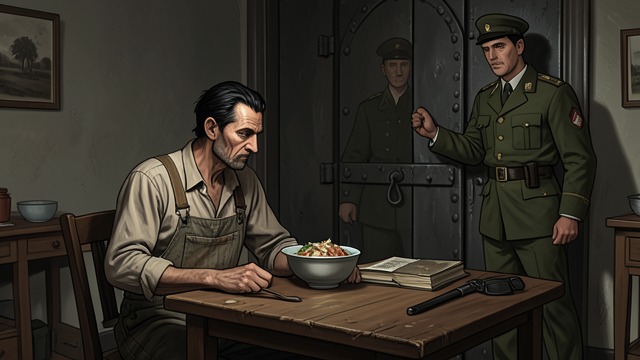
Recruitment as Hospitality
A deceptive welcome
Bulgarians invite the hungry Candide to dinner and ask whether he loves their king. His innocent agreement becomes the pretext for forced enlistment.
The body disciplined
Military training turns movement into command and punishes disobedience with blows. Candide discovers that war begins not only on a battlefield but through institutions that seize people.
The Battle’s Pageantry
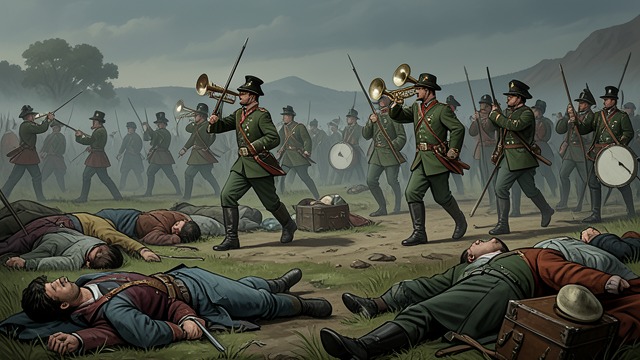
The Battle’s Pageantry
Violence staged as music
Trumpets, drums, and cannon accompany a battle that kills thousands. Both monarchs order religious thanksgiving while the combatants’ bodies lie on the field.
Satire of military honor
The spectacle exposes the distance between ceremonial glory and mass death. Candide flees, unable to reconcile the proclaimed heroism with the physical cost.
Villages Under the Laws of War
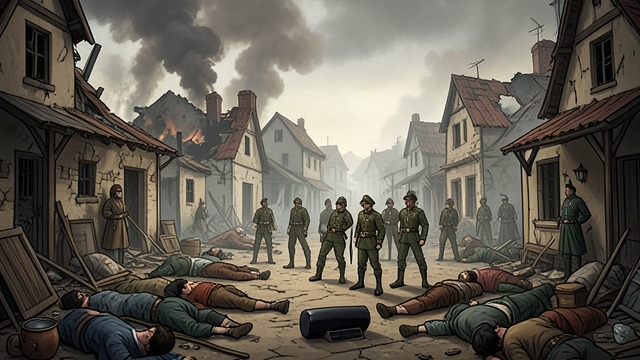
Villages Under the Laws of War
Reciprocal destruction
Candide passes through a burned Abarian village and then a devastated Bulgarian one. Civilians are killed, assaulted, and left among the ruins.
The language of legitimacy
The destruction is described as conforming to the laws and usages of war. That legal framing intensifies the satire: organized violence can be authorized without becoming humane.
Colonial Conflict in Paraguay

Colonial Conflict in Paraguay
A new military assignment
Candide’s drill experience wins him command of a company bound for Paraguay. The expedition is meant to suppress Jesuits accused of encouraging rebellion against Spanish and Portuguese rule.
Repeating the pattern
Candide reaches another conflict before he has recovered from earlier ones. The political causes change, but armed force again organizes competing claims to territory and authority.
An Admiral Made an Example

An Admiral Made an Example
Punishment for failure
Candide sees Admiral Byng shot by firing squad. The explanation is that he failed to bring the enemy close enough to defeat, and the execution is intended to encourage other commanders.
Institutional violence at home
The scene shows military discipline extending beyond the battlefield into public punishment. Candide is so appalled that he refuses to go ashore in England.
After Candide is expelled from the castle
During the Bulgarian-Abarian campaign
Immediately after the battle
After Candide escapes Buenos Aires
During Candide’s brief arrival in Portsmouth
