
From Optimism to Practical Labor
CandideThis thread traces the novel’s philosophical movement from Pangloss’s universal explanation through Candide’s doubt to the limited ethic of cultivating a garden.
increasing Bearing strength in each event
 decreasing
Bearing strength in each eventdecreasingThe Best Possible Castle
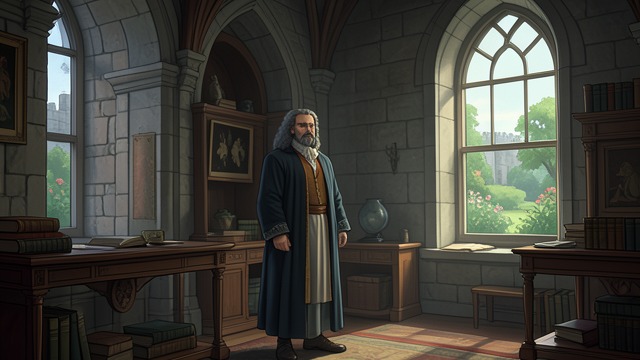
The Best Possible Castle
A theory made familiar
Pangloss argues that everything has been made for an end: spectacles prove the purpose of noses, and the Baron’s castle proves the order of the world. Candide learns the doctrine inside a protected household.
Comfort mistaken for proof
Because Candide has little experience beyond the estate, he accepts its arrangements as universal. The philosophy’s confidence is sustained by the narrowness of the world he has seen.
War’s Counterargument

War’s Counterargument
The world outside the lesson
Candide sees armies kill thousands and villages destroyed on both sides. Military authorities treat the devastation as lawful and glorious.
The theory absorbs the evidence
Pangloss’s principle remains in Candide’s mind, but the bodies and ruins make its reassuring conclusion increasingly difficult to believe. Experience begins to challenge doctrine without immediately replacing it.
El Dorado’s Different Arrangement
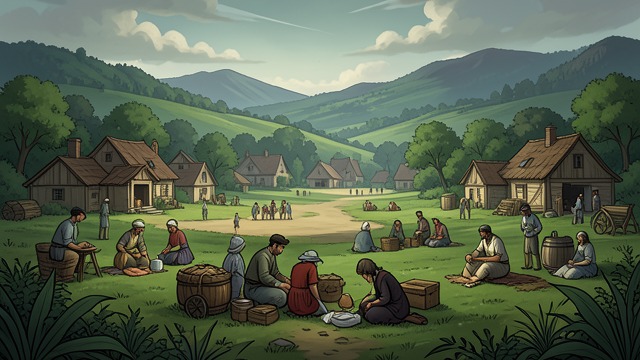
El Dorado’s Different Arrangement
A real contrast
El Dorado’s public provision, lack of prisons and lawsuits, and indifference to precious stones give Candide evidence of a society unlike the one he left. Its customs make the Baron's estate look provincial rather than optimal.
Utopia cannot settle desire
Candide still chooses to leave because Cunegonde is elsewhere. Even a society close to his ideal cannot satisfy his personal longing or dictate his choices.
The Enslaved Worker’s Testimony

The Enslaved Worker’s Testimony
A concrete moral fact
The enslaved man in Surinam describes mutilation imposed in sugar production and connects his suffering to European consumption. Candide recognizes an evil no formula can make acceptable.
Explicit renunciation
Candide says he must renounce Pangloss’s optimism. His response turns accumulated unease into a direct rejection of the claim that everything is right.
Cultivate the Garden
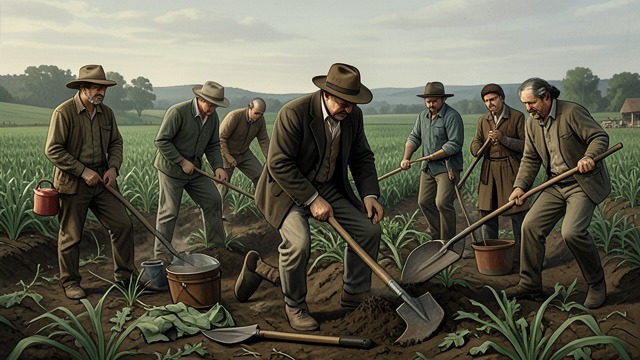
Cultivate the Garden
A limit on speculation
The Dervish refuses Pangloss’s demand for an explanation of evil. Soon afterward, a hardworking farmer describes how labor protects his household from boredom, vice, and need.
Modest responsibility
Candide concludes that they must cultivate their garden, and the group takes up useful tasks. The ending does not prove that suffering has a hidden purpose; it proposes bounded action as a way to make life more bearable.
At the beginning, in Westphalia
During Candide’s escape from the Bulgarian-Abarian fighting
During Candide’s month in El Dorado
At the start of Candide’s Surinam episode
At the final farm, after visiting the Dervish
