
The School Flag and Hidden Ancestry
Cartes Postales from GreeceThis thread follows Evangelia’s pride in a national parade, the prejudice against an Albanian flag-bearer, and the secret ancestry that unsettles her judgment.
increasing Bearing strength in each event
 decreasing
Bearing strength in each eventdecreasingA Parade of Pride
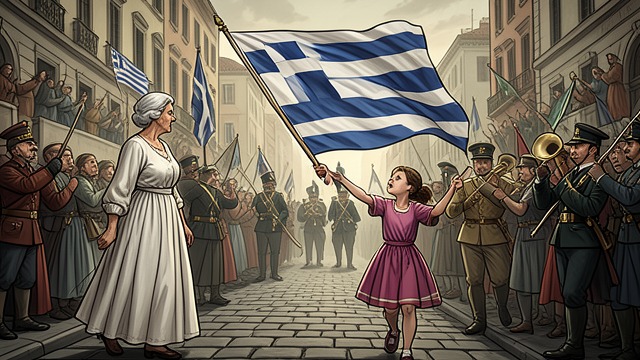
A Parade of Pride
A family tradition continues
Eighty-year-old Evangelia watches her granddaughter carry the Greek flag in the Independence Day parade. As a former flag-bearer herself, she feels pride in the achievement.
National memory fills the street
The parade links school, army, costume, and the story of independence. The flag carries a history Evangelia has repeated for decades.
The public celebration prepares a conflict between inherited national pride and the more complicated ancestry Evangelia carries privately.
A Boy Carries the Flag
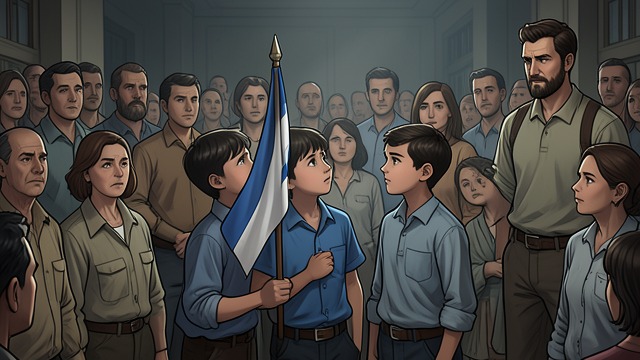
A Boy Carries the Flag
Achievement meets prejudice
A handsome Albanian-background student carries his school’s flag because he is top of his class. Neighbors complain that only a pure Greek should have the honor.
A father watches silently
The flag seller, the boy’s father, follows his son through the crowd while others question the boy’s belonging. Evangelia notices his tears and the pride he cannot express aloud.
The crowd’s celebration becomes a test of whether civic merit or ancestry defines national belonging.
Evangelia Recognizes the Double Standard

Evangelia Recognizes the Double Standard
Sympathy arrives too late
Evangelia congratulates the boy’s father but realizes she had not supported the neighbors who objected. The moment also forces her to consider her own family’s hidden history.
The granddaughter’s ancestry
The man Evangelia loved during the occupation was German. Her granddaughter is not “pure” in the terms the neighbors have just demanded.
The prejudice directed at the Albanian boy exposes a contradiction in Evangelia’s own pride and in the community’s idea of identity.
The Occupation Recalled

The Occupation Recalled
A German officer protects her family
Franz stops a soldier from threatening Evangelia’s father in the cafe. His action gives Evangelia a reason to see him as an individual within the occupying force.
The relationship crosses a boundary
Their conversations in French develop over months, and they eventually share a farewell encounter before the German withdrawal. Their relationship is personal, but it takes place within the violence of occupation.
The memory complicates any easy division between national identity and private affection.
A Secret in the Present

A Secret in the Present
The old hope remains
Evangelia has spent decades scanning German visitors for Franz’s face and reading a poem about return. She never told Efi who her father was.
Pride becomes self-questioning
The flag parade forces her to recognize that her family, too, crosses the boundaries others police. She alone knows why her granddaughter’s claim to pure ancestry is false.
The secret does not resolve the politics of belonging, but it makes Evangelia newly aware of the cruelty of judging others by blood.
Greek Independence Day, decades after the occupation
During the same parade, as a second school passes
Minutes after the boy passes
1940s, when Evangelia is eighteen
The end of the parade day
