Adamakos Family Murders
Cartes Postales from GreeceThe Adamakos family murders are the eventual consequence of Akis Adamakos’s response to Savina’s flight from their wedding. Rather than pursue her, he made her family the target of a revenge designed to last: years later, he killed her father and brother, spared her mother and sister, and was arrested that day. The episode moves from a promise of fear to a long-delayed act of violence, while leaving Savina absent from the scene and its aftermath.
Background and the threat of revenge
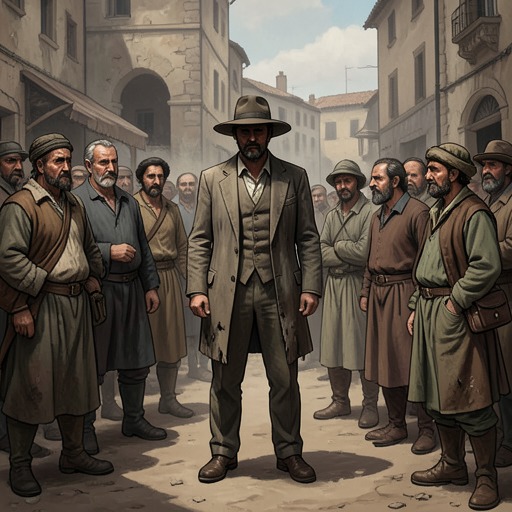
After the wedding-day rupture, Akis leaves flowers at the feet of the man who would have been his father-in-law and walks away with Nikos, his oldest friend. They drive out of the village in silence before stopping on the road. Their exchange establishes that violence is already imaginable to both men: Nikos speaks of deciding when to act, while Akis rejects the possibility that they might not act at all. The difference is not whether vengeance will come, but what form it should take.
Both men are from the Mani, and the narration identifies vendetta as part of their inherited world. Nikos offers to take his brothers back that night and kill at least the father and son. Akis refuses this immediate course. He regards fear of an unknown future attack as a greater revenge than a single killing: in his plan, the family will wait for the bullet and never feel at peace. His purpose, as he states it, is to make Savina and her relatives live under the continuing expectation of a telephone call that might announce violence.
The threat is bound to Akis’s own humiliation and jealousy. Looking out toward the sea, he wonders how far Savina has travelled and whether she is wearing her wedding dress. He imagines her with another man and struggles with jealousy. The narrative presents the revenge not simply as a response to the loss of a marriage but as an effort to answer a perceived loss of face. Akis does not respond when Nikos challenges him about returning to the church and facing the crowd’s humiliation; his silence leaves the proposed confrontation unresolved.
The long-delayed murders
The later account reveals that Akis eventually did return to the village outside Nafplio. He had kept a gun in his car for a quarter of a century, and the narration presents this long interval as a period of waiting rather than as a change of mind. When the time came, he killed Savina’s father and brother. The eventual act makes the earlier threat more than rhetoric, but its delay distinguishes it from Nikos’s proposal to carry out an immediate attack.
Akis did not kill the whole family. He left Savina’s mother and sister alive, and he did not track Savina down. The limits of the attack are part of the reported outcome: the violence was directed at her male relatives, while Savina herself remained beyond its reach. The account does not establish what she knew of Akis’s plans or where she was when the murders occurred.
Arrest and family aftermath
Akis was arrested on the day of the murders. Savina did not return for the funerals of her father and brother. The narrator suggests that grief and guilt may have made their deaths worse for her than her own death would have been, and speculates that she might also have feared Nikos. These are explicitly presented as possibilities, not confirmed explanations for her absence.
The reprieve Akis had once described as a life of fear becomes, in the aftermath, a family bereavement and an enduring separation. His choice not to pursue Savina did not spare her the consequences of his revenge: the deaths of her relatives and her absence from their funerals connect her flight to a loss she could not undo. The account offers no reconciliation or later meeting between them.
Retelling and significance
The murders reach the narrator through a couple in Nafplio who recount the story of a jilted man. Their telling is striking because the couple does not know the narrator’s own situation; the narrator recognizes the irony of hearing another story of romantic loss while carrying a personal grievance. This framing links the historical account to the narrator’s reflections without equating the two outcomes. The narrator is angry at a former partner but says that anger is not enough to make killing conceivable, and wonders whether murder could offer catharsis while admitting there may be no answer.
That contrast sharpens the episode’s significance. Akis turns humiliation and jealousy into a prolonged design against a family; the narrator, listening to the story, considers the same broad territory of loss but does not claim to share Akis’s capacity or choice. The sequence also revises the apparent meaning of his original threat: the fear he wanted to impose did not replace violence, but preceded a killing that came after decades of waiting. Savina remains the absent centre of the account—first the person who fled, then the person Akis did not pursue, and finally the daughter and sister whose family suffered in her absence.