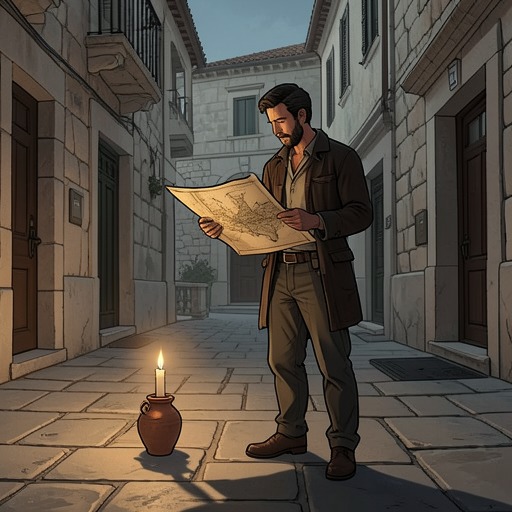
Anthony Is Stood Up at Kalamata Airport
Cartes Postales from GreeceAnthony Brown’s abandonment at Kalamata Airport breaks open a future he had arranged in detail: a two-week journey with the woman he intended to marry. After waiting for her and receiving only a brief message that she cannot come, he is left without an explanation or a reply. The episode turns anticipation into grief, and the journey they had planned together into the beginning of his solitary travels through Greece.
The Meeting That Does Not Happen
Anthony Brown had gone to Kalamata Airport expecting to meet the woman he addresses as “you.” When she did not appear, he stayed for twenty-four hours, persuading himself that there might still be an ordinary explanation: perhaps he had misunderstood the arrangements, perhaps she would arrive on the next plane, or perhaps a delay had prevented her from contacting him. His waiting was not entirely solitary. He slept on a seat behind the luggage trolleys, and a cleaner swept around him and brought him a piece of spinach pie that the cleaner’s wife had been about to discard. The airport staff seemed to form a family network, a detail the cleaner described with pride. Their everyday kindness offered a sharp contrast to the absence for which Anthony was waiting.
By the following morning, Anthony had to leave the Arrivals area. He sat outside, unsure where to go, when his phone buzzed. Its screen had shattered after he dropped it while reaching into his pocket, but he could make out a message: she could not make it, and an apology. He suspected that she had asked a friend to send it. He called the number, repeatedly, but received no answer. The message confirmed that the meeting was over without telling him why. The account records the impact of that brevity: no further message arrived from her, only a later greeting from his brother.
The Journey Reversed
Returning to Athens would have meant retracing the road Anthony had travelled in expectation of meeting her. He could not face that drive. Numb and unsure of his destination, he continued until he reached the sea and stopped where the road ended, beside a sign advertising rooms. He stayed in Methoni, where the waves and his own distress occupied the days that followed. He ate little, could not speak, and felt powerless. In one measure of how far his grief had narrowed his awareness, he stood under a shower until the water ran cold and noticed no sensation; his watch showed that an hour had passed.
Anthony also threw his phone into the sea. The broken screen had become a repeated reminder of the silence, and destroying the phone made that silence final: he accepted that he would not hear from her and that he had cut himself off from the outside world as well. The owners of the pension responded to his withdrawal with small acts of care, leaving food in his room each evening and bringing flowers, replacing them when they wilted. He could register their kindness without yet being able to respond to much else.
The Future He Had Prepared
The scale of the rupture becomes clear when Anthony remembers the itinerary he had designed for the two of them. He had planned a tour of the Peloponnese, a ferry to Kithera, another to Crete, and a return through Athens to London, all timed around the two weeks of holiday she had available. The plan was precise; its premise—that they would make the journey together—was not. As he recovered enough to consider what to do next, the itinerary seemed ridiculous to him.
The intended proposal gives the failed meeting an additional, private consequence. In Athens, Anthony had bought a solitaire diamond ring from Zolotas. He had imagined proposing at sunset in western Crete. The scene never took place, but he continued to replay it, describing it as a future that existed only in his expectations. The ring and the planned sunset make visible the distance between the shared life he believed he was preparing and the message he received at the airport.
Choosing to Continue Alone
Anthony had practical reasons to remain in Greece. His research in Athens had gone well: the curator at the Museum of Cycladic Art had opened parts of the archive to him, leaving him with material for a book. He had a book contract and an advance that, if carefully managed, could support him for a year. London, by contrast, seemed bound up with the prospect of looking for the absent woman in every crowd, and he dreaded the melancholy of a British autumn. These circumstances do not erase his grief, but they make continued travel possible.
After almost a fortnight in Methoni, the pension owner’s cheerful greeting of the new month brought Anthony face to face with how much time had passed. He packed, arranged for his brother to collect his post and deal with bills, and went to the village shop for supplies. There he chose a postcard of the Venetian Castle, a place he had not visited during his stay. He wrote to the woman who had not come, not because he expected a reply but because sending a card offered a way to communicate without one. He posted it, then sat in his car for at least an hour, staring at a map before he could bring himself to drive east. That hesitant departure marks the practical beginning of his travels alone.
Narrative Significance
The episode is presented through Anthony’s notebook, in an intimate account addressed to the absent woman. Its first-person recollection makes the airport message the hinge between the journey he had planned and the one he actually undertakes. It also gives the later postcards a different meaning: what had once been part of a shared itinerary becomes a deliberately one-way conversation. Anthony listens to people he meets and records their stories, finding that their voices gradually fill some of the silence left by the abandoned meeting. The narrative does not claim that travel immediately cures his loss. Instead, it traces a change in what he can do with it: he moves from waiting for a reply to choosing where to go, even when the choice initially feels almost impossible.