Anthony’s heartbreak over Sarah
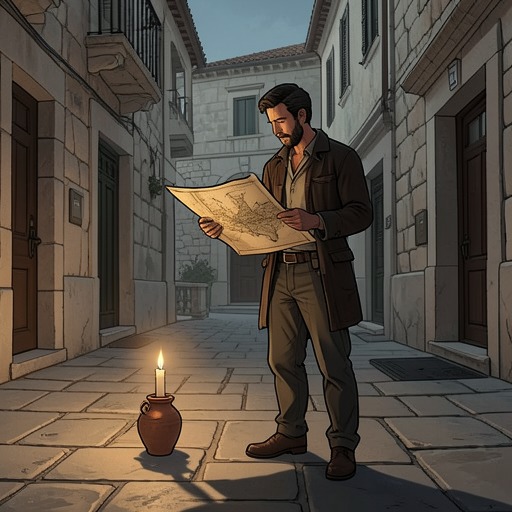
Cartes Postales from GreeceAnthony’s heartbreak over Sarah is the collapse of a love he had treated as a revelation: her apparent affinity for his interests seemed to make romance, art, and classical myth converge in one person. In retrospect, he recognizes both his misreading of her signals and the blindness of his own hope. The loss remains vivid in ordinary reminders, but his conversation with Ellie also gives it a place in a changed life shaped by Greece.
The encounter and its promise
Anthony meets Sarah in the bar at the Curzon in Mayfair while he is alone, waiting for a film by the Greek director Lanthimos. The person Sarah had intended to meet has not arrived. Their encounter begins in that gap: two strangers passing time, with no indication yet of the scale Anthony will give their meeting. He remembers Sarah as someone trained in the art of conversation, quick to speak and seemingly unable to remain alone without chattering. Her ease becomes part of the attraction, but it also makes her difficult for him to read clearly. Sarah catches on to Anthony’s interest in Greece. She has studied History of Art at university, and the conversation turns naturally to his book on Cycladic sculpture. She appears sincerely interested and recalls that one of the islands she visited as a child belonged to the Cyclades. For Anthony, these are not merely agreeable details. They seem like signs of recognition: a meeting of intellectual interests and a shared responsiveness to art and place. He says that he fell deeply in love, while admitting the possibility that he was deluded.
Love, art, and misrecognition
Anthony later questions the evidence on which he built his certainty. He had taken the sparkle in Sarah’s eyes for attraction; in retrospect, he thinks it may have reflected enthusiasm for their conversation, or simply the watery eyes associated with contact lenses. His account turns on this small correction. What had felt intimate and unmistakable becomes uncertain, and he can no longer separate her interest in the conversation from an interest in him. For a time, Sarah’s apparent enthusiasm seemed to support his hopes. She accompanied him to galleries and appeared to respond to works as he did. Anthony describes being seduced by her charm and by erotas, the force of love that seemed larger than himself. Classical myth and the art inspired by love acquired new significance: poetry, painting, and sculpture from different periods seemed newly connected to his experience. He was absorbed in the blissful possibilities of Eros and Psyche, he says, and did not want to attend to the betrayals and tragedies that also belong to love. He was not interested in endings. The age difference between them was fifteen years. Looking back, Anthony does not treat the difference as proof of Sarah’s motives; instead, he judges himself to have been the child, despite being old enough to be her father. The admission recasts the romance as a failure of discernment as well as a loss. His education and cultural knowledge did not protect him from taking hope for evidence. Ellie, listening to him, recognizes this very susceptibility: even an intelligent, highly educated person can be temporarily blinded by infatuation.
The material afterlife of the loss
The heartbreak has concrete remnants. Anthony held on for a while to a ring he had bought, then summoned the courage to return it only the week before the conversation with Ellie. The return brings humiliation, but also a practical consequence: the money will cover a year of rent. He hopes new legislation will allow him to stay at least that long. The ring therefore marks both the intended future that did not happen and the immediate financial circumstances in which he is trying to carry on. Other reminders are less manageable. Even now, passing someone in the streets of Athens who wears Sarah’s perfume can overwhelm Anthony with memories. He sees no way to prevent this without avoiding the streets altogether. Ellie responds sympathetically that he cannot; the exchange makes the persistence of grief part of everyday movement through the city, rather than something he can resolve by choosing not to remember. Anthony also recalls that, although he had a good arm when he played cricket, he could not throw his phone far enough. His wry remark conveys anger and frustration without making them the whole of his account. He can now look at the episode with humor, but the joke does not erase the force of what happened. Nor does his acknowledgment that Sarah lied: he accepts that the deception was hardly her only lie, while continuing to describe her as the person he thought was the love of his life.
Greece, Ellie, and a changed perspective
Anthony says that, for the short time Sarah inhabited his world, she was his world. The scale of that statement helps explain why the breakup reaches beyond the loss of a partner: it had reorganized his attention, making art and love feel newly legible, and its ending left him with memories that still surface without warning. When Ellie asks whether he had thought the relationship was the real thing, he confirms that it had seemed so to him. His account is not a claim that the hope was justified, but a description of how completely he inhabited it. The conversation takes place on a terrace overlooking Athens. Anthony points out the Acropolis, Lycabettus, the Botanical Gardens, and the Parliament Building; as they look across the city, he continues speaking about Sarah, as though saying it all might mean he would never need to mention her again. Ellie has read his journal and feels some guilt at having read what was effectively a diary, but Anthony is glad that someone knows what he went through. Their exchange turns private recollection into something witnessed and shared, without suggesting that Ellie can remove the grief. By the end, Anthony can hold disappointment beside gratitude. He tells Ellie that Greece is giving him so much, and that without the experience of the relationship and its disappointment he would not still be here. Ellie tentatively connects the chain of events to her own presence; Anthony agrees that these turns have led to the two of them sitting together that night beneath the moon and stars. His heartbreak is therefore neither simply repaired nor left as an unqualified ruin. It remains painful in memory, while also forming part of the route by which he arrived at a life and companionship he can value.