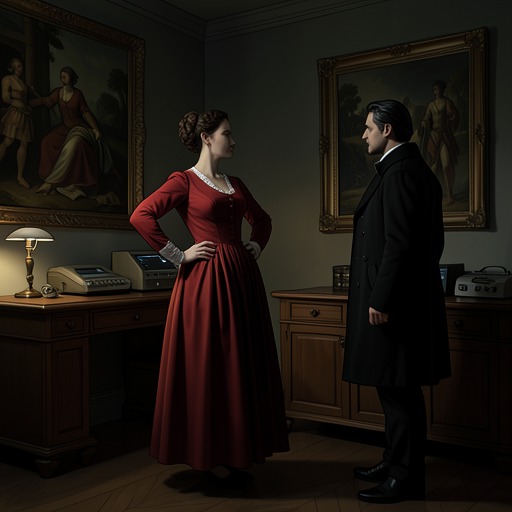
Antigoni leaves Christos
Cartes Postales from GreeceAntigoni leaves Christos after he destroys the paintings that embody her work and her connection to her sister. The decisive moment is not a negotiated separation but a rupture: as her portrait of Ismini burns, Antigoni pulls free of her husband and runs from the house. A schoolmaster’s practical help enables her departure the next morning; the painting she later sends him becomes the first clear sign of the independent artistic life she will make for herself.
The destruction of the paintings
Christos finds Antigoni’s leather portfolio under the bed and takes her to the paved yard behind the house. There, her four portraits have been piled on kindling, with the portfolio on top, and fire is already licking up from below. The paintings are not incidental possessions: the scene gives them a physical place at the center of the conflict. Christos has arranged their destruction, and Antigoni’s first response is to reach for them. He grabs her arm to stop her, orders her to do as she is told, and demands respect. His command makes the struggle over the pictures a struggle over who may act and whose work is allowed to exist.
The scene gives Christos’s anger a force that exceeds the flames: it is described as rage that prevents him from seeing beyond it. But Antigoni’s turning point comes through what she sees. As the portfolio melts and individual pictures curl upward and float out of the fire, she recognizes the portrait of Ismini. The destruction thus becomes personal as well as artistic. The image of her sister, burning before her, is the circumstance that makes her pull away from Christos and run through the house and out the front door. The account does not describe a final argument or a settled plan; it shows an attempted rescue, a restraint, a recognition, and then flight.
Departure and assistance
Antigoni leaves the house knowing that a ferry will depart early the following day. She is willing to face the consequences of her actions, a resolve that distinguishes her departure from an impulsive escape without regard for what follows. Before setting out, she goes to the schoolmaster’s door. He willingly gives her money for both the bus and the ferry, supplying the specific means by which she can leave. His assistance is practical and immediate: it turns her resolve into a journey she can actually undertake.
The contrast between Christos’s intervention and the schoolmaster’s is sharp. Christos physically prevents Antigoni from saving her work and insists on obedience; the schoolmaster gives her the money needed to move away. The narrative does not make him the cause of her decision—she has already run from the house and is prepared to bear its consequences—but his help enables her next step. The departure therefore joins a decisive act of self-release to an act of support from outside the marriage.
The painting returned
A few months after leaving, Antigoni sends the schoolmaster a painting as thanks. It is a still life, and the account calls it rich repayment: the help that first made her departure possible becomes part of an enduring exchange, answered not with money but with her work. The painting also reverses the image of the portfolio in the fire. Christos has tried to destroy Antigoni’s pictures; the painting she gives away survives, and its later value can be recognized by someone other than her husband.
A decade later, Antigoni has become a celebrated painter. The schoolmaster is able to sell the still life she gave him and finally retire. These outcomes extend the meaning of her flight beyond the immediate break: she continues painting, gains public recognition, and turns a gesture of gratitude into something of lasting practical value for the person who helped her. The narrative does not detail how she trained or established her career, but it makes the contrast in outcomes explicit—the four portraits are consumed in the yard, while her later work endures and can support another life.
Separate lives and lasting consequences
Christos continues to spend long periods at sea, returning only for short breaks to his dusty home. Antigoni, by contrast, never leaves Piraeus again. The account places their later lives in parallel without suggesting a reconciliation: his established pattern of absence continues, while her departure becomes a permanent break with the place from which she fled. The Vandis mansion is now a guesthouse, a final change in the domestic setting associated with their marriage.
Antigoni’s exit is therefore both a specific act of escape and the beginning of a lasting change in her circumstances. Its immediate trigger is the burning portrait of Ismini, but what follows is more than the preservation of one image or the end of one household. With the schoolmaster’s help, Antigoni leaves; months later she answers that help through painting; years later, she is celebrated for the art Christos tried to destroy. The story’s reversal rests on those concrete consequences: the fire marks an attempt to suppress her work, while her later career establishes that the attempt did not define its future.