Aphrodite statue
Cartes Postales from GreeceThe Aphrodite statue is an ancient marble sculpture discovered by Costas Arvanitis while he was digging his smallholding. Its unusual sound beneath his spade first alerts him to it; as he gradually uncovers its face-down figure, he comes to see not merely a buried artefact but the goddess of love and beauty. That transformation shapes both his attachment to the sculpture and the events that follow: Costas dies while trying to turn it over, and his friend Orestes covers it again, choosing to keep the discovery from the village.
Discovery and excavation
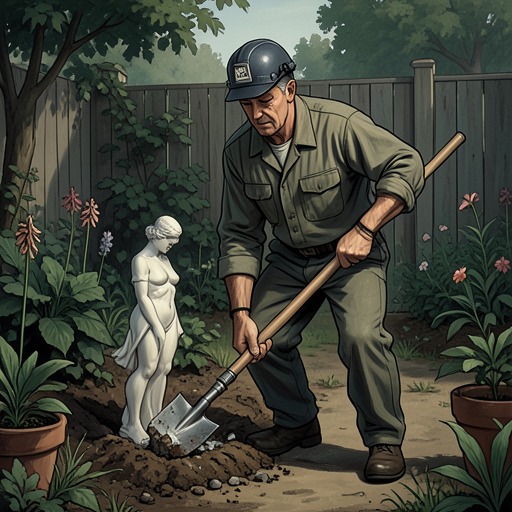
Costas encounters the sculpture during a difficult winter’s work preparing his land for planting. The ground is hard after little rain, and his spade regularly strikes flint among the stones he has to clear. This time, however, it produces a distinct, bright, bell-like note. In the fading light he can make out only what looks like a large white stone, firmly embedded in the earth. He leaves it until morning, with no clear idea of what he has found.
The discovery unfolds over several days rather than in a single reveal. At noon on the third day, Costas’s continued work confirms that the stone is smooth and shaped. By mid-afternoon, he recognizes the contours of a woman’s body; by evening, after clearing an area roughly forty by eighty centimetres, he can see her back, legs, neck, and part of her hair. She lies face down, one arm beside her and the other ending at the elbow. The gradual uncovering matters: the sculpture becomes legible to him through sustained labour and touch, while its full identity remains out of reach.
Costas has grown up in a rural village and has never visited a museum, so the find has no immediate place in an established knowledge of ancient art. The text presents his response as a discovery in its own right. He is captivated first by the sound, then by the form emerging from the soil; the object’s significance develops alongside the physical work of exposing it.
The statue as Aphrodite
Once fully uncovered, the sculpture is presented as a complete figure lying face down. Costas understands her as Aphrodite, although he does not know her name from any stated identification or inscription. The narration connects this recognition to an older conception of divine images: the sculptor who represented a god believed not only that the figure stood for the deity, but that the deity was present in the image. Costas, in turn, experiences the statue through that conviction. His interpretation is not established by an archaeological examination; it is the powerful personal meaning he gives the sculpture.
His attention moves from the figure’s body to the face he has not yet seen. He covers the statue with a blanket at night and addresses her with tenderness, treating the buried artefact as a presence to be cared for rather than as a find to be announced or assessed. The following day, the face becomes visible: the sculpture has a strong nose, full lips, and an oval eye whose carved corner suggests a smile. For Costas, the discovery of the face confirms the completeness of the beauty he already attributed to the figure.
This movement from an unidentified stone to a goddess gives the statue two kinds of significance. It is a material object painstakingly released from the earth, with a body, a face, and a damaged arm; it is also, in Costas’s perception, Aphrodite herself. The narrative holds those meanings together without making the sculpture’s archaeological history more definite than the evidence allows.
Costas’s attachment and death
Costas’s response intensifies as the statue is revealed. The discovery disrupts the ordinary pattern of work on his smallholding, but his focus remains on the sculpture and on seeing its face. Once it is exposed, he waits until the next day to try turning it. The effort is physically demanding, and the action that might complete his encounter with the statue instead becomes its decisive reversal.
As Costas tries to lift the sculpture, it falls face first into the soil again. He sees its face only briefly before it returns to the earth. He then experiences shortness of breath, tightness in his chest, and pains in his arms. He lies down close to the statue, hoping that rest will relieve what he takes to be the effects of overexertion, and places his head on her shoulder. Costas never rises again. The narration links his death to the strain of trying to turn the sculpture; it does not give a medical confirmation beyond the later suggestion that he may have suffered a heart attack.
The physical arrangement of the final scene echoes the discovery. Costas had laboured to uncover the figure and had treated her as a presence deserving protection; at the end, he lies beside her, and a blanket used to cover the statue is used to wrap his body. His death leaves the find both exposed and vulnerable, and makes Orestes the person who must decide what happens to it.
Orestes conceals the find
When Orestes reaches Costas’s smallholding, it is too late to help his friend. He notices that Costas’s face bears a smile, moves his body carefully aside, and finds a hard piece of stone in his top pocket. He removes a stone finger and wraps Costas in the blanket that had protected the statue. The passage places this fragment beside Costas’s body without providing a separate account of when it came away; its presence emphasizes the intimate, physical closeness between the man and the sculpture.
Orestes decides not to report the discovery. He considers how an ancient sculpture might affect everyday life in a village where residents depend on their land. In his view, archaeological investigations could bring restrictions on building or agriculture, while discoveries elsewhere in Greece had caused construction works to take much longer. He worries that an investigation might uncover further remains and draw archaeologists onto local property. The statue’s value to a small number of people, as he sees it, does not outweigh the disruption its discovery might bring to the community.
He therefore covers the sculpture with successive layers of soil, rebuilding the ground over it and smoothing the surface. The reburial reverses Costas’s careful excavation: what had been revealed through days of work is hidden again in about an hour. The statue’s story ends, for the time being, not in a museum or an announced archaeological find, but beneath the earth where Costas encountered it. Its beauty and historical significance remain entangled with the practical costs Orestes fears, while the sculpture’s return to concealment preserves the secret of Costas’s last attachment.