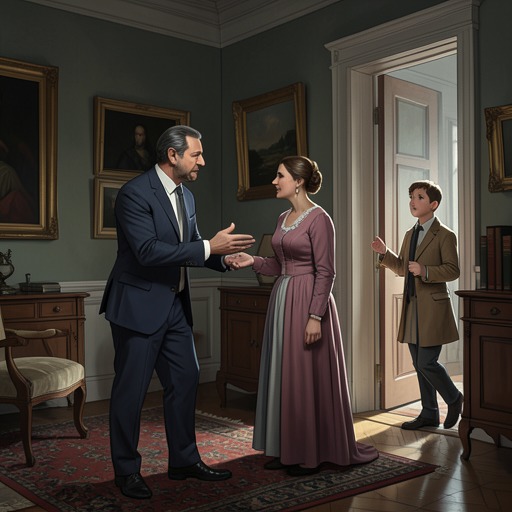
Apostolos Papazoglou and Stephanos Papazoglou
Cartes Postales from GreeceApostolos Papazoglou and Stephanos Papazoglou are father and son, but their relationship becomes defined by a contest over who will inherit Apostolos’s hotel empire. Approaching his seventy-fifth birthday, Apostolos wants to retire without dividing the business or simply handing it to his elder son, Manos. Though Manos is the expected heir, Apostolos privately believes Stephanos has greater charm and is better suited to lead. Rather than turn that preference into an appointment, he creates a test that puts both sons’ business decisions—and the family’s future—at stake.
Family and Succession
Apostolos’s sons have grown up in circumstances far removed from the small family home of their childhood. During a decade of summers at resorts in their father’s luxury group, they live on room service and Coca-Cola and never learn to make a bed. Their mother has praised them even when they do poorly at school, while Apostolos has been preoccupied with making money. By their twenties the brothers bicker constantly, and both assume that half the business will eventually pass to them. The inheritance question is therefore not merely about selecting a capable manager: Apostolos must overturn their expectation of an automatic division and make the sons’ respective claims compete.
Apostolos’s private assessment of Stephanos complicates the fairness of the test he proposes. He does not declare his younger son the successor, despite believing him better suited to the role; instead, he accepts Melina Papazoglou’s suggestion that the brothers prove themselves through their work. The arrangement converts a judgment about leadership into a measurable contest. It also exposes the limits of Apostolos’s earlier involvement as a father: he now expects his sons to demonstrate business ability even though they have left school at sixteen, done no further study, and grown up expecting wealth and inheritance to secure their futures.
The Test and the Beach Hotel
On his birthday, 13 October, Apostolos brings an old drachma coin from his desk to a family celebration at a smart restaurant in Patras. As Manos and Stephanos argue about football, he announces that he owns two undeveloped sites in the city: one near the busy port and one on a stretch of beach outside town. A coin toss will assign the plots, and the son whose hotel proves more successful will take over the entire empire. Apostolos sets a strict measure for the decision: after two years he will compare their balance sheets, and even a lead of ten drachmas will determine the winner.
The toss assigns the port-side site to Manos and the beach plot to Stephanos. The date, 13 October, carries a warning in the scene: eavesdropping waiters regard the thirteenth as unlucky, especially in Greece, and note the digits of 1453 also add to thirteen. Their unease gives the succession test an ominous frame, but Apostolos proceeds. He has made the outcome depend on both chance and performance: chance determines which opportunity each son receives, while the balance sheets are meant to settle the inheritance.
Stephanos’s choice fits his enthusiasm for swimming. Unlike Manos, who adapts an existing office block for Hotel Pyrgos, Stephanos builds the Thalassa from scratch, with only just over six months to prepare for the tourist season. Its plain rooms all face the sea. Construction is fast and inexpensive: the foundations are shallow and the walls little more than a single sheet of plywood. The low expenditure helps the hotel’s financial performance, while the seaside setting brings guests who spend their days at the beach and evenings in local bars.
The brothers make their rivalry public through their openings. When Stephanos learns that Manos plans to open the Pyrgos on 29 May, he targets the same date. Apostolos attends the Pyrgos launch first, while his wife goes to the Thalassa; the parents then exchange venues. Their presence at both celebrations registers a father attempting to oversee two competing ventures without yet choosing between his sons. After the first summer, both hotels appear successful by profit margin, and Apostolos is impressed and surprised by what they have achieved. He does not investigate the businesses more deeply, leaving the contest to proceed on the figures he has requested.
Unequal Fortunes and the Collapse of the Contest
Stephanos’s seasonal model initially serves him well. The Thalassa needs to operate for only six months to make a profit. Guests receive little beyond the basic accommodation, but spend freely on drinks at the beach bar and on water-skiing at inflated prices. The contrast with Manos’s year-round ambition is important to the contest: Stephanos’s apparent advantage comes partly from a business designed around a short, profitable season, not from operating the more elaborate establishment.
Manos’s fortunes deteriorate as his hotel attracts pressure from Giorgos Kourtis, a rival hotel owner with powerful connections. After the Pyrgos draws business away from Kourtis’s hotel, Manos faces extortionate payments to restore electricity and water, followed by repeated police searches that uncover gambling. He resorts to bribes and loans to keep operating. In winter, power cuts leave rooms cold, condensation damages the gambling-room paintings, and occupancy falls. His costs outstrip his income; mounting debt and stress undermine his ability to keep the hotel going. This is the setting in which Apostolos’s balance-sheet test begins to measure not only the sons’ choices but also the hazards each business faces.
The Thalassa’s apparent commercial success proves inseparable from its unsafe construction. Around four in the morning on a warm June night, an earthquake measuring 4.3 on the Richter scale shakes the building. Its floors shift, then collapse one upon another, leaving a heap of concrete, metal railings, beds, and debris. Stephanos, who does not live at the hotel, runs to the site after being woken by the quake. More than two hundred guests had been staying there; thirty die and about a hundred are wounded. The forensic investigation finds that the hotel was built without proper regard for guest safety, and bereaved families and injured guests take Stephanos to court for negligence. The Pyrgos, by contrast, sustains only a cracked window.
The Failed Inheritance and Its Aftermath
The collapse destroys the idea that the contest can end with one son taking over a thriving empire. Manos’s debts are unpayable, and his last guest and remaining employee leave on the day Stephanos is charged. Apostolos’s seventy-seventh birthday, which was supposed to mark his retirement and the transfer of the business to one son, instead finds both sons facing trial. The proceedings are to begin in Athens on the same day, forcing Apostolos to choose which son’s trial to attend; Melina suggests that he toss a coin. The image recalls the birthday test, but now there is no hotel competition to decide. The family’s earlier device for making succession seem orderly returns as a grim emblem of how little control Apostolos has over the outcome.
Seven months later, on 29 May—the date of the rival hotel openings—both cases end in manslaughter verdicts. Compensation owed to the injured guests and bereaved families exceeds what the sale of the entire hotel empire can cover, and Apostolos is forced to declare bankruptcy. The date links the brothers’ celebrated competition to its eventual legal reckoning, while the bankruptcy makes the original prize impossible: neither son inherits the intact business his father had set out to preserve. The ruined hotels remain for years as reminders of the catastrophe. Apostolos’s attempt to settle succession through a test of entrepreneurial performance ends not with a successor, but with the collapse of the hotels, the trials of both sons, and the loss of the family empire.