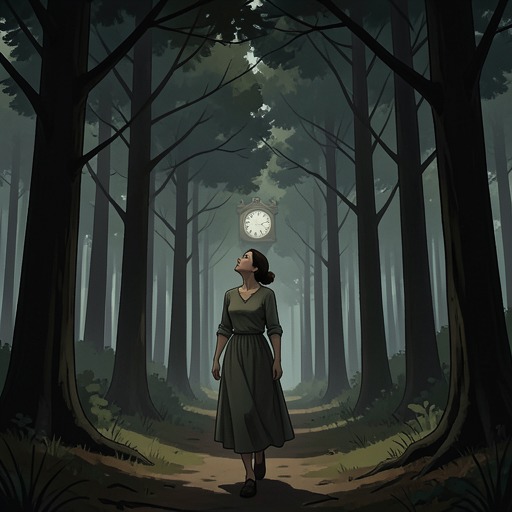
Athanasia Returns to Her Father's Hometown to Find His Grave
Cartes Postales from GreeceAthanasia Returns to Her Father's Hometown to Find His Grave follows Athanasia Malavas on a search for the father she never knew and the village her mother left behind. The journey begins as an attempt to locate a grave, but the absence of reliable family records turns it into an encounter with gaps: no remembered father, no identified tomb, and finally no women among the rows of graves she surveys. Against the apparent beauty of Arcadia, the episode places loss and historical absence in plain view.
Background and Purpose
Athanasia grew up amid the dust and noise of Athens, a city she loved and had little desire to leave. At twenty-eight, however, curiosity and unanswered questions take her toward her father’s village, high in the mountains beyond Kosmas. She was born there, but has no memories of it. Her destination is both a family origin and a place she must approach as a stranger.
Her father, Grigoris Malavas, died when she was two. He was rarely discussed as she grew up, and Athanasia has no recollection of him. Her mother’s silence was accompanied by a striking absence of objects: no photographs, letters bearing both parents’ names, wedding picture, or even marriage certificate. Athanasia is the only evidence of the couple’s life together that remains to her. The search for a grave therefore cannot rely on the familiar signs by which a family history is usually recovered.
Her mother had left the village after Grigoris’s forty-day memorial and never returned, not even for the later anniversaries of his death. She explained only that his brother had done what was necessary. From this, Athanasia knew she had an uncle, but did not know whether he was still alive. The visit is driven partly by these scattered disclosures and partly by a wish to test what she has heard about Arcadia: whether it truly is the most beautiful place on earth.
Arrival in the Mountain Village
On a Sunday morning, Athanasia follows the winding road higher into the mountains. The landscape seems to justify Arcadia’s reputation. She stops to look down across a valley toward Mount Parnonas, and the cool, clean air is so intense that breathing it nearly burns her lungs. The view has inspired paintings, but the paintings, she feels, have not come close to the reality before her. The beauty of the setting is immediate; knowledge of her family’s place in it is not.
In the village, a man asks why she has come, in a manner that feels more confrontational than curious. Athanasia explains that her family, or at least her father, came from there. When she adds that he died and her mother left, and that she would like to visit his grave, the man asks for her family name. She answers Malavas. He continues peeling and eating chestnuts without showing interest in her explanation. The exchange gives her a surname to follow, but no welcome or guidance that resolves the search.
Searching the Cemetery
Athanasia walks uphill to the cemetery, a fifteen-minute journey along a road lined with old chestnut trees. The iron gates stand wide open. Inside, the burial ground is unexpectedly extensive for such a small village, with white-marble tombs and elaborate statues. Photographs, poems, and tributes adorn the graves; the scale and ornament remind her of the First Cemetery of Athens. She had visited that cemetery with her mother shortly before her mother died, to lay a flower on a famous singer’s grave. Finding similarly grand memorials in this remote mountain village surprises her.
The cemetery is carefully tended. Its paths are neat, swept, and weeded, and even graves more than fifty years old look freshly cleaned. Instead of faded artificial flowers, the tombs bear fresh carnations, roses, and lilies. The care given to the dead contrasts with the lifelessness of the village she has just walked through. Athanasia notices that the dead outnumber the living, and that those who have died seem, in this place, to be actively cherished.
The family name is plentiful: there are dozens of Malavas graves, including several men named Grigoris. Yet none of the dates matches the date on which Athanasia believes her father died. Even a photograph would not necessarily help her identify him, because her mother kept no picture of her late husband. The cemetery offers many memorials but no dependable means to distinguish her father from the others. The search’s central obstacle is not a lack of graves; it is the lack of a record connecting one of them to her.
The Missing Women and an Unfinished Search
Athanasia wanders among the graves until dusk. She is not sentimental about a father she never knew, but the memorials move her: the photographs, poems, and tributes make visible the care other people have preserved for their dead. During her walk, another pattern becomes impossible to overlook. Every name she encounters is male. Some of the dead were young, others died in middle age, but most reached their seventies or eighties. Row after row, the cemetery presents a community of men.
As the light fades, Athanasia leaves without finding the grave she came for. The unsuccessful search has nevertheless produced a sharper question: where are the women? To her, their absence is not confined to the cemetery. As she returns through the quiet streets, the village’s shops and workspaces are also occupied by men: a butcher chops, two men carry bakery trays, and a male grocer serves a youth. The disparity joins the village of the dead to the village of the living. Her inquiry into one missing father opens onto a wider absence that her family’s silence alone cannot explain.
The episode’s title, Et in Arcadia ego, places death inside the language of paradise. Arcadia offers Athanasia clean air, a vast mountain view, and a beautiful landscape, but it does not restore the family history she lacks. Its immaculate graves make care for the dead conspicuous even as they fail to tell her which grave belongs to her father. At dusk, after hours of searching, she also discovers that her Micra is no longer where she left it beneath the plane tree. A battered car bearing a handwritten taxi sign is parked in the square. The missing car adds an immediate practical complication to a visit already marked by unanswered questions, leaving Athanasia’s return to her father’s village unresolved on more than one level.