Costas Dies Suddenly While Trying to Turn the Statue Over
Cartes Postales from GreeceCostas Arvanitis dies while trying to turn the Aphrodite statue, an attempt he insists on making alone. The episode shifts from a careful effort to reveal the sculpture to a fatal physical exertion: the statue rises briefly, Costas sees its face, and then he collapses beside it. His death makes the work’s central contradiction tangible—his determination to possess the discovery privately depends on a task far beyond what one person can safely manage.
The Decision to Work Alone
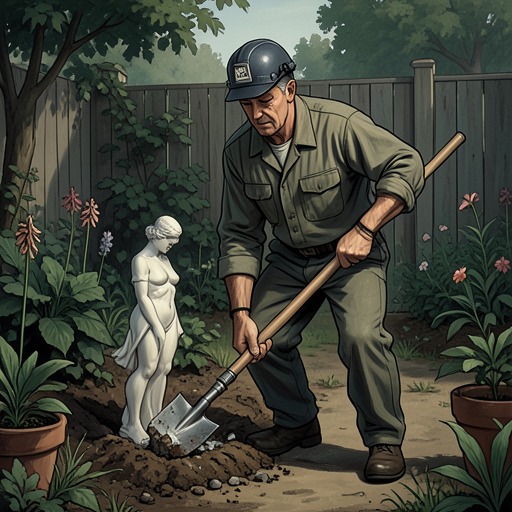
Costas prepares to turn the statue using wooden planks he has dragged from his truck and a rope. The task would ordinarily require half a dozen people, but he does not want to share the woman he has found with anyone. His choice is therefore not simply a practical shortcut. It expresses how completely his fascination has narrowed the discovery into a private relationship, even as the scale of the work makes solitude dangerous.
The first attempts fail. Costas keeps adjusting the arrangement, afraid that the statue will break. His attention is divided between the physical problem of moving the stone and the need to protect the object that has become the focus of his desire. The scene gives that desire a practical consequence: refusing help leaves him to undertake alone work that the narrative explicitly presents as work for several people.
The Brief Revelation
At about three in the afternoon, the arrangement finally works. As Costas leans on the lever, the statue rises slightly from its face-down position. For a moment, he sees the face he has not yet been able to inspect: its profile, strong nose, full lips, and the edge of an oval eye. The carving of a smile at the corner of the eye completes the image for him. The glimpse is brief, but it confirms that the statue’s beauty is not limited to its body.
The revelation lasts only an instant. The statue falls face-first into the soil again, turning the achievement of lifting it into a renewed loss of sight. Costas’s response is not measured or detached: the sight overwhelms him, and the scene makes his physical reaction part of the event’s turning point. The object he has tried to expose remains beyond his control, while his effort to reach it has already placed him under severe strain.
Collapse and Death
Costas gasps again, and his shortness of breath continues. Tightness in his chest and pain in his arms follow; he understands that he has overexerted himself trying to lift the statue. He lies down beside it in the hope that resting will ease the unfamiliar symptoms, placing his head on the statue’s shoulder. He never gets up again.
The episode’s reversal is stark: Costas succeeds in raising the sculpture just enough to see its face, but the moment of discovery is immediately followed by his collapse and death. The narrative connects the two without suggesting that the statue itself causes his death; the stated cause is the exertion of attempting to lift it alone. His last position beside the sculpture preserves the intimacy that shaped his decision, while making its cost unmistakable.
Orestes Arrives Too Late
Orestes reaches the garden after Costas has died, when there is nothing left to do for his friend. He notices that Costas has a smile on his face. As he moves Costas’s body aside, he feels a hard piece of stone in the dead man’s top pocket and removes the finger before wrapping him in the blanket that had protected the statue.
The details join the human aftermath to the unfinished encounter with the sculpture: a stone piece remains in Costas’s pocket, and the blanket that covered the statue becomes his shroud. Orestes’s arrival cannot undo Costas’s decision or restore the brief view of the statue’s face. It marks the end of the attempt as a private act and leaves its consequences in the hands of the friend who finds him.