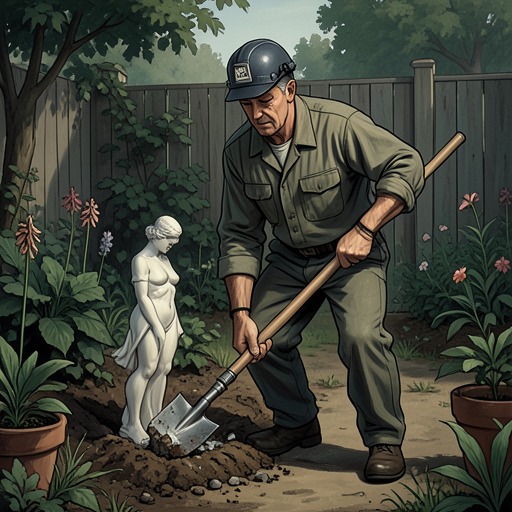
Costas Discovers the Aphrodite Statue
Cartes Postales from GreeceCostas Discovers the Aphrodite Statue begins with an ordinary task—preparing a smallholding for planting—and turns it into a discovery that briefly gives Costas Arvanitis’s life a new focus before ending in his death. The statue emerges slowly from the ground, first as an inexplicable sound and then as a sculpted figure. Costas’s growing attachment to it leads him to work alone to turn it; when he dies, Orestes conceals the find beneath the soil again, choosing to protect the village’s everyday life from the disruption he expects an archaeological discovery to bring.
Labor and the First Sign
A dry winter had left the ground hard, and Costas spent his days digging it over in preparation for planting. His smallholding covered a few hectares, with orange and olive trees occupying about half. One evening, as he worked in the fading light, his spade struck something that rang with a clear, unfamiliar note rather than the duller sound of striking flint. That difference catches his attention: in rocky ground where he routinely sifted out stones, this was not the sound he expected.
It was almost dark, and he could make out little beneath the spade. By picking away soil with his fingernails, he exposed what looked like a large white stone, but it was stuck fast and he left it for the next day. The discovery interrupted a routine built around strenuous work. His plot was not merely a place to grow food; it gave structure and purpose to his days. The evening’s unexplained sound therefore became a reason to return, even before he knew what lay beneath the earth.
Excavation and Recognition
The next morning, Costas went directly back to the plot. Wind had shifted more soil overnight, revealing a pale surface with a pearly sheen. Concerned that a spade might damage it, he began clearing it by hand. At first the exposed area seemed broad and without edges. He supposed that recent seismic movement had pushed the stone toward the surface, and thought removing it would help his tomatoes, courgettes and beans grow. Practical explanations and agricultural concerns remained part of his response even as the object began to seem unusual.
The work continued over several days. Costas dug around the emerging shape, piling earth into mounds, and gradually recognized that it was a sculpture rather than an ordinary obstruction. By noon on the third day he had found a smooth, modeled form; as more soil came away, he identified the figure as a woman. By evening, a substantial part of her body was exposed, including her back, legs, neck and one arm. The other arm ended at the elbow. Costas had never visited a museum, so the sight was outside his experience; the discovery arrived not through scholarly expectation but through repeated work with his hands.
A Private Attachment and the Attempt to Turn the Statue
The narrative presents Costas’s response as more than curiosity. He understands the statue as Aphrodite, although he does not know her name when he first uncovers her. The account links this identification to an ancient sculptor’s belief that an image of a god did not merely represent the deity but embodied it. In that light, Costas’s attachment is not simply to a valuable object: the statue seems to him to make love and beauty present in his otherwise familiar, often difficult life.
He leaves the figure face down overnight and covers her with a blanket. His thoughts and dreams turn toward her, while the everyday pressures that had filled his days recede. At dawn he returns, removes the covering and sees the marble in the early light. He wants to discover the statue’s face, but refuses to invite anyone to help. Turning the heavy figure would ordinarily require several people; instead, Costas brings wooden planks and rope from his truck and attempts the work alone. His decision makes the excavation intensely private, but also exposes him to the physical strain of lifting the statue.
Death and Concealment
When Costas finally raises the statue enough to see her face, he finds a carefully modeled countenance, including a slight smile. The revelation is immediately followed by his collapse back toward the soil. He gasps, experiences shortness of breath and chest tightness, and recognizes that he has overexerted himself. He lies beside the statue to rest, placing his head on her shoulder. He never gets up again.
Orestes arrives at the plot too late to help. Costas has a smile on his face, and Orestes moves his friend’s body aside before wrapping him in the blanket that had covered the statue. He also finds a hard piece in Costas’s top pocket and removes a finger. The account places this small object amid the immediate work of dealing with Costas’s death, without explaining further what the fragment meant to him.
Orestes then considers what the discovery would mean beyond the field. In his view, an ancient sculpture would interest only a few people but could disrupt the lives of many. He thinks of building work in Greece being delayed when ancient remains are suspected, and fears that archaeologists might come onto village land and restrict either development or farming. He covers the sculpture with layer after layer of soil, rebuilding and smoothing the ground until the find is hidden again. He then drives back to the village and goes to see Stella, who believes Costas must have had a heart attack.
Significance of the Discovery
The event binds discovery to loss. The statue’s emergence changes the meaning of Costas’s familiar labor: a sound in the soil draws him from routine into a private encounter that absorbs his attention, but the effort to complete that encounter costs him his life. The slow excavation also shapes the scene’s movement, delaying recognition until the figure and then her face come into view. What begins as a practical attempt to clear an obstacle for crops becomes, for Costas, an encounter with an image he experiences as divine.
Orestes’s response supplies a second, contrasting consequence. To him, uncovering the statue is not an uncomplicated public good: it could bring outside scrutiny and interfere with local farming and development. His decision to rebury it preserves the land’s ordinary appearance, while leaving the discovery—and the circumstances of Costas’s death—without a public archaeological aftermath in the scene. The statue is therefore both the focus of Costas’s renewed intensity and the object Orestes hides to prevent that intensity from altering the village’s daily life.