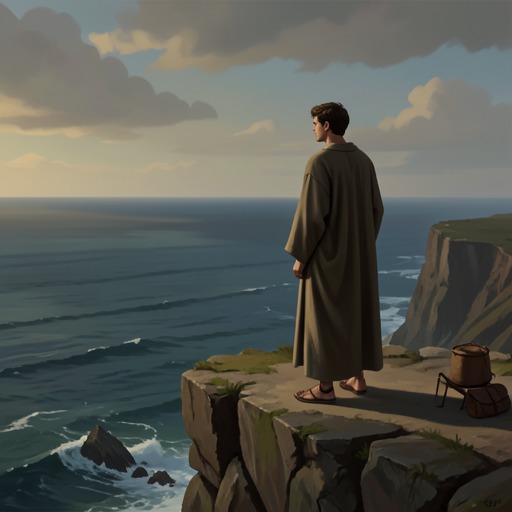
Dimitris Leaves the Monastery After Confession
Cartes Postales from GreeceDimitris’s encounter with a woman seeking confession reopens a shameful memory he has spent years trying to suppress. Rather than leaving the monastery with the spiritual certainty his role promises, he becomes increasingly unable to find relief in confession or prayer, and ultimately departs in distress.
The Confession and Its Revelation
A younger woman from a visiting coach party approaches Dimitris while her husband is looking around a museum. She asks to confess as soon as possible, and Dimitris takes her into the chapel sanctuary. There he puts on the epitrachelion, the priest’s stole associated with the authority to absolve, and sits opposite her to hear her confession. She describes a persistent desire that she cannot set aside. As she speaks, Dimitris recognizes that her voice recalls Natalia, whose voice has troubled him since adolescence. The recognition overwhelms him: he loses consciousness and wakes on the stone floor, with the woman gone and a visiting novice tending to him. The stole lies twisted beneath him, a sign of the abrupt reversal from priest hearing another person’s confession to a man confronted by his own unresolved burden.
The Adolescent Memory and Its Return
The woman’s voice connects the confession to an episode from Dimitris’s adolescence, before he left home for theological school. Giannis had persuaded him to use a telephone extension in their grandmother’s room to listen to a woman called Natalia, whom Giannis had contacted before. Dimitris had been reluctant, but his brother pushed him to take a turn. The experience awakened a desire that was unfamiliar to him; when Giannis showed him a pornographic magazine, Natalia’s image entered his imagination.
The encounter ended when their father came into the room. Giannis stood by the window, while Dimitris was caught off guard. Their father questioned him and then severely beat him. For Dimitris, the lasting wound was not an ongoing sexual relationship but the shame of being discovered: talking to Natalia remained the closest he had come to a sexual encounter, yet the memory followed him for years and entered his dreams. He continued to fantasize about the woman on the telephone, and the confessor’s voice revived that private history after a silence of fifteen years.
The confession thus reverses the apparent roles in the chapel. Dimitris had been placed in the position of a priest empowered to hear and forgive another person; instead, the encounter makes him recognize his own unresolved shame. The memory returns not as a settled recollection but as a persistent burden that his religious vocation has not erased.
The Burden and Departure
The confession continued to trouble Dimitris long after the woman had left. In the months that followed, he lay awake until two or three in the morning, then spent the rest of the night on his knees in prayer, sometimes weeping from the pain of kneeling on stone. He sought confession for himself, but neither it nor prayer eased the burden or quieted his fixation. The icons around him, once sources of comfort, seemed reproachful instead. His religious practices continued, but their promised reassurance no longer reached him.
Giannis visited the monastery, carrying koulouria their mother had made for Dimitris, and left after about an hour. Soon afterward, Dimitris hurried out of the monastery, unable to endure the saints and the surrounding images of heaven and hell. The certainty of salvation had deserted him; he even wondered whether his brother was right to regard coffee and confession as equally ineffective. Nearby caves, where hermits had sought solitude, offered no relief either: there he found himself looking further into his own darkness, pursued by the religious teaching that lustful thoughts were already a sin.
As night fell, Dimitris ran down a hidden path and climbed a nearby mountain whose summit had not been built over by monks. Away from the monastery’s images of judgment, he stopped in the open, mist gathering around him. Giannis, by then driving away, glimpsed a solitary figure on the neighboring summit; fog obscured the man, and when it cleared the mountain appeared empty. The account leaves Dimitris’s fate unresolved, ending with his disappearance from sight rather than explaining what became of him. His departure is the consequence of a crisis that religious authority and repeated acts of penance have failed to settle.
Narrative Significance and Unresolved Ending
The episode closes without confirming what happens to Dimitris after he vanishes from view. Its uncertainty makes the departure more than a physical exit: the narrative offers no assurance that leaving the monastery has freed him from guilt, only a brief image of a solitary figure erased by mist. The surrounding narrator’s reflection turns this unresolved fate toward the difference between solitude and loneliness, and considers the profound psychological and physical effects of the clergy’s vow of celibacy. That shift also places Dimitris’s crisis beside the narrator’s own reflections on being alone, without equating their experiences: the monastery’s isolation has become oppressive to Dimitris, while the narrator describes growing stronger in solitude.