Eirini
Cartes Postales from GreeceEirini is the schoolmaster’s companion and the woman Antigoni paints alongside him. Seen first through a visit to the couple’s home, she is described as a delicate, beguiling woman in her early forties, with laughing eyes and a youthful appearance. The narrative sets this intimate domestic picture against village gossip about the relationship’s beginnings: the contrast makes Eirini’s life visible both as a private attachment and as a subject of public judgement.
Identity and Household
Eirini lives with the schoolmaster, whose library and offer of books bring Antigoni to their home. The schoolmaster presents reading as a pleasure and a way to pass the time, and Antigoni accepts the invitation to borrow books. When she visits, Eirini opens the door; she, the schoolmaster, and Antigoni then sit together over coffee. The scene establishes Eirini not through an account of her past or her own explanation of the relationship, but through her place in a shared household that receives a visitor warmly.
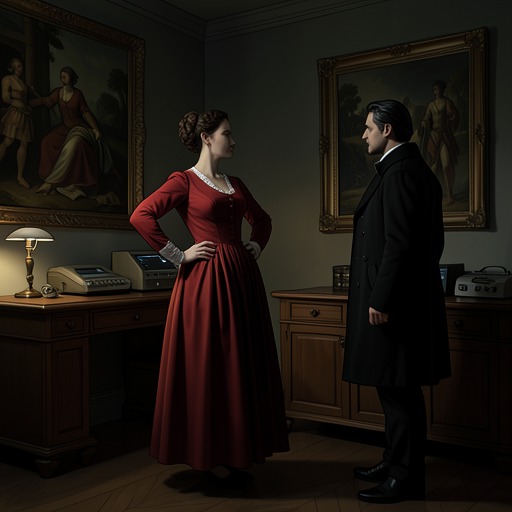
Her appearance is described with unusual care: she is in her early forties, delicate, with laughing eyes, and looks younger than her years. The description gives her an immediate, vivid presence, while leaving her thoughts and personal history unstated. She is not merely a figure glimpsed beside the schoolmaster, however. Along with him, she willingly becomes the subject of Antigoni’s proposed portrait, and the couple’s response helps carry the encounter from hospitality into artistic collaboration.
The Relationship and the Village Scandal
After Antigoni returns home, her maid tells her that the schoolmaster’s household had been the subject of a scandal roughly two decades earlier. According to the account, a former pupil moved in with him when she was eighteen and he was already in his forties. They never married. Many people wanted the schoolmaster removed, but there was no one to take his place as teacher; the matter was consequently overlooked, though not forgotten.
The narrative places this story beside Eirini’s introduction and the couple’s striking age difference, inviting a connection between the former pupil and the woman Antigoni has just met. It does not explicitly identify the former pupil as Eirini, so the identification remains an implication rather than a stated fact. The timing and ages make the association suggestive, while the village’s continuing memory of the affair supplies the social shadow around the couple’s domestic life.
The scandal’s account also describes the unequal conditions under which the relationship was judged. The schoolmaster’s position as the village’s indispensable teacher helped ensure that the affair was tolerated in practice, even when it remained a source of disapproval. Eirini’s own view of the history is not reported. The contrast between a community that remembered and judged and a couple that appears at ease together is therefore mediated by Antigoni and by the maid’s report, not resolved through Eirini’s testimony.
The Portrait and Antigoni’s Response
After spending about an hour in conversation and choosing books, Antigoni asks whether Eirini and the schoolmaster will sit for a portrait. They accept immediately, and she arranges to return the next day to make a sketch. The couple’s readiness matters: they take part in shaping how their relationship will be represented, rather than resisting the attention or the image it may create.
Antigoni finds pleasure in portraying their cheerful disposition and the love they have for each other. She sees no judgement to be made, and the finished painting becomes her favourite so far. That response directly opposes the village’s lingering scandal: where gossip defines the couple by the circumstances in which their life together began, the portrait attends to their present affection. Eirini’s narrative significance lies partly in this change of view. She enters through other people’s accounts, but the painting makes the couple’s visible companionship—not the remembered accusation—the centre of Antigoni’s attention.
Narrative Role and Limits
Eirini’s role is concentrated in a small sequence: the invitation to borrow books, the coffee visit, the proposal to sit for a portrait, and the revelation of an old scandal. Books and the prospect of a good story provide the occasion for the meeting; the portrait gives it a lasting artistic outcome. The sequence moves between hospitality and hearsay, showing how readily a private household can be framed by the village’s memory of its past.
The account gives Eirini a distinctive appearance and a place within a loving partnership, but offers no direct speech from her and no independent account of her history. That restraint limits what can be claimed about her motives or feelings. Her willingness to sit for the portrait and the affection Antigoni observes are concrete details; the scandal’s connection to Eirini remains implied. Together, these elements make her a quietly significant subject in Antigoni’s artistic development: the woman whose present life is recorded with warmth, even as an old public judgement still surrounds it.