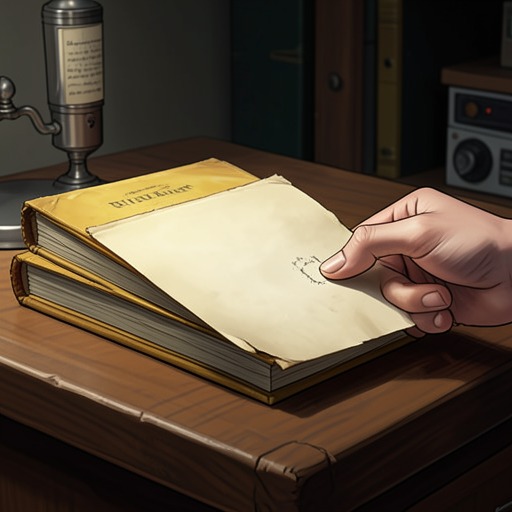
Ellie returns Anthony’s notebook
Cartes Postales from GreeceEllie Thomas’s return of Anthony Brown’s notebook brings her postcard-led journey to a point of personal contact: she crosses Athens to find the man whose package reached her by mistake, then places the battered blue notebook back within his reach. What began as an anonymous correspondence she could only look at becomes a meeting with its human recipient. The return matters not only because the notebook is restored, but because it has been a companion to both of them in different ways.
From the Postcards to the Decision
Before the notebook brings Ellie and Anthony together, Greece has entered Ellie’s life through postcards. She pins them to a corkboard, where their blue-and-white skies, seas, boats and whitewashed buildings gather into a vivid mosaic. Their place names, among them Methoni, Mystras and Nafplio, stir her imagination; gradually, a country she has never visited becomes more than a set of pictures. The cards offer only a snapshot, and cannot give her the scents or sounds of the places depicted, but that incompleteness does not weaken their pull. She is falling in love with Greece from a distance.
That distance becomes harder to bear during the winter in London. Ellie leaves for work before dawn and returns after dark to a flat whose curtains remain shut; her job selling advertising space does not fulfil the promise of a route into publishing. The postcards cheer her, while her ordinary routine feels increasingly unlike the life she had expected. When they stop arriving, she checks her pigeonhole each morning and feels the disappointment of each empty search. Back in her flat, she sees the cards curling on the board and wonders whether their sunlit images exaggerate the country. She buys a flight to Athens and books a week near Nafplio, a spontaneous choice that nevertheless feels as if it has been planted by the cards over many months.
The journey gives her more than the postcard version of Greece. On the way, she encounters a beautiful fishing village near Lamia whose residents show little welcome to visitors: restaurants dismiss her request for a table, and there are no hotels, rooms, or even postcards for sale. The absence of filoxenia unsettles her idealized expectations. Yet the trip also changes how she experiences being alone. After leaving the village, she accepts a cheerful hotel owner’s invitation to stay another night and finds that the word alone has lost some of its sting. This is the traveler who eventually decides that the notebook cannot simply remain with her.
Choosing to Find Its Owner
As Ellie prepares to leave Greece, the notebook forces a choice. She knows the package was not meant for her and that Sarah Ibbotson never received the postcards; returning it means explaining both the mistaken delivery and her having opened it. She refolds the envelope and puts it in her bag, but the prospect of losing the days she has just lived also sharpens the moment. Her clothes still smell of sun cream and carry salt and sand, and she is reluctant to wash away the traces of the trip. Even as she weighs what to do about the writer, she knows she must seek him out.
The following morning, Ellie leaves her hotel in Tolon after breakfast, takes a taxi to Nafplio, and has one last coffee in the square before going to the bus station. The coach carries her back to Athens; she sleeps during the journey and wakes to find herself in the city in the heat of the day. She has two purposes before her flight the next morning: to deliver the notebook and, if time allows, to visit the Acropolis. With the afternoon already advancing and the temperature above thirty degrees, finding the address is urgent rather than ceremonial.
The Encounter in Athens
Ellie uses a metro map to work out how to reach Aristophanous Street, but the journey would require several changes after a long walk to the nearest station, so she takes a taxi. The driver leaves her well short of her destination to save time. She continues on foot until she finds the right street and number, then searches a panel bearing several dozen bells for the name she needs. When she rings, a man answers. Ellie nervously says she has a package for him, and he invites her upstairs to the top floor.
The approach to the meeting is unceremonious and exposes Ellie’s discomfort. As the lift clanks up to the sixth floor, its mirrored wall shows her sun-dried, bleached hair, burnt nose and perspiring face. In her T-shirt and shorts, she feels underdressed for the smart apartment block. When the doors open, Anthony Brown is standing there: slim, with thick brown hair touched by grey, jeans and a grey T-shirt. But he looks not at Ellie’s face first. His attention goes straight to the battered blue notebook in her hands.
Anthony’s shock is immediate. He asks where she got the notebook, and Ellie feels suddenly like a thief; her first impulse is to thrust it at him and run down the six flights of stairs. She stays long enough to explain that he sent it to her, though she recognizes how absurd that must sound. The notebook has made the encounter awkward before either of them can establish the facts, turning a simple return into a moment of exposure for both: Ellie must account for possessing something that was never meant for her, and Anthony is confronted with an object he had not expected to see again.
The Notebook Returned
Inside, Ellie asks for water. Anthony sits opposite her and refers to the journal on her lap as a former companion. Ellie answers that it has been hers as well, in a way, and puts it on the table between them. The placement gives the return a quiet physical form: the notebook moves from Ellie’s custody into the shared space between its former owner and the accidental recipient. Anthony picks it up and turns it over with exaggerated care before slowly flicking through its pages. He says he is glad it did not disappear into the ether.
Anthony then asks solemnly whether something has happened to Sarah. The question makes clear that the notebook’s significance is not exhausted by its battered cover or by Ellie’s attachment to it during her travels. It belongs to a history and a concern that Ellie does not yet control. The scene therefore does not resolve everything the postcards have set in motion; it brings Ellie to the person behind the return address and opens a conversation whose emotional stakes are larger than the delivery itself. The notebook has connected two strangers through absence and error, and its return is the first moment when that connection can be acknowledged face to face.