Evangelia
Cartes Postales from GreeceEvangelia’s life is shaped by two lasting forms of remembrance: her youthful love for Franz Dieter during the German occupation and her annual return to a parade where her granddaughter carries the Greek flag. The contrast between public national pride and a private family secret gives her story its defining tension. What she once experienced as a moment of youthful glory becomes, decades later, the setting in which she recognizes the cost of keeping silent.
Identity and Early Significance
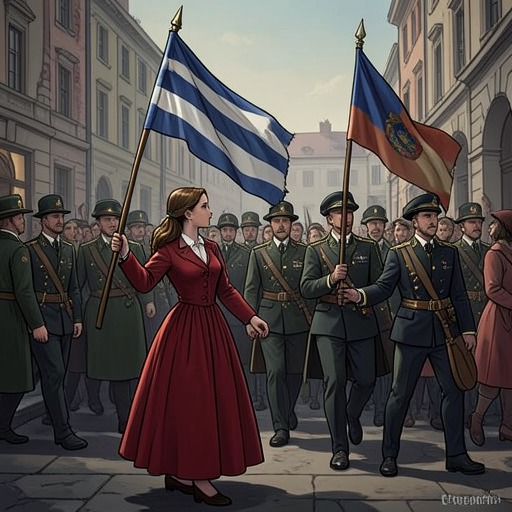
As a young woman, Evangelia earned the privilege of carrying the national flag in a parade by being top of her class. The honor remained vivid for decades: each year, she relived her own moment of glory as the parade approached. In old age, she watched with pride as her granddaughter, also named Evangelia, prepared to bear the flag. The role passes from grandmother to granddaughter, turning a remembered achievement into a family inheritance.
The flag’s design gives this inheritance a national meaning. Its nine horizontal stripes recall the nine-syllable rallying cry associated with the Greeks’ struggle to rid their country of the Turks. For the crowd, the blue-and-white flag is a familiar emblem of shared identity; for Evangelia, its public symbolism presses against a private history that complicates any simple account of belonging.
Love During the Occupation
Evangelia was eighteen when German soldiers marched into her city. Her father owned Je Reviens, a café near the port, and the occupying authorities forbade him to close it. The café soon became popular with German soldiers. Evangelia’s mother refused to take part in its operation, while her brothers left the city to join the resistance. As the only family member left to help her father, Evangelia washed glasses and cleaned tables, and she was not permitted to speak to the soldiers.
She hated the German soldiers, many of whom were drunk and undisciplined when off duty, but made an exception for one. Franz Dieter sat quietly apart from the others, apparently keeping watch over them. When their fights became unruly, he disciplined the men responsible and threw them out onto the pavement. Higher-ranking than the rest, he did not drink with them; he sat and read instead. Evangelia’s account distinguishes him from the occupying soldiers around him without erasing the circumstances that brought him into her father’s café.
Their attachment ended under the pressure of separation. At their last meeting, Evangelia asked in French whether he would come back. Franz did not answer. They stood facing one another in the café, and Evangelia took his hand and led him into the shadows because she urgently wanted to kiss him one last time. Her feelings surfaced in a moment that offered no promise or reassurance: his silence leaves the question of return unresolved.
The Secret and Its Inheritance
The wartime relationship becomes a secret that outlasts the occupation. Evangelia’s daughter, Efi, was never told who her father was. She grew up in a period of relative peace and later had children of her own, naming her eldest daughter after Evangelia. Efi resembled her mother rather than her German father, whose blond, Teutonic appearance left no visible trace in her. That resemblance helped keep the secret concealed; the account connects Efi’s unknown paternity to Evangelia’s lost relationship with Franz.
Decades later, the family history remains legible to Evangelia even though it is hidden from the people around her. At the parade, she hears the conversation turn to whether an Albanian boy has a right to carry the flag. She worries that he may have understood the remarks, and her shame deepens because she did not support a woman who objected to them. The incident forces her to recognize the contradiction in the crowd’s judgment: if the boy is unworthy because of his origins, then her granddaughter is also excluded by the same standard. The granddaughter’s father, like the boy’s, spoke little Greek, and Evangelia knows that the child is not considered pure in blood. The secret has survived for years, but the flag-bearing ceremony makes its implications immediate.
Rituals of Remembrance
Evangelia’s private mourning has its own annual pattern. On 25 March, her name day, she goes to church and lights a candle for Franz, who never promised to return. Even so, she continues to hope that she might see him again. When German tourists pass, she scans their faces for his sapphire eyes and gentle smile, carrying the possibility of recognition into encounters that cannot resolve her loss.
After the church, she takes a taxi to the port and stands outside the abandoned café. As she does every year on that day, she removes an old, battered book from her handbag and silently reads a particular poem. These repeated gestures preserve a connection the original meeting could not secure: the candle marks Franz’s absence, while the poem and the return to Je Reviens keep the remembered love attached to a specific place and ritual. Evangelia’s history therefore moves between two recurring scenes—the flag parade, where the family secret challenges public definitions of belonging, and the deserted café, where she continues to wait in memory for a man who gave no answer.