Evangelia and Franz's Love Affair and Farewell
Cartes Postales from GreeceEvangelia and Franz Dieter’s love affair and farewell begin in a café made busy by occupation and end with Franz’s departure from Greece. Their relationship grows through the protection he offers Evangelia’s family and the conversations they manage in French, a language shared privately in a room otherwise dominated by soldiers. The farewell is both an intimate parting and the origin of a family secret: Franz leaves without promising to return, and the daughter Evangelia later bears is never told who her father was.
The café under occupation
Evangelia was eighteen when German soldiers entered her city. Her father owned Je Reviens, a café near the port, and the occupying authorities forbade him to close it. Its busy location made it convenient to the soldiers, and it soon became popular with them. Evangelia’s mother refused to take part in the business; her brothers had left to join the resistance. With no one else to help her father, Evangelia washed glasses and cleaned tables, while being instructed not to speak to the customers.
Most of the soldiers struck her as drunken and undisciplined. One was different: a higher-ranking man who sat apart, read, and did not drink with the others. When fights broke out, he intervened and expelled those responsible. That distinction became personal when a young corporal touched Evangelia as she carried a tray. Her father confronted the jeering soldiers, and one man rose and drew his gun. Evangelia feared that she and her father might be killed. The quiet soldier stood up and shouted an order; the younger man put his weapon away, and the offending group did not return. From then on, seeing the officer at his usual table made Evangelia feel safe. Her father, recognizing the protection he provided, never charged him for coffee or the occasional glass of raki.
A language held between them
A few days after the confrontation, Evangelia saw the officer reading a book in French. It was a subject she had excelled in at school, and despite the rule that she keep her distance from customers, she spoke to him to thank him for saving her father. He explained that he had acted from duty. They exchanged names: he was Franz Dieter, and she was Evangelia. The conversation altered how she saw him. German, which she associated with a harsh sound, had seemed at odds with him; French, linked in her mind with poetry and literature, offered another way to know him.
Their exchanges remained brief, but they recurred over several months. French was foreign to both of them and incomprehensible to the other people in the café, giving their conversations a privacy that their circumstances denied them elsewhere. Franz asked Evangelia not to assume that all Germans thought or wanted the same things. He could say little more without risking a court-martial, but the request asked her to see him as an individual, not simply as one of the occupying soldiers.
As they talked, Evangelia learned that Franz had not chosen military service. Before being made a soldier, he had taught French at a university and lived in Dresden; he had wanted neither to leave his post nor to abandon his home. Over the following year, Evangelia looked for him each day. He told her in advance when duty would take him away, and both understood that their attachment was growing. Their formal conversations allowed feeling to accumulate without either having to declare it openly. The day Franz first asked whether he could address her informally became meaningful to them both. Her French improved, and her father did not object to their talking, in part because Franz’s presence helped protect the café.
The departure and farewell
Three years after the German soldiers had arrived, news spread that they had been defeated and would leave Greece. People celebrated quietly, though many waited to believe it until the soldiers were actually gone. One night, while the café was empty, Evangelia was behind the bar polishing glasses. Her father was still upstairs. The entrance bell sounded, and she turned to find Franz holding a small pile of books. He told her they were for her and that the soldiers were leaving.
The books were the ones he had been reading over the preceding months. Franz said that he could not take them with him. Evangelia put them down and embraced him. Their relationship had never before brought them so close; Franz initially tried to draw away, conscious that her father or another soldier might appear. But the embrace gave way to a kiss. For both, the encounter brought discovery as well as panic, intensified by the knowledge that they might never meet again.
Evangelia asked whether Franz would return. He did not answer. They remained facing one another in the café until she took his hand and led him into the shadows, seeking another kiss before he left. In a small storeroom he laid down his jacket for her, and they became intimate there until her father’s approaching footsteps interrupted them. Franz left quietly through another door, holding Evangelia’s fingers until the moment he had to let go. After he was gone, she straightened her clothes and hair and returned to the bar. The books remained on the table; she picked them up and held them close, claiming them as hers.
The farewell’s lasting consequences
The German withdrawal did not bring an easy recovery. Evangelia’s family, like other ordinary families in Greece, struggled to rebuild amid devastation. The brothers who had joined the resistance became caught up in renewed fighting between Left and Right, and several years passed before either returned to Thessaloniki. Hundreds of thousands of Greeks had died during the occupation, many from starvation, and the widespread undernourishment meant that Evangelia’s pregnancy was noticed outside her family only in its seventh month.
Her parents accepted the pregnancy, and the family invented a story of a fiancé who had failed to return from the front. In a period marked by loss, a child without a present father was not unusual. When Efi was born, she was adored by the people around her and regarded as new life amid dust and rubble. She was never told that Franz was her father. She grew up in a relatively peaceful period and later had children of her own, naming her eldest daughter after Evangelia. Her resemblance to her mother, without any trace of Franz’s blond appearance, helped keep the secret.
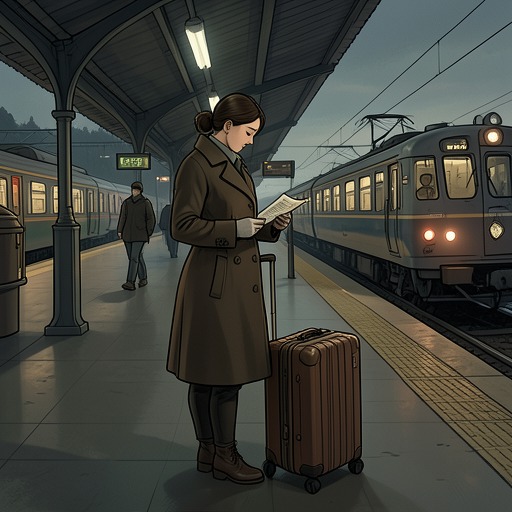
Evangelia’s attachment did not end with the departure. On the afternoon of 25 March, her name day, she went to church as she did each year and lit a candle for Franz. She had no promise from him, only the hope that she might see him again. When German tourist groups passed through, she searched their faces for his blue eyes and gentle smile. Afterward she took a taxi to the port and stood outside the abandoned café. Each year she brought an old, battered book from her handbag and silently read a particular poem. The books Franz had left behind thus became more than gifts: they belonged to the private language through which the relationship had begun, and to the annual ritual by which Evangelia kept its unresolved ending alive.