Franz Dieter
Cartes Postales from GreeceFranz Dieter is a German soldier whose conduct sets him apart from the occupying troops around him and whose connection with Evangelia develops through their shared French. Their relationship culminates in a hurried farewell as the Germans leave Greece; afterward, Evangelia keeps alive the hope of seeing him again, and the narrative places their final encounter beside the secret of Efi’s unknown father.
Identity and Wartime Setting
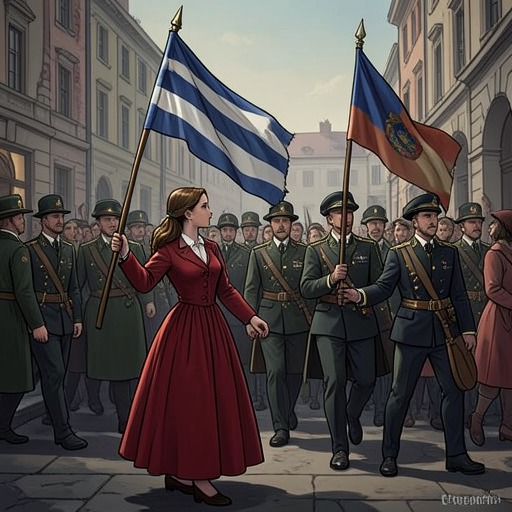
When German soldiers entered Evangelia’s city, she was eighteen and her father’s café, Je Reviens, was required to remain open. It became popular with the occupying soldiers, many of whom were drunk and disorderly when off duty. Franz, by contrast, sat apart, read, and did not drink with them. A higher-ranking soldier, he sometimes intervened when fights broke out, disciplining those responsible and turning them out onto the pavement. His quietness distinguishes him within a setting where the surrounding soldiers’ power over civilians is immediate and threatening.
Franz’s distance from the others does not mean that he stands outside the occupation: he is a German soldier in a city controlled by German forces. But the story gradually establishes that he did not choose military service. He had wanted to remain in his university post teaching French and in his home in Dresden; he had chosen neither to leave them nor to become a soldier. This account gives personal circumstances to the man Evangelia first encounters as one of the occupying soldiers, without erasing the danger his presence represents.
Protection and a Shared Language
Franz’s protective role becomes personal when a young corporal touches Evangelia as she carries a tray. Her father confronts the jeering soldiers, and one draws a gun. Before the threat can become violence, Franz stands and sharply orders the younger man to put it away. The offending group does not return to the café. From then on, Evangelia feels safe when Franz is in his usual corner; her father, in turn, does not charge him for coffee or the occasional glass of raki.
A few days later, Evangelia notices that Franz is reading in French, a subject in which she had excelled at school. Although she has been instructed to keep her distance from customers, she speaks to him to thank him for protecting her father. Franz says that he acted from duty. They exchange names and begin talking in a language both love, though it is foreign to them both and unintelligible to the café’s other customers. For Evangelia, hearing him speak the language she associates with poetry and literature changes how she sees him: German had seemed ill-suited to him, while French makes another aspect of his character audible.
Their brief conversations continue over the following months. Franz asks Evangelia to understand that Germans do not all want or believe the same things; saying more, he indicates, could bring a court-martial. His request is not a defense of the occupation but a plea to be seen as an individual. Over the following year, Evangelia looks for him each day, and he tells her beforehand when duty will take him away. Their formal conversations carry a growing attachment. A small change in address—the day he first asks to use the informal form of you—becomes meaningful precisely because so much between them remains unspoken. Evangelia’s French improves, and her father does not object to their talks, since Franz also offers the café a measure of protection.
Departure and Farewell
Three years after the German troops arrived, rumors spread that they had been defeated and would leave Greece. The news is quietly celebrated, but many wait for proof. One night, with the café empty, Evangelia is polishing glasses behind the bar when Franz comes in carrying a small pile of books. He gives them to her and tells her that the soldiers are leaving. The books are well-worn; as she takes them and glances at their spines, she blinks back tears. The gift is a tangible remnant of the reading that had first opened their conversations.
The two stand looking at each other until Evangelia takes Franz’s hand and leads him into the shadows. Their last kiss is no longer timid: the approaching departure turns their restraint into a passionate farewell. In a small storeroom, Franz lays down his jacket for her, and they make love until Evangelia’s father’s footsteps interrupt them. Franz leaves quietly through another door, holding her fingers until the last moment when he has to let go. The encounter is brief, private, and unfinished; he has not promised to return, and their parting supplies no assurance of reunion.
The Life of the Farewell
The narrative subsequently relates that Efi was never told who her father was. It says that she resembled Evangelia rather than inheriting her father’s blond, Teutonic appearance, and that this resemblance helped keep the secret. Placed after Franz and Evangelia’s final encounter, this account strongly invites the reader to connect him with Efi’s concealed parentage, while Efi herself remains uninformed. The contrast is stark: the adults’ last meeting is intensely intimate, yet its consequence becomes a family secret that is not disclosed to the child.
Franz’s absence persists in Evangelia’s repeated acts of remembrance. On the afternoon of 25 March, her name day, she goes to church and lights a candle for the lost Franz. She has always hoped to see him again, though he never promised to return; when German tourists appear, she scans their faces for his sapphire eyes and gentle smile. Afterward, she takes a taxi to the port and stands outside the now-abandoned café. As she does every year, she takes an old, battered book from her handbag and silently reads the poem Présence de Dieu. The café, once the place where a book in French began their connection, has fallen silent, but her annual reading renews the memory. Franz’s narrative significance lies in this unresolved passage from danger to intimacy and from departure to remembrance: he becomes both a particular man whom Evangelia loved and the absent figure around whom her hope and Efi’s hidden history gather.