German occupation of Greece during World War II
Cartes Postales from GreeceThe German occupation of Greece during World War II is portrayed as an imposed presence in everyday life whose end did not end its consequences. In Thessaloniki, the occupation entered a family café, separated Evangelia from her brothers, and formed the backdrop to an attachment between her and a German officer. Its aftermath brought hunger, displacement, and further conflict, while the wider narrative sets Greece’s inviting postcard image against the history still carried by its places.
Occupation and Civilian Life
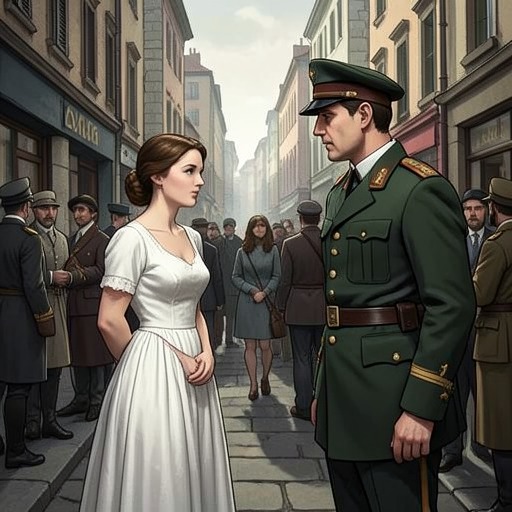
When German soldiers marched into Evangelia’s city, she was eighteen. Her father owned Je Reviens, a café near the port, in a busy location that the Germans would not allow him to close. The bar soon became popular with occupying soldiers, turning the family business into a place where civilian survival and military occupation met each day.
Evangelia’s mother refused to take part in running the café, and her brothers had left to join the resistance. Evangelia was therefore the only family member available to help her father. She washed glasses and cleaned tables, but was forbidden to speak to the soldiers. The occupation thus shaped not only the family’s circumstances but also the limits placed on her ordinary movements and speech.
The soldiers were often drunk and ill-disciplined when off duty. Evangelia hated them, with one exception: a higher-ranking officer who sat apart, read, and intervened when fights became unruly. He disciplined the men responsible and ejected them from the café. In the narrative’s account, he also offered the establishment a measure of protection, complicating the simple division between the occupying force and the daily life it controlled.
Evangelia and Franz Dieter
Over the following year, Evangelia looked out for Franz Dieter each day. When duty would take him away, he told her in advance; their attachment grew within the formality of their conversations. A small change in address—the moment he asked to use the informal French pronoun—became meaningful to the two of them. Evangelia’s French improved, and her father did not object to their conversations, partly because Franz offered some protection to the café.
Their connection unfolds under conditions created by occupation, rather than outside them. The café remained a place where soldiers gathered and where Evangelia had been told not to speak to them; within that constraint, a private understanding developed. The narrative does not make this attachment erase the coercive setting. Instead, it places an intimate relationship alongside the family’s dependence on the café and the resistance activity that had drawn Evangelia’s brothers away.
Withdrawal and the Hardship That Followed
Three years after the Germans had marched in, news began to circulate that they had been defeated and would leave Greece. The announcement was met with quiet celebration, but many people withheld belief until the soldiers were actually gone. The troops retreated in 1944; their withdrawal marked the end of the occupation, not a return to security or prosperity.
In the following months, Evangelia’s family struggled alongside other ordinary families to rebuild. The joy of the Germans’ departure was shadowed by the devastation left behind. Her brothers were drawn into renewed fighting between Left and Right, and several years passed before either returned to Thessaloniki. The transition from occupation to peace was therefore neither immediate nor complete: another conflict prolonged the family’s separation and the city’s instability.
The account describes Greece as chaotic and impoverished after the occupation. Hundreds of thousands of Greeks had died during those years, many from starvation, and the population was broadly undernourished. Evangelia’s pregnancy did not become noticeable to people outside her family until her seventh month. Her parents accepted it, and the family invented a story of a fiancé who had never returned from the front—a plausible explanation in a period when fatherless children were not unusual. When the baby was born, relatives and neighbors adored her; new life amid dust and rubble was received as a blessing.
Historical Memory and the View from Later Greece
The narrative connects the occupation’s immediate aftermath to a longer accounting of its damage. It describes German troops as having destroyed resources and infrastructure during their 1944 retreat, and records continuing Greek demands that Germany pay what was still owed. The narrator cites an estimate of nearly 300 billion euros in current value for the unpaid costs of Nazi war crimes, infrastructure damage, and a forced loan extracted from Greek banks, presenting the figure in relation to the debt burden crippling Greece in the present.
Thessaloniki bears a particular mark of this history in the deportation of more than fifty thousand people, the majority of Greece’s Jewish population, by train to Auschwitz; very few escaped. The narrative observes that such hardship can be difficult to imagine on a sunny spring day, even as memories remain. That contrast echoes the broader travel narrative: postcards gather blue skies, sea, boats, and whitewashed buildings into a colourful mosaic, but offer only a glimpse of the country. The distance between that appealing image and the history beneath it makes the occupation not just a period in the past, but a continuing presence in how Greece’s places are seen and remembered.