Giannis
Cartes Postales from GreeceGiannis is Dimitris’s older brother and a successful Athens coffee-franchise owner whose yearly journey to visit him at Meteora brings two sharply different lives into view. For Giannis, the trip combines family duty with the exhilaration of a fast car; for Dimitris, it is a rare meeting with the brother whose everyday world remains distant from the Church. Their brief encounter culminates not in a revelation between them, but in Giannis driving away and seeing a solitary figure vanish into the mountain mist.
Family Background
As boys, Giannis and Dimitris seemed to their mother to be pursuing opposite habits. Dimitris prayed and kept a Bible tucked beside his bed, while Giannis had acne and hid dirty magazines beneath his mattress. Their mother hoped they would both outgrow their respective inclinations; their father threatened to beat them if they did not. In time, Giannis’s spots cleared, while Dimitris entered training for the priesthood and was sent far from the family. The contrast that began in the household became a distance between their adult lives: Dimitris lived among monasteries, and Giannis built a business in the city.
Business and the Annual Visit
Giannis runs five outlets of a coffee franchise in Athens. During the Greek crisis, he set the lowest prices in the city, and queues formed outside every branch each morning. His business was doing well even as the country struggled. When Dimitris asks how things are going, Giannis replies that people will spend their last cent on espresso, even while Greece collapses around them. His answer turns economic hardship into the setting for his success: crisis brings customers to his low-priced coffee, and he is prospering from their daily demand.
Each year Giannis makes the long journey to see his brother. He usually travels early in the year, when the weather is misty; on this visit, heavy snow has fallen in the region. The road from Karditsa gives him a chance to drive fast, and that is what produces his surge of adrenaline—not the first sight of the remote monasteries ahead. His cars have grown more conspicuous over the years: a Nissan in the early days of Dimitris’s mountain life, then a BMW, and now a red Porsche. Yet Dimitris never sees the car itself, since Giannis must park some distance from the monastery.
The visit also makes clear how little the brothers share in their daily routines. Giannis knows what Dimitris has been doing—reading the Bible, praying and meditating—and is unsure whether prayer and meditation are different things. He is more curious about confession: what people might disclose to Dimitris, and how a man who knows nothing of sin could respond to them. The curiosity does not bridge the gap between their experiences. It registers, instead, the difficulty Giannis has imagining his brother’s work from within.
Departure from Meteora
The approach to the monastery exposes a small but telling mismatch between Giannis’s preparation and the landscape. He has forgotten to bring a change of shoes, and his suede loafers are unsuitable for the long climb through ancient trees and damp leaves. Even so, the steep ascent is part of the annual journey. The monasteries, perched high above the houses below, make the visit a passage into a world that Giannis encounters only once a year.
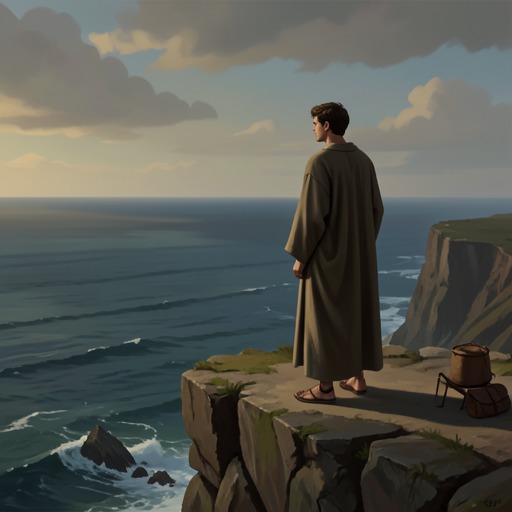
As darkness falls, Giannis smokes a second cigarette, checks his reflection in the rear-view mirror and starts the car. Rounding a bend, he sees the monastery, unlit and lonely. Then he notices a solitary man on a neighbouring mountaintop, surrounded by swirling mist and constantly reforming clouds. The fog hides the figure; when it clears a few seconds later, the man is gone and the mountain is empty. Giannis turns up the radio and drives on. He does not stop to investigate or call out. The scene offers no explanation for what he has seen, and his departure leaves the sight unresolved.
Narrative Role
Giannis’s visits give the story a human scale for the distance between worldly success and religious seclusion. His red Porsche, thriving chain of coffee outlets and pleasure in an empty road stand against Dimitris’s repeated life of prayer and meditation. Yet Giannis is not simply indifferent to his brother: he makes the journey every year and remains interested in what confession reveals about people. The interest is real, but it remains an outsider’s curiosity, unable to turn the monastery into a familiar place.
The final sight on the mountain sharpens that contrast without resolving it. A solitary figure appears beside the monastery and disappears into mist; Giannis responds by driving on with the radio louder. Whether the encounter has any larger meaning is left open. What the scene does establish is the limit of his contact with that mountain world: he witnesses an image of isolation, but the visit ends with his return to the road.