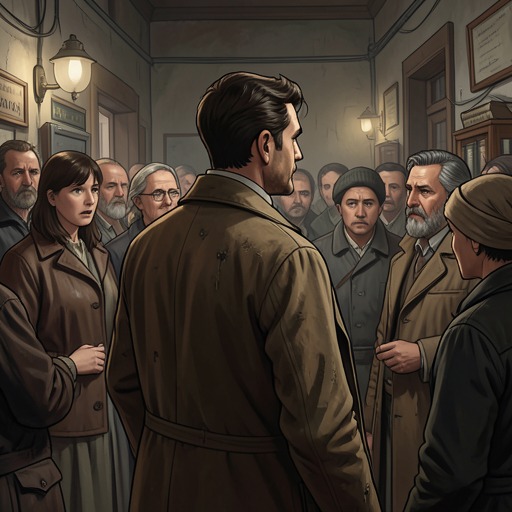
Giorgos Learns Mihalis Is Alive at the 2010 Theophania Ceremony
Cartes Postales from GreeceAt the 6 January 2010 Theophany ceremony, Giorgos Ziras learns that Mihalis Nikopoulos, long believed dead after disappearing during the cross-diving ritual, has survived. The recognition comes not through a confession or public explanation, but through a glimpse in the crowd and news of a funeral. For Giorgos, who has spent nearly forty years living under suspicion and guarding his innocence, the news transforms the ceremony from a yearly act of endurance into the first promise of vindication.
The ritual and its history
The ceremony belongs to the Greek Orthodox calendar, but it also structures public life in the town. In 2010 the church is crowded, and the procession to the sea gathers clergy, municipal dignitaries, representatives of the army and navy, and townspeople. Young boys in orange brocade wait to carry the cross; nearby, young men prepare to enter the water. The formal religious observance and the swimmers’ contest share the same public stage.
The cross-diving contest brings both religious recognition and local standing. The senior priest releases the cross into the sea, and the swimmers race to retrieve it. The winner receives a special blessing and becomes a local hero. Mihalis had won for ten years, moving through the cold water with an ease that made his success seem assured. His place in that annual ritual helps explain why his disappearance became so consequential: the ceremony was not simply a contest, but a recurring event through which the community watched its young men and recognized its champions.
The 2010 observance echoes an earlier Theophany in the late 1970s, when the church had also been full and the liturgy proceeded in its customary rhythm. Giorgos had attended that earlier ceremony as a competitor, swimming trunks beneath his clothes and later waiting outside wrapped in a towel. The cross was released after the priest immersed it three times. In the crowded water, Giorgos lost his goggles and struggled to see. Mihalis disappeared in connection with that ceremony, and the unresolved event left Giorgos under a cloud of suspicion rather than providing an answer about what had happened.
Giorgos returns to the crowd
By 2010, Giorgos’s relationship with the ceremony is shaped by the years that followed Mihalis’s disappearance. He avoids people who might know him and takes particular care to keep away from the men who had swum on the day Mihalis vanished. His attendance is deliberate: Theophany is the one day when he feels able to hold his head high, and returning each year serves as a quiet insistence on his innocence.
That insistence has come at a cost. Giorgos has lived almost as a shadow, remaining with his mother and avoiding the town centre. He works at a feta-packing and export company an hour’s drive away. From April to October he stops on his way home to swim alone at a deserted, inaccessible beach; in winter he goes directly home. He and his mother never discuss the disappearance, but he understands that the stigma and the unproven suspicion have also weighed on her. At the ceremony, the swimmers are now the children and grandchildren of his generation, while many spectators are the same people who witnessed the old event.
A church service held three years after Mihalis’s disappearance had drawn a congregation as large as the Theophany crowd. The scale of that gathering shows how fully the missing man’s fate had entered the town’s shared life. For Giorgos, however, public attendance has never meant that the matter is settled. He cannot seek forgiveness for a sin he does not believe he committed; the contradiction leaves him feeling both guilty and innocent, a man treated as a criminal without a crime.
A glimpse and a confirmation
As the ceremony proceeds, Giorgos scans the crowd, trying not to stand too close to anyone connected with the old disappearance. A detail on one man catches his attention: a dolphin tattoo at the back of the man’s neck, visible above a cheap leather jacket. The man is nearly bald, wears semi-opaque sunglasses and a dark blue cap, and stands at the edge of the crowd. His face is largely obscured. Giorgos thinks the man may be Mihalis; the possibility unsettles him, and he tries to put distance between them.
Giorgos’s recognition is not initially confirmed by a conversation with the stranger. Instead, he encounters Leonidas, the loyal schoolfriend who has never doubted his innocence. Their exchange is interrupted by news that Markos Nikopoulos, Mihalis’s father, died the previous day and that his funeral will take place that afternoon. The death supplies the circumstance that makes the stranger’s presence intelligible: Mihalis has returned for his father’s funeral, keeping out of public view so that only close family may know he is there.
That inference becomes certainty for Giorgos. The man he glimpsed is Mihalis Nikopoulos, and Mihalis is alive. The revelation reverses the most important assumption attached to the old disappearance, even though it does not explain how Mihalis vanished, where he had been, or why he remained absent. The scene therefore delivers confirmation of survival without supplying a full account of the past.
Relief and unresolved consequences
Giorgos begins to cry. Leonidas cannot understand why the death of Markos Nikopoulos should bring such grief, but he holds Giorgos as the sobbing becomes uncontrollable. The response is not simple mourning: the news has brought the possibility of exoneration, vindication, and absolution after decades in which Giorgos could neither prove his innocence nor escape the stain attached to his family.
The ceremony does not itself clear Giorgos’s name in public, and Mihalis’s return remains discreet. Its consequence is first inward: what Giorgos had been unable to know is now certain to him, and the man whose disappearance shaped his life is no longer dead. The recurring ritual, once bound to accusation and loneliness, becomes the setting for that change. The story closes the event on Giorgos’s relief and Leonidas’s support, while leaving the unanswered history of Mihalis’s disappearance in place.