Giorgos Ziras
Cartes Postales from GreeceGiorgos Ziras is a water-polo player whose victory in the town’s Theophany cross-diving ritual becomes inseparable from the disappearance of his predecessor, Mihalis Nikopoulos. Though Giorgos wins the cross through skill and persistence, the community reads the outcome through their rivalry and leaves him to live under suspicion for nearly forty years. His repeated return to the ceremony makes it both a public contest and a private insistence that he is innocent.
Identity and Introduction
The story introduces Giorgos at the church on 6 January 2010, standing near the entrance and watching a crowded service. The ceremony joins ordinary family gestures with formal religious pageantry: worshippers kiss an icon, light candles, and make room for children to move towards the front. Outside, boys in ceremonial clothing wait to carry the cross to the sea, while young men gather for the dive. Giorgos is present among the spectators, but the story’s movement between this gathering and an earlier ceremony gives his stillness a history: he has returned to the same ritual for decades.
In the earlier episode, the young men selected to dive are members of the town’s water-polo squad, an unusually prestigious group whose standing exceeds that of local officials and police officers. Taking part in the ritual is one of the privileges attached to membership. Giorgos is the team’s newest member. His speed and agility have earned the coach’s confidence, and his selection for important games has made the others resent him. The contest therefore begins before anyone enters the water: his place in the team has already unsettled its hierarchy.
The Cross and the Rivalry
Giorgos’s arrival has displaced Mihalis, the squad’s long-serving captain and highest-ever goal-scorer. Mihalis had anchored the team for a decade, but the coach told him shortly before the ceremony that he would no longer be needed and that his ten years as captain were over. The coach allowed him one final chance to retrieve the cross. Although Mihalis gives no visible sign of emotion, the account presents the dismissal as a shock that intensifies the rivalry. Giorgos has the advantage in speed and agility; Mihalis is powerful but has begun losing points for fouls, making him a liability to the team.
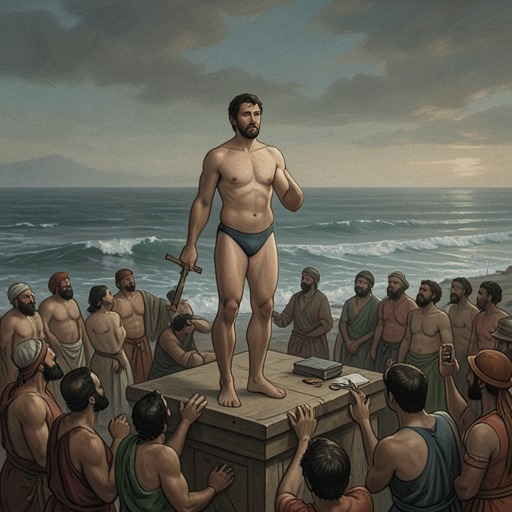
For ten years Mihalis has won the cross-diving contest, and the winner receives not only a special blessing but the standing of a local hero. The competition is thus both religious ritual and public measure of status. As the priests and civic representatives process from the church to the sea, the swimmers wait on a platform. When the priest releases the cross, Giorgos is pushed from the platform and loses his goggles in the crowded water. He nevertheless continues diving. He sees Mihalis near the cross, then finds it wedged beneath a rock. Rather than merely pull at it, Giorgos shifts the rock, frees the cross, and brings it to the surface. His win is decisive, but the other swimmers’ restrained response makes clear that the team had not expected him to succeed.
Disappearance and Suspicion
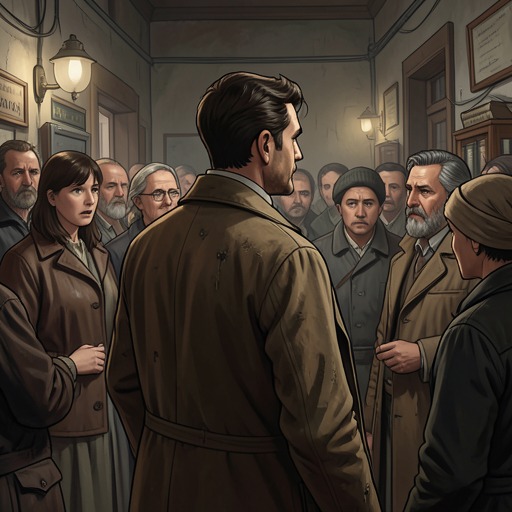
After the contest, Mihalis disappears. The account makes the rivalry central to how the town interprets his absence: Giorgos has replaced him in the squad and outperformed him in the previous season, while Mihalis had turned other team members against the newcomer. When the search begins, Giorgos is known to have been among the last people to see him. Residents search nearby shores for three days, but find no body. Without a body there is no funeral and no final certainty about what happened. Mihalis’s father makes his suspicion of Giorgos plain in the local coffeehouse.
The police question people and speak to Giorgos last, having formed a picture of the relationship between the two players. Local gossip links Mihalis to crime, but the town resists believing ill of its sporting hero. In December, two men had been killed during an armed robbery; Mihalis’s brother and uncle were caught in the act and faced trial, while witnesses had mentioned a third man and some people expected Mihalis to be arrested. The account does not establish what happened to Mihalis or prove his involvement. Instead, it shows how the lack of a body and the community’s attachment to its former champion allow suspicion to settle on Giorgos. Though he has never been in trouble and cannot be arrested or formally charged without evidence, townspeople cast him as a ruthless competitor capable of anything to win.
A Life Under the Accusation
The coach apologizes but drops Giorgos from the squad because the team cannot function without the support of its other members. The former teammates go on to success in the national championships, and three later compete in the Olympic Games. Giorgos, by contrast, takes a job an hour’s drive away at a company that packs and exports feta cheese. He continues living with his mother but avoids the town centre. From April to October he stops on his way home to swim alone at a deserted, inaccessible beach; in winter he goes straight home. His private swimming contrasts with the public contest that first made his name a subject of local judgment.
Three years after Mihalis’s disappearance, a church service draws a congregation as large as the Theophany crowd. For nearly forty years Giorgos lives like a shadow, with little presence in the town. He and his mother never discuss the event, but he understands that she bears the strain of her son’s unprovable innocence and the stigma attached to their family. Her decline is among the most painful consequences for him. He continues to attend the annual ceremony because it is the one day on which he feels able to hold his head high. The swimmers are now the children and grandchildren of his generation, while many spectators remain the same. The ritual preserves a connection to the community even as it recalls the accusation that has excluded him from it.
Reappearance and Narrative Significance
In 2010, Giorgos recognizes a man who has returned discreetly for his father’s funeral as Mihalis, and understands that Mihalis is alive. Recognition turns the old disappearance into a revelation: Giorgos has spent decades under blame for a death that did not occur. He breaks down in tears, and his friend Leonidas holds him as he sobs. The relief is expressed as a longing for exoneration, vindication, and absolution, although Giorgos has committed no established crime and has nothing to confess.
Giorgos’s arc is shaped by the gap between what the evidence can establish and what a community decides to believe. Winning the cross should have confirmed his place among the town’s young men; instead, Mihalis’s disappearance transforms victory into suspicion. The recurring ceremony gives that unresolved past a yearly public setting. Giorgos returns not because the ritual can prove his innocence, but because it lets him appear before the same community and keep faith with what he knows. Mihalis’s return finally offers the possibility that the decades-old judgment can be overturned, while Leonidas’s embrace gives Giorgos immediate human support at the moment that possibility becomes real.