Greek Independence Day
Cartes Postales from GreeceGreek Independence Day is observed on 25 March, when a parade in Thessaloniki turns the anniversary of liberation from Ottoman rule into a public meeting of history, religion, and family memory. The event’s significance lies not only in the procession but in the stories attached to it: a flag becomes a record of resistance, and a witness speaks of the past as though it were still present.
The date and the parade
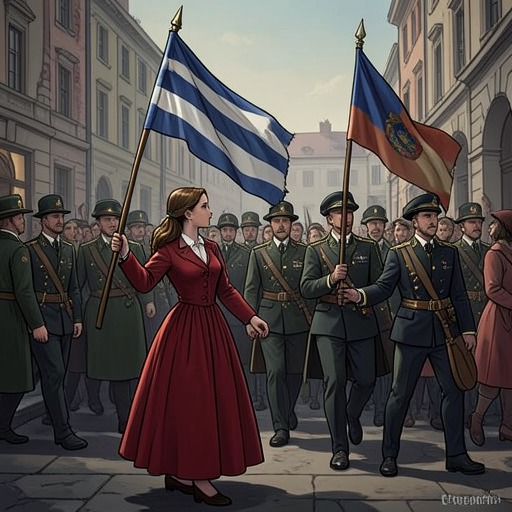
The narrator encounters the commemoration after leaving Kalambaka for Thessaloniki, where the quiet of days spent walking gives way to a city crowd and the prospect of music and street life. On a warm spring day, the narrator heads toward the seafront and finds flags on balconies and public buildings, in people’s hands, and for sale in the squares. The streets are lined with spectators watching thousands of schoolchildren, soldiers, and people in regional dress pass in the Independence Day parade.
The date carries two meanings in the account. Greek Independence Day marks the country’s liberation from Ottoman rule, while 25 March is also the Feast of the Annunciation, commemorating the announcement to the Virgin Mary that she would bear a child. Their conjunction gives the old man beside the narrator a religious frame for the national struggle: he presents the fight for liberation as a cause in which God supported the Greeks. The parade therefore places a national anniversary and a major religious feast on the same calendar day, rather than treating commemoration as separate from faith.
A struggle retold in the crowd
The old man recounts the uprising with pride. He stresses that the Greeks faced overwhelming numbers, yet, in his telling, held on to their language, traditions, and religion through centuries of Turkish rule. He attributes the choice of the day for the rising to a bishop, linking the beginning of the fight to the Feast of the Annunciation. He describes a struggle lasting nine years and concludes that it ended in freedom.
His account is not delivered as distant historical exposition. He speaks to the narrator, whose attentive listening gives him a new audience, while his wife and daughter have heard the story many times. As he raises a small Greek flag, nearby spectators turn to listen; a young woman holding her child responds with approval. His excitement makes the past seem immediate to him, although the fight he describes belongs to the nineteenth century. The parade thus becomes a setting in which historical memory is spoken aloud and shared across generations, with the old man’s family and the surrounding crowd forming part of its audience.
The flag as a record of resistance
The flag is the parade’s most concentrated emblem. Evangelia, an older woman recalling her own earlier role as a flag-bearer, regards its blue-and-white design as full of meaning. She remembers that the nine horizontal stripes recall a nine-syllable rallying cry used in the struggle to expel the Turks: “Freedom or Death.” In this account, the flag does more than identify the country. Its pattern preserves a phrase of resistance, making the national symbol a compact memorial of the struggle.
Evangelia’s recollection also connects public ceremony to personal and generational continuity. In her schooldays, carrying the national flag in the parade was a privilege awarded to the top pupil in the class. Decades later, she relives that moment each year and takes pride in anticipation of her granddaughter, who bears her name, carrying the flag in her turn. The parade’s repeated appearance does not erase the passage of time: the older woman remembers her own place in it while looking forward to her granddaughter’s. The ritual gives both experiences a shared form.
Public commemoration and family life
The parade is presented as both civic spectacle and an occasion for ordinary hospitality. Regional costumes—embroidered jackets, elaborate headwear, gold-coin necklaces, knickerbockers, long boots, and white skirts—give the procession a theatrical variety. The marchers include schoolchildren trying to keep in step, while the old man’s daughter waits for the parade to pass before inviting the narrator to join her family for lunch. Her invitation turns a stranger in the crowd into a guest at their home.
The family’s meal also places the national date within domestic celebration. They are marking the grandfather Vangelis’s name day as well as the Feast of the Annunciation, and the family has prepared a large cake. At their apartment, they serve bakaliaros skordalia, a special meal for the feast. The day consequently moves between the public street and the family table: the flag and the parade recall liberation, while the shared meal makes the anniversary part of present-day life. Through these linked scenes, Greek Independence Day appears as a recurring occasion when historical memory is renewed in public and welcomed into the home.